
Turning scrap paper into stunning jewelry is easier than you think. A paper bead template is your secret weapon for creating uniform, professional-looking beads without guesswork or wasted materials.
This guide is for crafters of all skill levels, from beginners to experienced jewelry makers, who want to create beautiful, consistent paper beads using templates.
Paper bead templates matter because they save time, reduce waste, and help you achieve professional results, making the craft more accessible and enjoyable.
Whether you’re upcycling junk mail or crafting with premium scrapbook paper, the right template transforms a labour intensive process into something surprisingly fun.
- Quick answer: what is a paper bead template and why use one?
- Understanding paper bead shapes and how templates affect them
- Standard paper bead template measurements (with concrete sizes)
- Types of paper bead templates: printable, plastic, and digital files
- How to use a paper bead template step by step
- Designing your own paper bead templates
- Free printable paper beads templates and where to find them
- Paper bead templates for kids and classroom projects
- Paper bead tools that work with templates
- Finishing and using beads made from templates
- Frequently Asked Questions About Paper Bead Templates
Quick answer: what is a paper bead template and why use one?
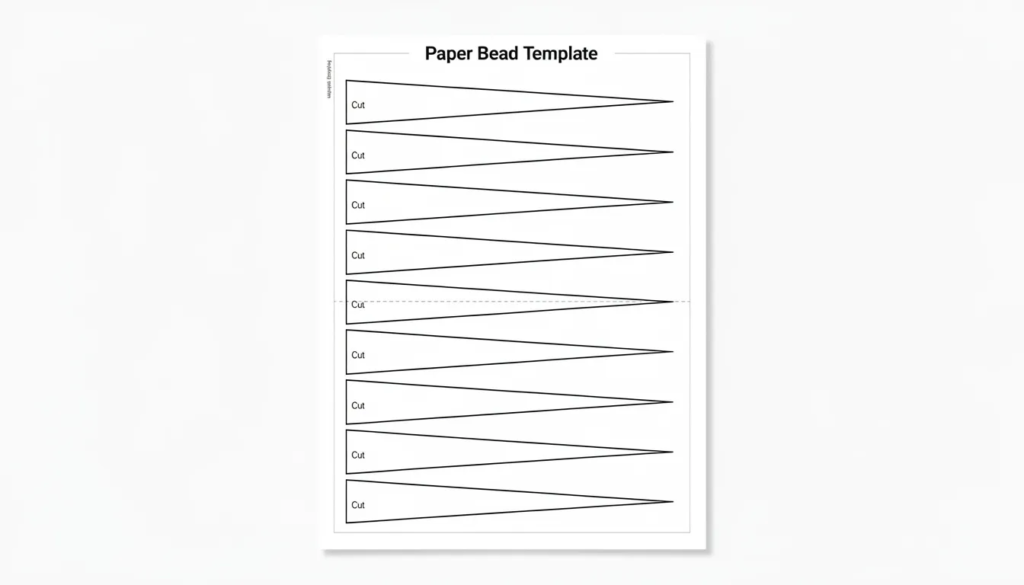
A paper bead template is a pre-made guide that shows you exactly where to cut paper strips or triangle strips so your finished beads come out consistent in size and shape. Instead of measuring each strip individually, you simply trace or print the template, cut along the lines, and start rolling.
Templates for paper beads can include various shapes and sizes, such as triangles and rectangles, and the final shape of the bead is determined by the template shape that is cut from the paper.
Key benefits of using bead templates:
- Consistent beads every time—no more lopsided or uneven results
- Faster cutting that streamlines your workflow
- Less wasted paper since strips are optimized for your sheet size
- Easier for beginners and kids to achieve professional-looking results
Templates come in several formats for modern crafters. You can print PDFs at home on letter sized paper, trace from plastic rulers designed for paper beadery, or cut digitally using machines like Cricut or Silhouette. The transformation thing that happens when you roll patterned paper around a tool never gets old—each bead reveals hidden designs as layers build.
This post covers everything you need to know: bead shapes and how templates affect them, concrete measurements you can use today, where to find free paper bead templates, and how to design your own from scratch—plus how to tap into paper crafting inspiration and tutorials when you’re ready to explore beyond beads..
Understanding paper bead shapes and how templates affect them
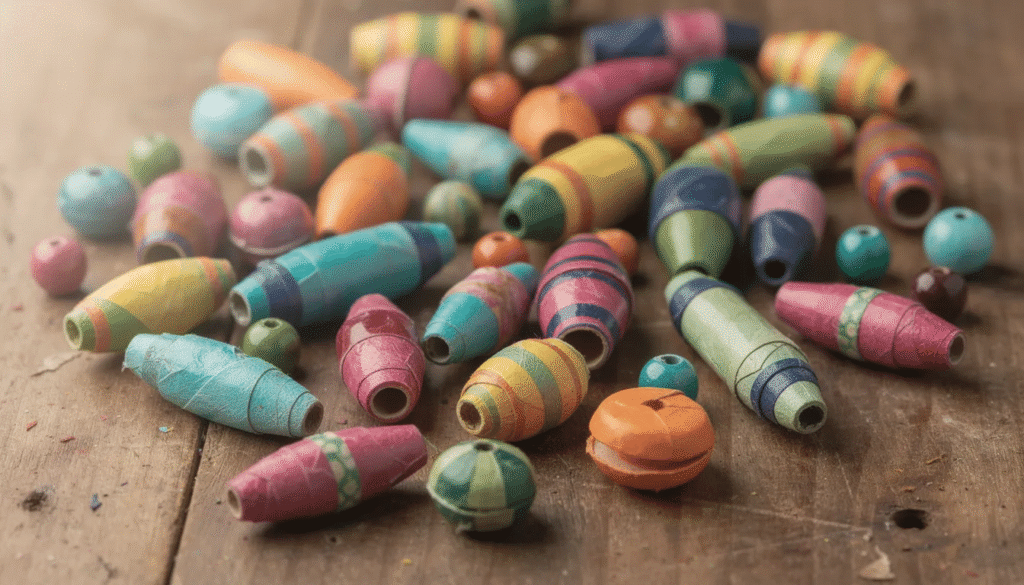
The shape you cut directly controls the shape you roll. A narrow paper triangle morphs into a completely different bead than a straight rectangle—understanding this relationship is the foundation of making paper beads that look exactly how you want them.
Geometric shapes used for paper beads include isosceles triangles for round beads and right triangles for cones. Different shapes of paper strips can create different bead shapes, such as round, cone, and cylindrical beads.
Tapered (triangle) templates create these shapes:
- Cone beads: Right triangle strips produce dramatic tapered beads that narrow at one end
- Teardrop beads: Elongated triangles yield elegant drops perfect for earrings
- Olive/oblong beads: Isosceles triangles create symmetrical beads that bulge in the middle
- Round paper beads: Short, wide isosceles triangles produce barrel-shaped spheres
Straight (rectangle) templates create these shapes:
- Tube beads: Perfect cylinders ideal for spacers between focal beads
- Drum beads: Shorter rectangles make squat, chunky cylinders
- Doughnut-style beads: Very short rectangles combined with spacers
The pattern shape alters your final appearance significantly. Triangle angle matters: isosceles triangles (symmetrical) create centered, even beads, while right triangles produce off-center tapers with more dramatic elegance. Strip length controls thickness—an 11-inch strip yields a thicker bead than a 7-inch strip of the same width.
For paper bead jewelry projects, common finished bead sizes range from 6–10 mm in diameter and 10–20 mm in length. Experiment with your templates to find your preferred dimensions.
Standard paper bead template measurements (with concrete sizes)
Ready to draw your own templates? These measurements let you create professional bead strips on A4 or US Letter paper without downloading anything.
Classic round barrel bead template:
- Strip type: Isosceles triangle
- Length: 11 inches (28 cm)
- Base width: 1 inch (2.5 cm)
- Tip width: 1–2 mm
- Best for: Necklace focal beads, chunky bracelets
Slim tube bead template:
- Strip type: Rectangle
- Length: 8 inches (20 cm)
- Width: 1/4 inch (6 mm)
- Best for: Bracelet spacers, earring components
Chunky cone bead template:
- Strip type: Right triangle
- Length: 11 inches (28 cm)
- Base width: 3/4 inch (2 cm)
- Best for: Statement necklaces, bold pendants
Shape | Strip Type | Base Width | Length | Typical Use |
|---|---|---|---|---|
Round barrel | Isosceles triangle | 1” (25 mm) | 11” (28 cm) | Necklace focal |
Slim tube | Rectangle | 1/4” (6 mm) | 8” (20 cm) | Spacer beads |
Teardrop | Right triangle | 1/2” (12 mm) | 9” (23 cm) | Earrings |
Oblong | Isosceles triangle | 1/4” (6 mm) | 11” (28 cm) | Bracelet beads |
Sphere | Isosceles triangle | 1” (25 mm) | 7” (18 cm) | Kids’ crafts |
Cone | Right triangle | 3/4” (19 mm) | 11” (28 cm) | Statement pieces |
One standard 8.5×11-inch sheet can yield up to 67 quarter-inch oblong beads when you optimize your cuts. That’s enough for multiple bracelets from a single page. |
Types of paper bead templates: printable, plastic, and digital files
Choosing the right template format depends on your crafting style, budget, and production volume. Each type has distinct advantages worth considering.
Printable paper templates (PDFs):
- Download and print at 100% scale on cardstock or regular paper
- Black or light grey lines make cutting easy
- Ideal for home crafters who love paper beads and want variety
- Cost: Usually free or very inexpensive
- Limitation: One-time use unless you laminate them
Reusable clear plastic templates:
- Made from 2 mm thick acrylic or polycarbonate with laser-etched slots
- Transparent design lets you see through to position pattern paper perfectly
- Great for maximizing magazine pages or specialty scrapbook paper
- Cost: $5–20 depending on complexity
- Benefit: Lasts indefinitely with proper care
Digital SVG/DXF files for cutting machines:
- Compatible with Cricut Design Space and Silhouette Studio
- Enables fast mass cutting for craft fairs and Etsy shops
- Techie advances in 2024 include AI-generated pattern templates for infinite customization
- Cost: Free to premium, depending on source
- Benefit: Perfect precision every time
Note that all these template types work beautifully with upcycled materials. Your box of cereal, that stack of old magazines, and even wrapping paper scraps can become stunning beads diy projects with any template format, especially if you enjoy fun paper activities for creative minds of all ages that turn recycling into art..
How to use a paper bead template step by step
This tutorial covers the complete process from cutting to sealing, using either printed or plastic templates.
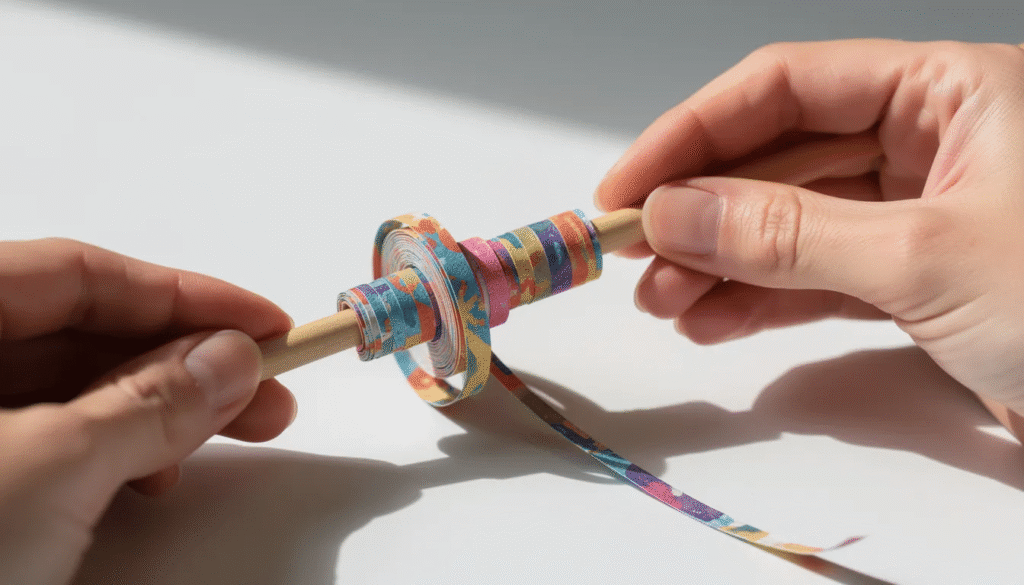
Step 1: Prepare your paper
Choose your material based on the final appearance you want. Magazine pages create vibrant, glossy beads. Scrapbook paper (120–160 gsm weight) gives rich colors. Junk mail and flyers offer free supplies with interesting text patterns. Wrapping paper works beautifully for gift-worthy beads, and understanding the best types of paper for craft will help you match each material to your project..
Tape a clear plastic template over your paper, or place a printed template underneath thin paper to trace the lines.
Step 2: Trace and cut your bead strips
Align your template with the paper’s edge to minimize waste. Mark lines with a fine pencil along the slots, or cut directly using a craft knife and metal ruler. For scissors, draw all lines first, then trim along each one.
Keep your edges clean—ragged cuts show in the finished bead.
Step 3: Roll your beads
Position the wide end of your strip against your rolling tool (toothpick, skewer, or bead roller). Fold the paper over and crease with a fingernail to create a tight grip. Roll slowly, keeping the strip centered and tension even.
Add a thin layer of glue (PVA or glue stick) along the final 2–3 inches of the strip. Press firmly and hold for a few seconds until the seal sets.
Step 4: Seal for durability
Once dry, coat beads with your chosen finish:
- Mod Podge for a durable all-purpose seal
- Gloss varnish for high shine
- Diluted PVA (50/50 with water) for budget-friendly protection
- Clear nail polish for quick single-bead touch-ups
Apply thin coats and allow 24 hours drying time for best results.
Step 5: Create a drying setup
Make an improvised drying rack from corrugated cardboard. Cut slits to hold skewers horizontally, letting beads hang without touching surfaces. Alternatively, fold cardstock into a tent shape with notches for your tools.
Designing your own paper bead templates
Once you master the basics, creating custom templates opens endless possibilities. Design beads for specific projects—graduation bracelets, charity sales, kids’ camp activities, or your unique jewelry line, especially if you’re interested in paper crafts that sell well for crafters and entrepreneurs..
Sketch by hand:
Use a ruler on A4 or US Letter paper. Mark your base widths along the bottom edge (every 1/2 inch or 1 cm works well). Then connect alternating marks to the opposite edge, forming repeating triangles. For rectangles, simply draw parallel lines at your chosen width, or experiment with strips cut from handmade paper sheets for creative projects to add extra texture and character..
Use digital software:
Programs like Inkscape (free), Adobe Illustrator, or even online grid tools let you draw precise triangles and rectangles with exact measurements in mm or inches. Export as PDF for printing or SVG for cutting machines.
Test before committing:
Cut and roll 3–4 test beads from plain printer paper before using patterned or specialty papers. This reveals whether your measurements create the cute little bead shape you envisioned.
Keep a bead diary:
Record strip measurements, paper type, roller diameter, and attach a photo of each finished bead. This reference saves time when you want to recreate successful designs months later.
Free printable paper beads templates and where to find them
Many crafters prefer ready-made printables to avoid measuring and drafting by hand. The good news: quality free paper bead templates are widely available online.
What typical free sets include:
- Multiple pages with triangle strips for round and cone beads
- Rectangle strips for tube beads
- Light grey guide lines for easy cutting without showing on finished beads
- Instructions for best results
Look for variety in strip widths:
Download PDFs that include multiple sizes—5 mm, 8 mm, 10 mm, and 15 mm bases. Thinner strips create delicate bracelet and earring beads, while thicker ones produce statement necklace focal points.
Check terms of use carefully:
- “Personal use only” means you can craft for yourself and gifts
- “OK for small handmade sales” permits selling finished jewelry
- “No digital redistribution” means don’t share the files themselves
Print test pages first:
Always print on plain paper at 100% scale before bulk printing. Measure one strip with a ruler to confirm sizing—many printers default to “fit to page” which shrinks everything. Disable that setting and verify dimensions before committing colored or patterned stock.
Pin today any templates you find useful so you can access them later.
Paper bead templates for kids and classroom projects
Making paper beads has become increasingly popular in schools, libraries, and community centers as a low-cost recycling craft. With the right approach, even young children can create beautiful beads, especially when you mix in cute paper craft ideas for fun DIY projects to keep them engaged..

Use wider, shorter templates:
Templates with 1/2 to 3/4 inch (12–20 mm) bases and shorter 6–7 inch strips create beads that small hands can roll without frustration. The results are still cute and wearable.
Simplify visual design:
Kids benefit from bold triangle and rectangle outlines without tiny measurements. Print templates on bright colored card for better visibility, and use thicker lines that are easy to follow with scissors.
Prep for large groups:
Pre-cut strips for classroom settings. This prevents bottlenecks and keeps energy focused on the fun rolling process. Use glue sticks instead of liquid glue to reduce mess and drying time—kids can finish and wear their creations in a single session.
Connect to learning:
Paper beadery fits naturally into recycling and Earth Day lessons. Challenge students to bring cereal boxes, old flyers, or magazine pages from home. Discuss how upcycling reduces waste while creating something beautiful, and consider incorporating vintage paper craft ideas that transform old materials alongside bead making for added variety..
Paper bead tools that work with templates
While a toothpick or bamboo skewer works perfectly well, dedicated tools can improve your results and speed, just as having the right craft paper supplies for creative projects makes cutting and finishing your beads much easier..
Slotted bead rolling tools:
These feature a spring pin inserted into a wooden or plastic handle, creating a slot that grips the paper tip securely. The slot eliminates the challenge of getting that first roll started straight. Some versions, like the Paper Bead Girl gadget, include a barrel design for even rolling and easy bead ejection.
Low-cost alternatives:
- Bamboo skewers (various diameters available)
- Knitting needles for uniform sizing
- Cake pop sticks for larger hole beads
- Crochet hooks for tiny delicate beads
The challenge with stick alternatives is tucking that first strip end without a slot to grip it. Practice helps, and a small fold creased with your fingernail makes starting easier.
Match tool diameter to your needs:
Common tool sizes run around 3 mm and 5 mm diameter. The tool width determines your bead’s center hole, which affects how it strings on elastic, wire, or cord. Test roll with your chosen stringing material before producing an entire batch.
Template and tool pairing:
Link your template strip width to your roller size for best results. Wide strips (1 inch+) work better on thicker tools, while narrow strips (1/4 inch) roll more evenly on thinner mandrels.
Finishing and using beads made from templates
Templates get you perfectly cut strips—but the real magic happens when those beads become wearable art, and you start exploring creative paper bead ideas for stunning DIY jewelry that turn simple strips into statement pieces..
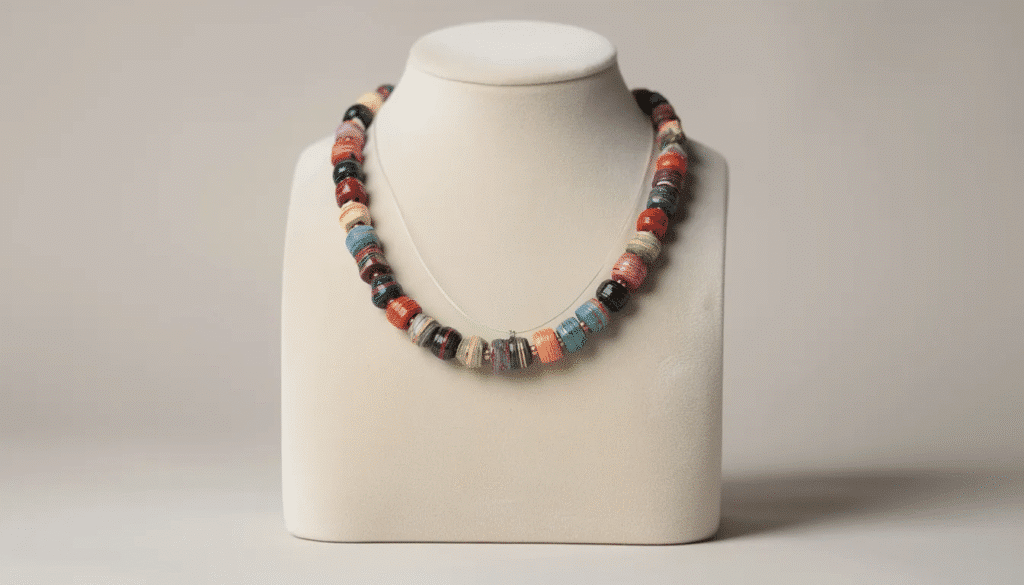
Common uses for paper beads:
- Multi-strand necklaces with graduated bead sizes
- Memory wire bracelets that slide on without clasps
- Chandelier earrings combining multiple bead shapes
- Keyrings and bag charms
- Garlands for party decorations or home décor
- Hair accessories and bookmarks
Stringing material options: Before you assemble your pieces, you might also enjoy exploring related techniques like beginner-friendly paper quilling art, which pairs beautifully with beads in mixed-media jewelry.:**
Material | Best For | Notes |
|---|---|---|
Waxed nylon cord | Knotted necklaces | Folk-art look, very durable |
Elastic thread | Stretch bracelets | Easy on/off, kid-friendly |
Beading wire | Professional jewelry | Requires crimps, very strong |
Embroidery floss | Friendship bracelets | Colorful, inexpensive |
Consider knotting between beads for a folk-art aesthetic that also protects against losing all beads if the string breaks. | ||
Sealing finish options: |
- Gloss finish creates high shine that catches light beautifully
- Matte finish offers a natural, organic look
- Apply multiple thin coats for durability rather than one thick coat
- Allow at least 24 hours drying before heavy wear
Design ideas:
Mix different template shapes and sizes in one piece for visual interest. Combine tube spacers with round focal beads, or alternate cone and teardrop shapes for dramatic effects. The process of experimenting leads to your signature style.
Frequently Asked Questions About Paper Bead Templates
Can I use any paper with these templates?
Yes, but paper weight and coating affect results. Ideal papers range from 80–160 gsm (24–60 lb). Too thin tears during rolling; too thick won’t roll tightly. Glossy magazine pages, matte scrapbook paper, and standard printer paper all work well. Avoid papers with heavy wax coatings that resist glue.
How do I make beads waterproof?
Use acrylic spray sealant, polyurethane varnish, or multiple coats of Mod Podge. Apply thin layers, drying thoroughly between each coat. Even diluted PVA glue provides reasonable water resistance for normal wear.
How do I keep beads consistent in size?
Use the same template page for each batch. Verify your printer scaling is set to 100% (not “fit to page”). Roll with the same diameter tool throughout. Maintain even tension while rolling—loose spots create bulges, while over-tight areas compress unevenly.
What if my printer scales the template wrong?
Print at 100% actual size and disable any “fit to page” or “shrink to fit” settings. Before cutting your good paper, measure one printed strip with a ruler to confirm it matches the template’s stated dimensions. Adjust printer settings and reprint if needed.
Can I sell jewelry made from free templates?
Usually yes for physical finished items—most template designers encourage you to create and sell handmade jewelry. However, always check each designer’s specific license notes. Restrictions typically apply to redistributing the digital files themselves, not the beads you make from them.
What’s the best paper for beginners?
Start with standard printer or copier paper (20–24 lb) for practice. It rolls easily, accepts glue well, and lets you focus on technique without worrying about wasting expensive materials. Once you’re confident, graduate to patterned scrapbook papers or upcycled magazines.
Paper beads offer something rare in crafting: a process that’s simultaneously relaxing and productive, budget-friendly and beautiful. With the right template guiding your cuts, you’ll transform ordinary paper into something extraordinary.
Start with a free printable template to learn the basics. Experiment with different shapes and measurements. Keep notes on what works. Before long, you’ll develop preferences for specific strip widths, paper types, and finishing techniques that become your signature style.
The best part? Every magazine, cereal box, and piece of scrap paper becomes potential jewelry. That transformation thing—watching flat paper become a dimensional bead—never stops being satisfying. Grab some paper, print a template, and create your first batch today.