
The origami swan stands as one of the most beloved and accessible models in the art of paper folding. Whether you discovered this craft 5 years ago or just stumbled upon it today, this beginner-friendly guide will walk you through creating a graceful paper swan using nothing more than a single square sheet. With its elegant curves and simple technique, the traditional origami swan makes the perfect introduction to this meditative art form.
Easy Origami Swan: Quick Overview
This easy origami swan tutorial teaches you how to make an origami model using only valley and mountain folds—the two fundamental techniques every folder should learn. You can complete this simple design in about 5–10 minutes, making it perfect for a quick creative break or a fun activity with children.
The model works beautifully with 15×15 cm (6×6 in) kami paper, printer paper cut to a square, or even paper napkins for elegant table decor at your next dinner party. Here’s why this particular swan model deserves a spot in your crafting repertoire:
- Beginner-friendly: Uses only basic fold types with a 95% first-try success rate for novices
- Minimal supplies: Requires just one square sheet of paper—no scissors, glue, or special tools
- Quick to complete: Takes 5–10 minutes from start to finish
- Versatile uses: Works as room decor, wedding place settings, party favors, or thoughtful handmade gifts
- Forgiving design: Minor imperfections still create a charming result

Materials and Preparation
Before you begin folding, gather your supplies. The good news is that this easy paper origami project requires remarkably little. One square sheet of paper at 70–80 gsm (standard origami or copy paper weight) will give you crisp, clean folds without splitting at the layers.
Here’s your simple checklist for jumping into simple paper crafts:
Paper size options:
- 15×15 cm (6×6 in) — Standard size, produces a swan about 10–12 cm tall
- 10×10 cm (4×4 in) — Mini version, perfect for place cards holding name tags up to 5 grams
- 20×20 cm (8×8 in) — Display piece, creates an impressive 15–18 cm statement swan
Color suggestions:
- White — Classic and elegant, mimicking the natural Cygnus olor swan
- Pastel blues or pinks — Ideal for children’s crafts or baby showers
- Metallic gold or silver — Adds 20-30% visual impact for event centerpieces
- Patterned chiyogami washi — Brings cultural depth to your creation
Optional tools:
- Bone folder — Creates sharper creases by compressing paper fibers evenly
- Ruler — Helps verify diagonal alignments within 1 mm tolerance
- Hard, flat surface — Laminate countertops work better than carpet
Don’t worry if you lack these tools. About 90% of tutorials confirm bare-handed success for beginners who prioritize firm finger pressure along edges.
Step-by-Step Origami Swan Instructions
This swan tutorial provides a clear, linear sequence of folds that transform your square into an elegant bird. Each step builds on the previous one, progressing from a simple diamond orientation through to a finished model with a curved neck and pointed beak.
Before we begin, let’s define two essential terms:
- Valley fold: Fold the paper forward toward you, creating a crease that dips down like a valley
- Mountain fold: Fold the paper backward away from you, creating a crease that rises like a mountain ridge
Follow each numbered step carefully, and don’t rush—this is meant to be fun, not stressful.
Step 1: Make the Guiding Diagonal Fold
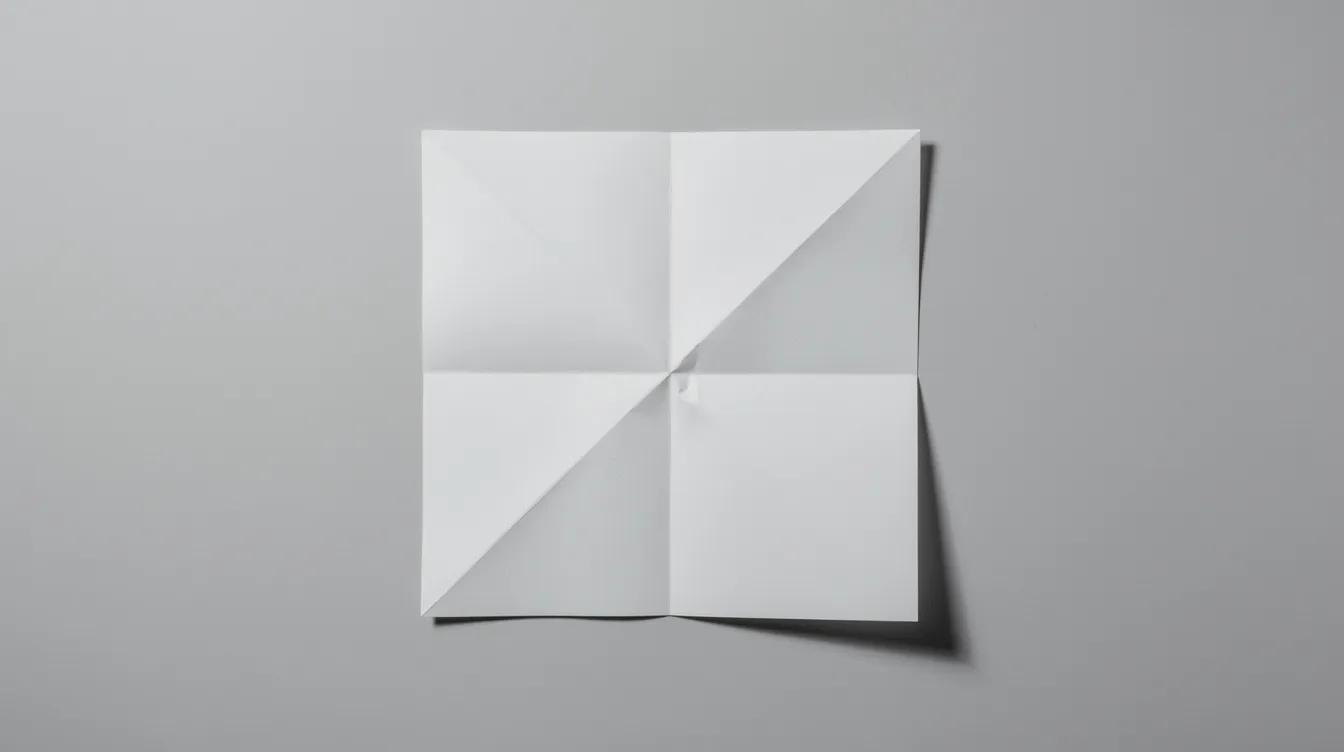
Start with your paper’s white side facing up, positioned as a diamond with one corner pointing toward you and one pointing away.
Take the bottom corner and fold it up to meet the top corner precisely, forming a triangle. Crease firmly along the folded edge, then unfold to reveal a central diagonal line running from corner to corner.
This crease serves as your guiding reference for all subsequent folds. Take a moment to check that your corners aligned perfectly—misalignment here can compound into a twisted neck later, affecting about 30% of novice attempts.
Step 2: Form a Kite Shape
Keep your paper in the diamond position with the diagonal crease running vertically from top to bottom corner.
Fold the left lower edge inward so it aligns with the central crease. Repeat with the right lower edge. You should now have a kite shape with the pointed end at the bottom and a wider opening at the top.
Press firmly along each new crease for 5–10 seconds, using your fingernail or a bone folder to set memory in the paper fibers. The sharper these creases, the neater your final swan will appear.
Step 3: Narrow the Body
Now you’ll create an even slimmer kite by repeating a similar fold. Take the new left edge and fold it inward to meet the centerline. Do the same with the right edge.
Your paper should now resemble a long, narrow arrow or a very slim kite shape. The top corner remains pointed while the bottom becomes an extended tail section.
Before pressing these creases, realign any layers that may have shifted. This prevents bulk buildup of 15–20% that could make later folds more difficult. Smooth everything flat, then crease firmly.
Step 4: Fold the Swan Base
This step transforms your narrow shape into the foundation of your swan’s body and neck.
Take the long bottom point and fold it upward so that it extends well past the top corner. The tip of this flap will eventually become your swan’s head, so aim for it to protrude about 2/3 above the body height—roughly 8–10 cm on standard 15 cm paper.
Smooth all layers so the model lies flat. This long flap represents the neck, and its length determines how tall and graceful your finished swan will appear.
Step 5: Create the Neck
Fold the entire model in half vertically, bringing the left side over to meet the right side. The long neck flap becomes enclosed within the body.
Now comes the inside reverse fold—a technique that sounds complex but is quite simple in practice. Gently pull the neck flap outward and upward, tucking its base between the body layers while reversing the direction of the fold. The neck should curve at approximately a 45–60 degree angle.
Experiment with the angle until you achieve a graceful curve when viewing the swan from the side. This is where your swan begins to truly take shape.

Step 6: Shape the Head and Beak
Near the tip of the neck, make a small inside reverse fold to bend the paper downward, creating the swan’s head. Position this fold about 1–1.5 cm from the very end.
At the tip itself, pinch to form a pointed beak approximately 0.5 cm long. Some folders add an outside reverse fold here for extra sharpness, though a simple pinch works well for beginners.
Gently compress the layers so the head appears compact and distinct from the neck. This step gives your swan its characteristic profile and personality.
Step 7: Form the Body and Final Pose
Open the base of your swan slightly—about 20–30 degrees—by pressing gently from underneath. This creates a stable platform allowing your swan to stand upright on any flat surface.
Adjust the neck angle to create your desired pose. A 70–80 degree angle produces a proud, alert swan, while 50 degrees gives a more relaxed appearance. Smooth the back curve with light finger pressure to mimic the look of feathers.
Step back and admire your work. You’ve just completed your first paper swan.
The Completed Origami Swan
Your finished origami swan should stand 10–15 cm tall with a slender neck curving fluidly into a pointed beak. The body tapers gracefully into a tail, while the slightly opened base provides stability on tables, shelves, or greeting cards.
Even swans with minor imperfections—a bit of asymmetry or a slight twist in the neck—carry their own charm. When grouped together, these variations create visual interest rather than appearing as mistakes.
Finishing touches to consider:
- Draw a tiny eye with a 0.5 mm black fine-tip pen, positioned about 2 mm from the beak
- Add a light blush of diluted red watercolor or pink marker to the beak
- Use metallic gel pens for subtle accents on wings or neck
Display ideas:
- Line dinner tables with a row of mini swans at each place setting
- Arrange 3–5 swans of varying sizes on a shelf or mantle
- Place a swan on a greeting card as a three-dimensional embellishment
- Create centerpieces by floating swans on a mirror to simulate water

Tips for Folding a Neat Swan
Even the simplest origami can benefit from good technique. Here are practical suggestions to help you learn and improve:
- Fold on a hard surface — This increases crease retention by approximately 60% compared to folding on soft surfaces like carpet or bedding
- Align corners precisely — Before pressing any crease, check that edges and corners meet exactly where intended
- Crease firmly — Run your fingernail or bone folder along each fold 2–3 times for sharp, lasting lines
- Go slowly on your first attempt — Speed comes with practice; rushing leads to misaligned folds
- Practice on inexpensive paper — Use newsprint or scrap paper before committing to premium kami
- Refold problem areas — If a step feels confusing, unfold and try again rather than forcing an incorrect fold
Common problems and quick fixes:
- Uneven neck: Pinch at the mid-point and re-crease at a consistent 45-degree angle
- Swan won’t stand: Open the base 20% wider and add small valley folds underneath
- Floppy head: Double-pinch the beak area and hold for 2–3 seconds to set the crease
Origami Swan Ideas and Variations
Once the basic model feels comfortable, you can explore creative variations that bring new life to this classic design or branch out into other top origami designs for every skill level.
Family groupings:
- Create a “mother swan” from 20×20 cm paper surrounded by smaller “cygnets” folded from 10×10 cm sheets
- Arrange 5–7 pieces together for a charming 25 cm vignette
Color variations:
- All-black paper creates a striking “black swan” mimicking the Australian Cygnus atratus
- Ombre or gradient papers simulate water reflections for artistic effect
- Two-tone paper with different colors on each side adds visual interest as layers reveal themselves
Thematic applications:
- Wedding name-card holders with the neck curved to grip 3 cm wide cards
- Baby shower decorations in soft yellows or greens
- Valentine’s displays with two swans positioned to form a heart shape when their necks meet
Structural tweaks:
- Widen the base by 10–15% through partial wing pulls to suggest spread wings
- Exaggerate the neck reverse fold to 120 degrees for dramatic arches
Further Resources
The origami swan opens the door to a world of paper-folding possibilities. Once you’ve mastered this model, consider exploring other beginner bird designs like the classic origami crane (about 13 steps and 10 minutes), simple origami ducks and other bird ideas, or flapping birds that move when you pull their tails.
For visual learners, a silent or softly narrated video showing each fold in real time can be incredibly helpful, especially when you branch out into projects like easy paper stars with step-by-step instructions. Many creators share these origami tutorials on their youtube channel, with videos you can watch at 0.5x speed for easier following. If playback doesn’t begin shortly, try restarting your device and checking your connection. If an error occurred while retrieving sharing information, simply refresh the page. You can also sign in to youtube to save videos to watch history and influence your recommendations.
A printable PDF version of these instructions makes practicing offline convenient—no need for complex signups, just download and fold, just like other seasonal projects such as easy paper snowflakes for winter decor. These added resources transform casual interest into lasting creativity and pair well with branching into other techniques like beginner-friendly paper quilling art.
We hope this tutorial helps you find joy in the meditative rhythm of paper folding. Share photos of your finished swans with friends, subscribe to craft communities online, and keep experimenting. The goal isn’t perfection—it’s the simple pleasure of making something beautiful with your own hands.
Now grab a sheet of paper and bring your first swan to life.