
The origami cube is one of the most satisfying paper models you can fold. Whether you want a quick decoration, a hands-on school project, or a gateway into geometric origami, this classic shape delivers. In this guide, you will learn how to make cubes using three different methods, from the traditional single-sheet approach to modular assemblies that create incredibly sturdy results.
- Quick Answer: What Is an Origami Cube?
- What You Need to Fold an Origami Cube
- Single-Sheet Water Bomb Origami Cube
- More Origami Cubes from One Square
- Origami Cube from Multiple Squares (Modular Cubes)
- Cubes from Paper Strips
- Origami Cube Ideas, Uses, and Variations
- Further Learning and Origami Cube Resources
Quick Answer: What Is an Origami Cube?
An origami cube is a three-dimensional hollow paper cube folded from a square sheet of paper. The most famous version is the water bomb cube, which can be inflated with a single breath to transform flat creases into a rigid 3D shape. No glue, tape, or scissors are required for any of the methods covered here.
You can create an origami cube from:
- One piece of paper – The classic water bomb method uses just a few folds to create an inflatable cube
- Six separate squares – Modular cubes (often called sonobe modules) slot together for a sturdy, reusable result
- Paper strips – Three interlocking strips form an open-frame cube that highlights the twelve edges
Each approach has its own advantages, and this page walks through all three so you can pick the method that fits your project, skill level, and available materials.
What You Need to Fold an Origami Cube
Before you start folding, gather a few basic supplies to set yourself up for success, especially the right craft paper supplies for creative projects.
Paper options:
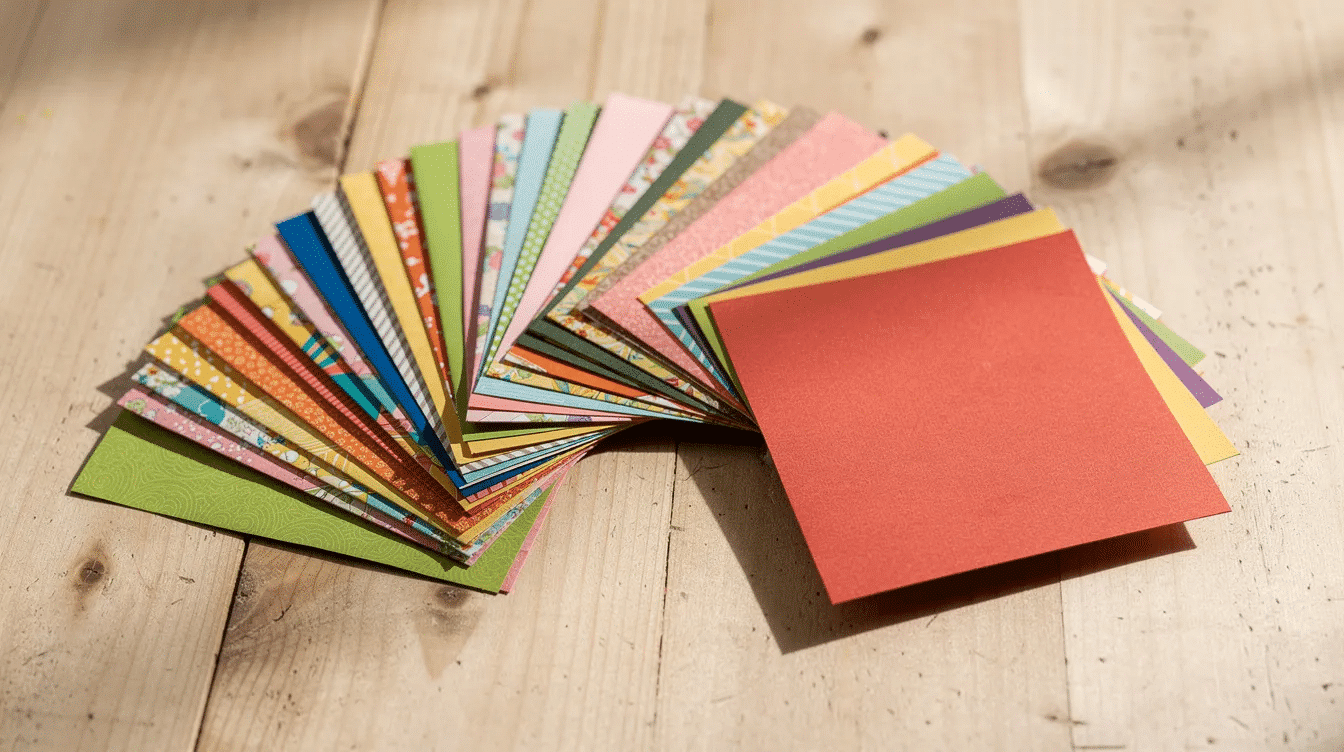
- 15 x 15 cm origami paper (the standard size found in most craft stores)
- Copy paper or printer paper cut down to a square
- Colored or patterned square paper for modular cubes
Paper weight recommendations:
- Thinner paper (70–90 gsm) works best for water bomb cubes because it inflates and locks more easily
- Slightly thicker paper (90–120 gsm) suits gift-box style cubes that need to withstand handling
Optional tools:
- A ruler for marking precise thirds or grid lines
- A bone folder or the back of a spoon for creating crisp creases
- A pencil for lightly marking fold lines (helpful for beginners)
Color tip: When assembling multi-piece modular cubes, try using contrasting colors or patterned sheets for each unit. This creates a checkerboard or rainbow effect on the finished cube that looks far more impressive than a single solid color.
Single-Sheet Water Bomb Origami Cube
The water bomb cube is the classic single-sheet method that has appeared in easy origami tutorials for decades. Years ago, children in Japan would fold these and fill them with water to throw at friends—hence the name. Today, this model remains a popular choice for decorations, classroom demonstrations, and fun weekend crafts.
Here is the general folding sequence:
- Start with a perfect square sheet positioned flat on your work surface
- Fold both diagonals to form an “X” crease pattern, then unfold
- Fold the square in half horizontally and vertically to add centerline creases, then unfold again
- Collapse the paper into a flat triangle by bringing opposite corners together—the existing creases will form a tent-like shape that flattens into what is called the preliminary base
- On each side, fold the lower triangle corners up to the top corner to create a diamond shape
- Fold the left corner and right side corners toward the center line to form small triangular flaps
- Tuck the small triangle tips into the pockets on each side, locking the flattened water bomb base
- Hold the model by opposite corners and gently blow into the small hole at one end—the creases will expand outward into a cube
- Adjust the corners by pressing them inward to sharpen edges and square off the shape
The finished cube will measure approximately one-third the side length of your original square. A 15 cm square sheet yields roughly a 5 cm paper cube.
Practical uses for water bomb cubes:
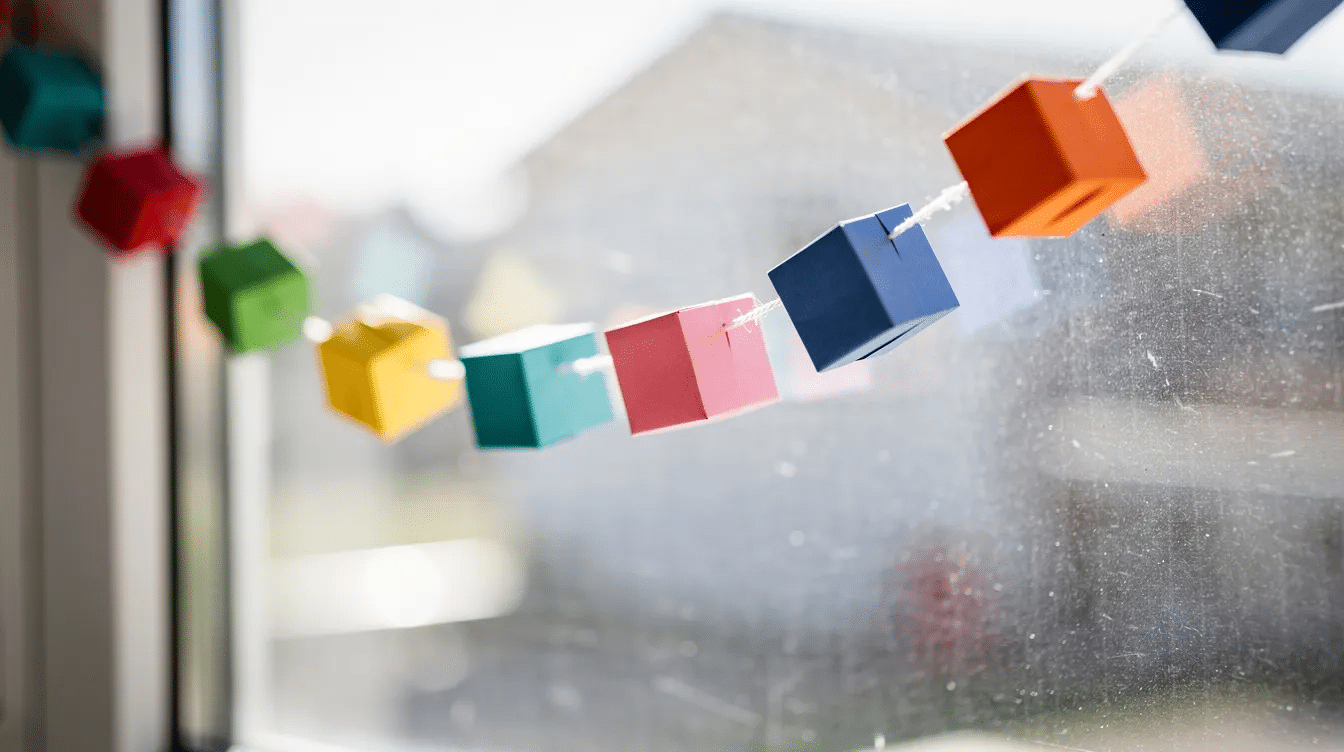
- String multiple cubes together as a garland or party decoration
- Slide over LED fairy lights to create diffused, glowing ornaments
- Use in classroom geometry lessons to explore volume and surface area concepts
More Origami Cubes from One Square
Once you master the basic water bomb, you can explore more advanced single-sheet cube designs. These variations often include integrated lids, reinforced edges, or connected cube chains—all folded from one piece of paper.
Grid-based folding:
Advanced cube models rely on pre-creasing a 4×4 or 8×8 grid across the square. These grid lines help locate mountain and valley folds that create internal pockets and hidden layers. The result is a cube that can open like a small gift box or feature extra structural stability.
Cube tubes and chains:
Some designs produce tubes made from three connected cubes in a row. These are typically folded from a square with extra flaps along one edge, or from an elongated rectangle cut from a sheet of paper. The technique involves precise thirds divisions—often marked with a ruler—to ensure right-angle bends line up correctly, and they are a natural next step after exploring top origami designs for every skill level.
Where to find tutorials:
Video channels on YouTube feature creators like Jo Nakashima who demonstrate these one-square variations. You can also find Shuzo Fujimoto-style adaptations that transform a single square into seamless cubes with lids. Some of these tutorials have accumulated 5.6M views and continue to attract beginners looking to level up their skills.
Creative applications:
- Decorative storage for tiny notes or small gifts
- Modular chains for hanging mobiles
- Mathematical exploration of nets and symmetry

Origami Cube from Multiple Squares (Modular Cubes)
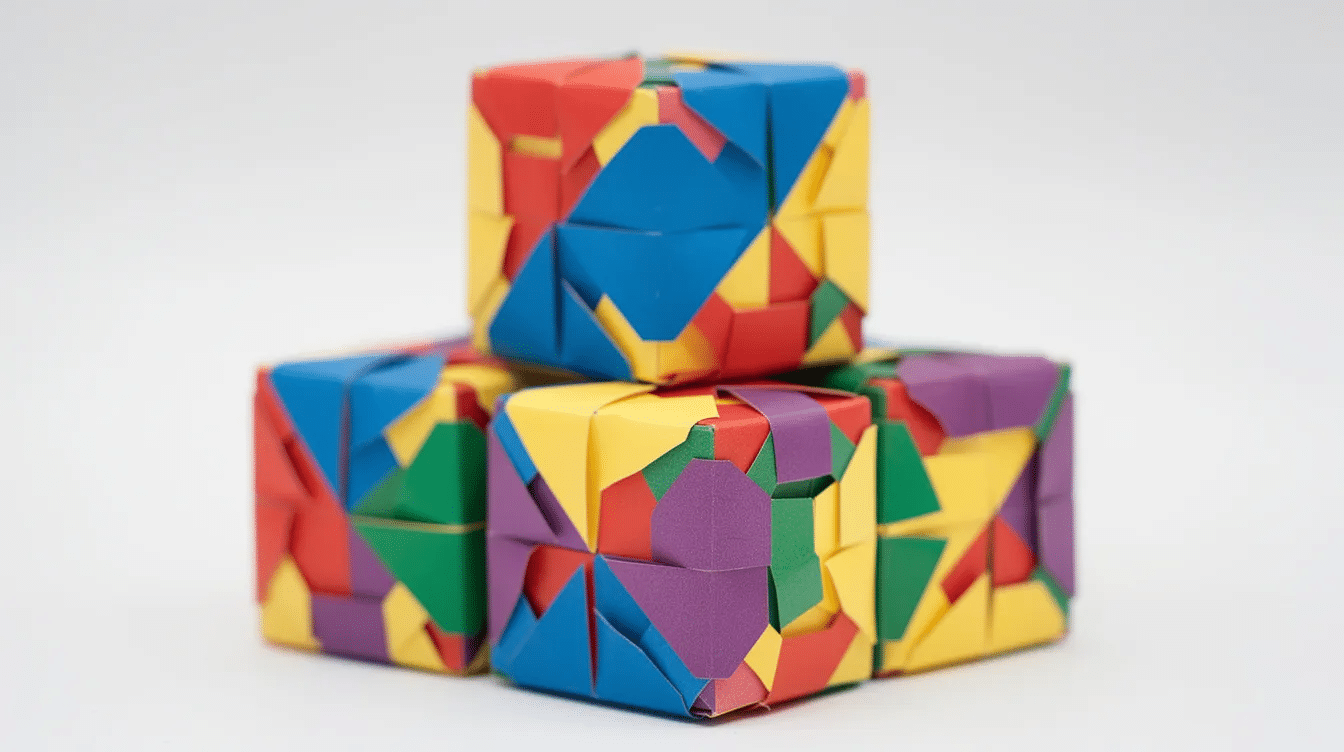
Modular origami cubes offer superior structural integrity compared to single-sheet versions. By folding six separate square units and slotting them together, you create a cube that can be disassembled, reassembled, and handled far more roughly without damage, making them a great addition to fun paper activities for creative minds.
How each unit is folded:
Each module starts as a square rotated into a diamond orientation. You fold the top and bottom corners to the center, then fold edges to the centerline. Finally, you tuck the left and right corners to create flaps and pockets. The result is a rectangular module with two triangular flaps and two pockets.
How to assemble the cube:
- Three modules meet at each corner of the cube, with triangle flaps from one unit sliding into the pockets of an adjacent unit
- Begin by connecting three units to form a trihedral corner (a three-sided pyramid shape)
- Add the fourth, fifth, and sixth modules to enclose all faces, ensuring all twelve edges interlock at eight vertices
- The key is precise orientation—flaps always insert into the next unit’s pockets in the same direction
Size recommendations:
Paper Size | Best For |
|---|---|
7.5 x 7.5 cm | Beginners and kids |
10 x 10 cm | General projects |
15 cm+ | Stable towers and stacking |
Under 6 cm | Not recommended (fragile locks) |
Advantages of modular cubes: |
- Extremely sturdy and reusable
- Perfect for building dice sets, color cubes, and stackable decorations
- Easy to scale—just adjust paper size consistently across all units
- Disassembly allows for compact storage
Nested cube variation:
You can create a cube-within-a-cube by making a second set of modules from squares that are 10–15% smaller. The inner cube slides inside the outer one, adding weight and durability for gift-box style projects.
Cubes from Paper Strips
Some origami cube designs skip squares entirely and use long paper strips folded and woven into a rigid frame. This method creates an open-frame cube that shows only the twelve edges, making it ideal for geometric models, ornaments, and engineering-style demonstrations, similar in spirit to folding paper stars with step-by-step instructions.
The three-strip method:
- Cut three strips approximately 3 cm x 29.7 cm (the full length of A4 paper)
- Mark each strip into thirds using a ruler or pinch-fold method
- Fold each strip into a band with 90-degree bends at the third marks, forming three right angles per strip
- Interweave the strips at the corners so each strip contributes four edges to the frame
- The strips lock at the vertices through tension, though some folders add a small twist for extra security
Benefits of strip cubes:
- Minimal material required (three strips versus six squares)
- Creates a skeletal, open-frame shape that reveals the cubic geometry
- Perfect for threading beads, wrapping with lights, or demonstrating mathematical edge-face-vertex relationships
- Using different colors for each strip emphasizes the cube’s structure visually
Where to learn more:
Search for “origami strip cube” on specialized origami and math-craft sites. You will find diagram PDFs and video tutorials covering variations with different strip widths and weaving patterns. The internet is full of creative interpretations of this technique.
Origami Cube Ideas, Uses, and Variations
Beyond basic folding, origami cubes open up a world of creative possibilities, much like other cute paper craft ideas for easy DIY projects. Here are some ways to put your cubes to work:
Practical uses:
- Party decorations and table centerpieces
- Advent calendars with numbers written or printed on each face
- Classroom geometry props for teaching surface area, volume, and Platonic solids, or as a starting point before trying creative paper duck folding techniques
- DIY “message cubes” with words, drawings, or pictures on each side
- School projects demonstrating 3D shapes from flat nets
Thematic variations: For even more inspiration, you can explore broader paper crafting ideas and tutorials.
- Holiday cubes: red and green for December, orange and black for Halloween
- Pastel cubes for spring garlands or baby shower decorations
- Metallic or foil paper for elegant wedding or dinner table decor
- Patterned diy paper for personalized gift boxes or as decorative bases for beginner-friendly paper quilling art projects
Combining cubes into sculptures:
- Stacked towers using graduated sizes
- Hanging mobiles with cubes at different heights
- Cube chains connected by string or ribbon
- Tessellated walls made from dozens of modular units
Durability tips:
- Use slightly thicker paper for cubes that must withstand handling
- Add a second internal cube (nested method) for extra rigidity
- Apply clear tape sparingly at stress points if the cube will be used as a toy or thrown around
A note for kids:
Origami cubes make excellent crafts for children because the basic shapes are forgiving. If a fold goes wrong, you can often unfold and try again. The water bomb cube in particular requires minimal precision—a bit of unevenness will not prevent inflation.
Further Learning and Origami Cube Resources
The world of origami cubes extends far beyond the basics covered here. A rich body of books, PDFs, and video tutorials exists for folders who want to explore more complex origami models.
Recommended authors and books:
- Kunihiko Kasahara’s “Origami for the Connoisseur” (1984) integrates cube folding with geometric theory and includes detailed diagrams
- Martin Gardner’s recreational mathematics columns connect paper folding to polyhedra symmetry and mathematical puzzles
- Both authors discuss cube polyforms and variations that challenge even experienced folders
Online resources:
- PDF diagram collections hosted on origami hobby sites (search for “origami cube diagrams”)
- Math-and-origami educational pages featuring water bomb cubes and modular constructions
- Multilingual tutorial sites with step-by-step instructions for various skill levels
Video tutorials:
- YouTube channels offer everything from beginner water bomb tutorials to advanced spiral magic cubes
- Look for videos labeled “origami plus easy origami tutorials” for accessible starting points
- Some channels feature auto dubbed versions for non-English speakers, making the craft accessible worldwide
- Tutorials posted 2 years ago, 3 years ago, and 4 years ago remain relevant since the fundamental techniques have not changed
Building your skills:
The best path forward is to start simple and progress gradually:
- Master the single-sheet water bomb cube until you can fold one cube in under five minutes
- Try the six-unit modular cube to experience how interlocking mechanisms work
- Experiment with grid-based single-sheet cubes for lids and integrated flaps
- Explore strip-based cubes for a different aesthetic and geometric understanding
Each new technique builds on the last, and before long you will have the skills to create complex geometric sculptures that lie somewhere between art and mathematics.
I hope this guide gives you everything you need to start folding. Grab a square of paper, play with the creases, and see what shapes you can form. The cool thing about origami is that mistakes are part of the process—if something looks wrong, just flip it over, slide out the fold, and try again. Every crease teaches you something new about how paper behaves in three dimensions.
Now it is your turn. Pick up a sheet, make your first fold, and create something worth keeping.