Origami is the better choice if you want a traditional folding-only practice with minimal tools, while kirigami is better if you want paper cutting, pop up effects, openings and more decorative flexibility. The main difference is simple: origami solely involves folding, while kirigami combines cutting and folding.
Choosing between kirigami and origami affects your technique approach, tool requirements, design complexity and creative possibilities. The right choice depends on your artistic goals, skill level and whether you prefer traditional folding or mixed cutting and folding methods.
Below is a practical comparison of kirigami vs origami techniques and applications.
Kirigami vs Origami: Key Differences
The main difference comes down to folding only versus cutting and folding.
- Origami relies solely on folding techniques without any cutting, while kirigami combines both cutting and folding to create more intricate designs.
- Origami relies exclusively on folding techniques and prohibits the use of glue, tape, or scissors.
- Kirigami uses precise cuts, folds and negative space to create shapes, openings, reliefs and patterns.
- Origami creates fully three-dimensional, freestanding sculptures, while kirigami often creates flat, lattice-like patterns and pop-up structures that fold flat.
Origami focuses on transforming a single sheet of paper through folds alone. Kirigami starts with similar folding techniques but adds cutting, which makes designs like paper snowflakes, windows, layered scenes and pop up cards possible.
Both origami and kirigami create beautiful paper art, but the finished piece has a different character. Origami emphasizes pure structure and folded sculpture, while kirigami emphasizes cut detail, transparency and movement.
Techniques and Methods
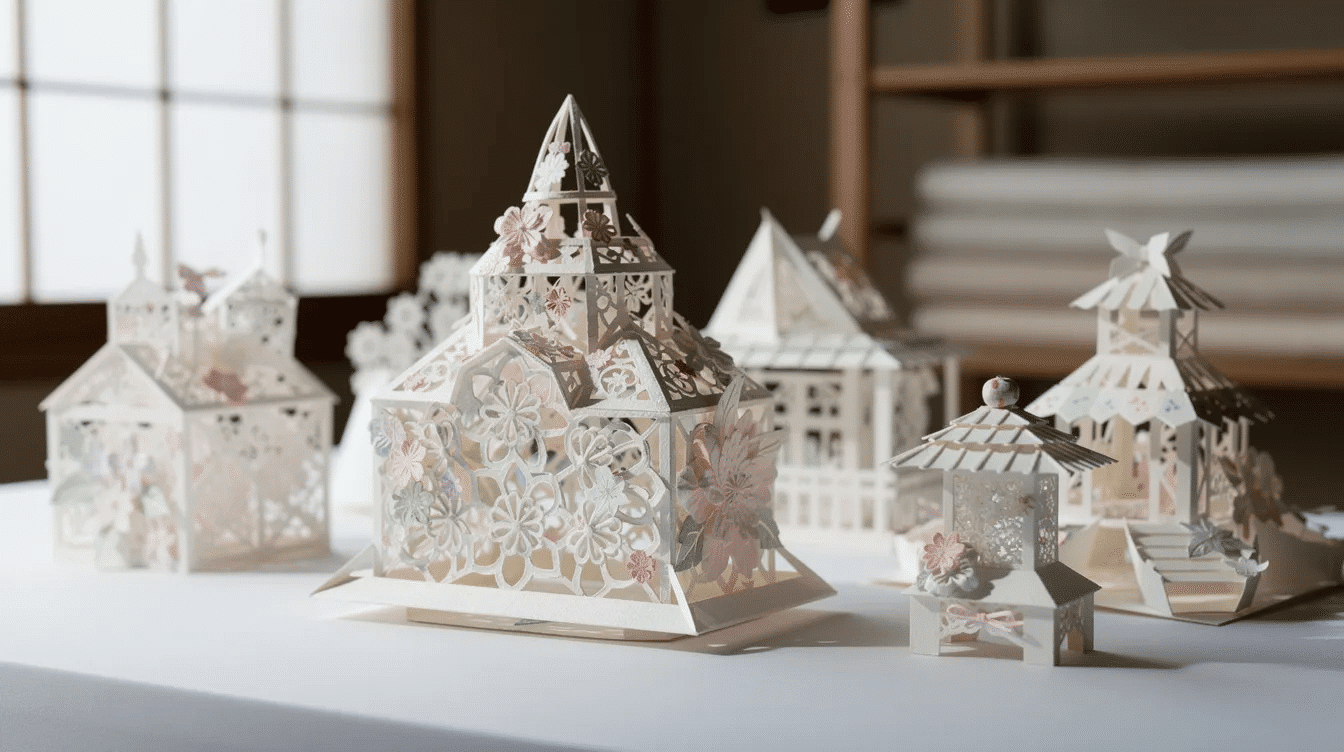
Technique is the clearest practical difference between the two arts.
Origami asks the artist to control shape through folding. Kirigami asks the artist to control both cutting and folding, so the design process includes where the paper bends, where the paper opens and where the sheet remains connected.
Origami Folding Techniques
Origami begins with basic techniques such as valley folds, mountain folds and reverse folds. These foundation folds create the structure for simple objects as well as complex sculpture.
Complex origami models use combinations of basic folds, including pleats, squash folds, inside reverse folds and outside reverse folds. A simple piece may take only a few steps, while an advanced model can involve many layers and precise sequences.
Origami techniques rely on geometric angles and precise point-to-point alignments to achieve structural integrity. Clean creases are essential because small errors can affect the final shape.
The limiting aspect of origami is also its strength: no cutting is allowed. Because traditional origami only involves folds, holes, lace-like openings and carefully cut internal details are generally impossible without leaving the rules of pure origami.
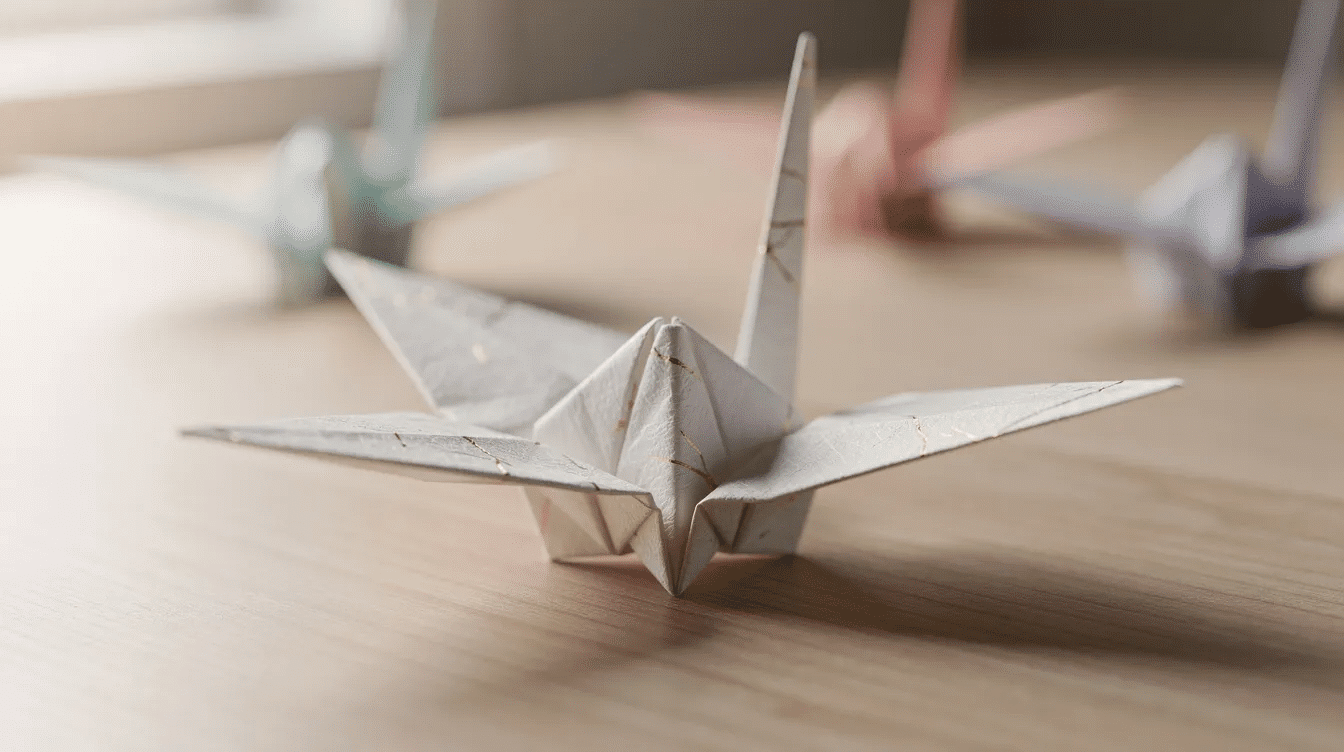
Kirigami Cutting and Folding Methods
Kirigami uses strategic cutting before or after folding to create openings, reliefs, repeated patterns and three-dimensional designs. Kirigami allows for the creation of three-dimensional structures with openings and reliefs, which is not possible with traditional origami that only involves folds.
Basic Kirigami techniques include marking your design lightly on the paper, cutting with smooth and controlled motions, and folding along scored lines to create three-dimensional designs.
Kirigami often employs symmetry, where the sheet is folded before cutting out a motif, allowing for repeated patterns, which is a common principle in creating designs like traditional snowflakes. A paper snowflake is one of the easiest examples: fold the sheet, cut shapes from the edge and unfold the design to reveal repeated patterns.
Pop up mechanisms combine cut lines with fold lines. These components operate like hinges, allowing a flat sheet of paper to transform into a raised image, architectural scene or layered structure when opened.
Tools and Materials Required
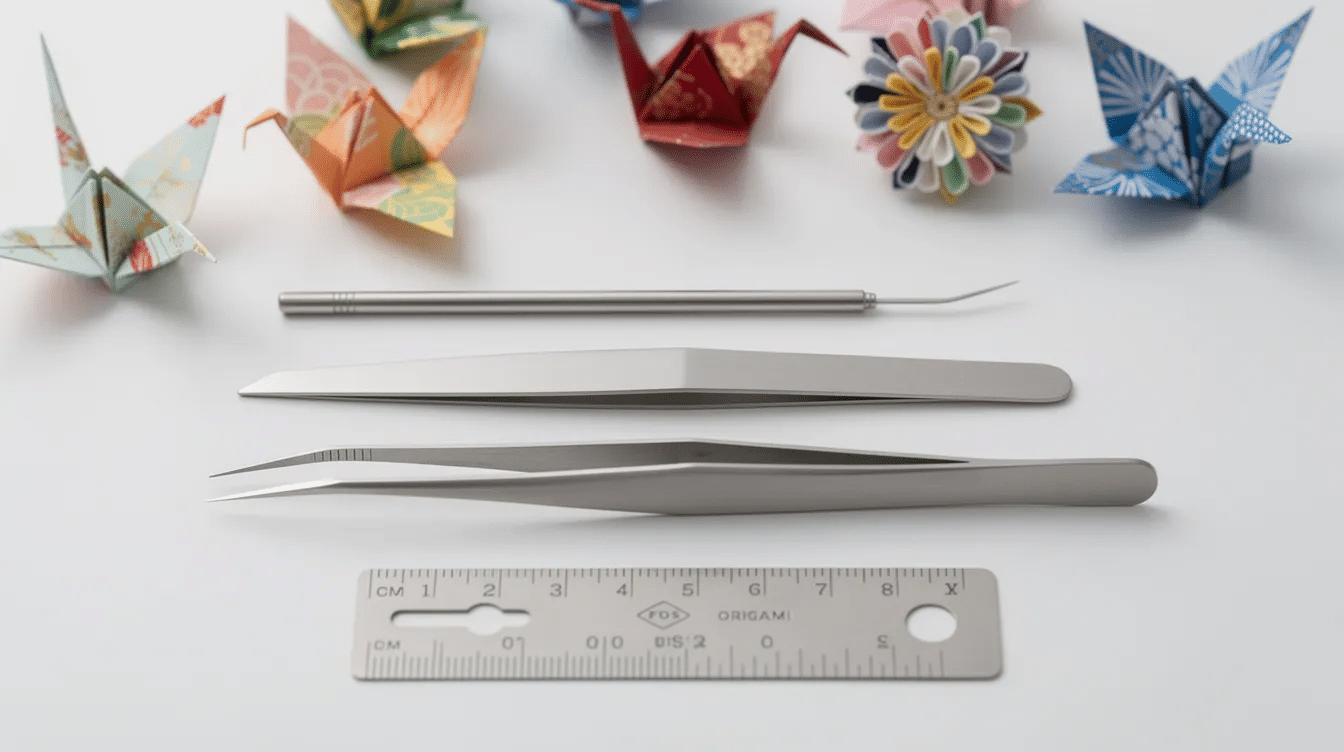
Tool requirements differ because origami avoids cutting tools, while kirigami depends on them.
Origami can be practiced almost anywhere with one sheet of paper. Kirigami needs more tools, more planning and more control over the cutting process.
Origami Tool Requirements
Origami requires very few tools:
- A clean sheet of paper
- A flat workspace
- Optional folding tools such as a bone folder
Quality paper matters. Thin paper handles many layers well, while heavier paper can be useful for sculptural forms or wet-folding. Texture also affects how sharply the paper creases and how well the finished piece holds its shape, so it helps to understand the best types of paper for craft and how they behave in different projects.
Traditional origami does not use a craft knife, scissors, tape or glue. That simplicity makes origami widely accessible, low-cost and easy to grab when you want a portable art practice.
Kirigami Tool Requirements
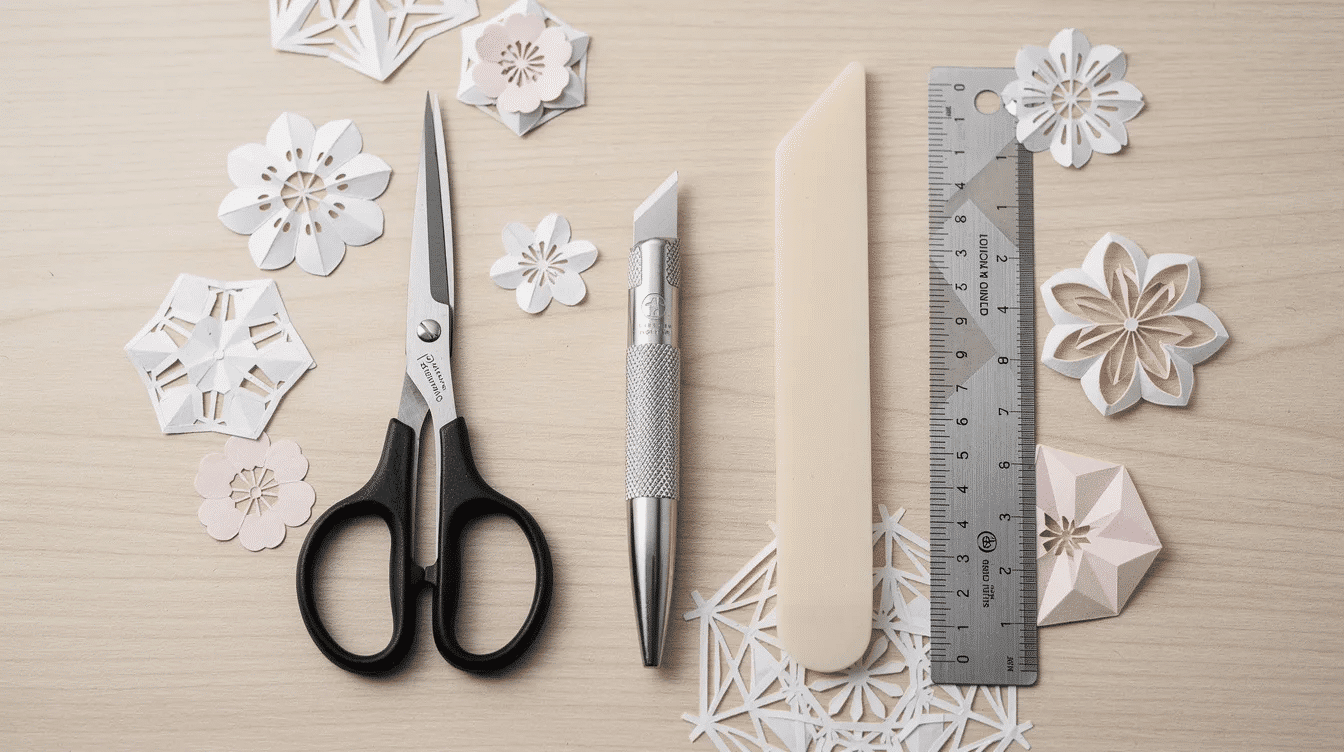
To get started with Kirigami, gather basic tools such as high-quality paper, sharp craft scissors or a precision craft knife, measuring and marking tools like a ruler and pencil, and folding tools like a scoring tool or bone folder.
A typical kirigami setup includes:
- High-quality paper or cardstock
- Precision craft knife or sharp scissors
- Cutting mat
- Ruler or straight edge
- Pencil and eraser for marking
- Scoring tool or bone folder
Paper selection matters because kirigami paper must handle both cutting and folding. Lightweight paper works well for delicate decorative patterns, while heavier materials support pop up structures, cards and architectural models, especially when you choose from top craft paper supplies for creative projects that suit cutting and layering.
The tool investment is higher than origami, and cutting mistakes are harder to repair. In return, kirigami offers greater creative flexibility and more ways to create depth, openings, shadows and layered detail.
Complexity and Design Possibilities
Allowing cutting changes what is possible.
Origami builds complexity through folds, layers and geometry. Kirigami builds complexity through folds, cuts, negative space and structural deformation.
Origami Design Scope
Origami excels at elegant sculptural forms created from folding paper. Classic examples include cranes, flowers, animals, geometric shapes and modular designs.
Mathematical precision allows origami artists to create impressive three-dimensional forms from a single sheet. The art depends on angles, symmetry, sequence and spatial reasoning.
Origami serves as a traditional artistic practice and mindfulness tool and inspires engineering applications such as folding solar panels for satellites. This connection between art and science shows how folding processes can influence real-world technological innovations.
Origami’s constraints challenge artists to work within folding limitations. Because cutting is not allowed, the artist must solve every design problem through crease placement, layer control and careful folding.
Kirigami Design Possibilities
Kirigami can create intricate patterns that are impossible with folding alone, including lace-like designs, open windows, architectural pop-ups and layered landscapes. Cuts enable negative space and transparency effects that give the finished piece a different visual function.
Kirigami offers a wide range of project ideas, including cut-paper snowflakes, pop-up cards, and intricate sculptures, making it suitable for all skill levels.
A popular kirigami project idea is to create decorative wall art by sketching complex patterns on a large sheet of paper, cutting out the details, and layering the design for depth.
Creating kirigami cards involves preparing a folded base, sketching a design, cutting to create pop-up effects, and personalizing the card with colors or messages.
Kirigami enhances various practical applications including greeting cards, architecture models, and creates structures used in material science like flexible medical bandages.
Kirigami techniques are being utilized in soft robotics to create flexible components that can mimic the movement of biological organisms, such as octopus tentacles, allowing for greater freedom of movement compared to traditional rigid robots.
Researchers have applied kirigami principles to design flexible membranes made from silicon or polymers that can transform from flat sheets into useful three-dimensional shapes, which are ideal for applications in electronics and medical sensors.
Kirigami-inspired designs have been used to create stretchable structures and foldable objects, which can be employed in various applications, including energy absorption systems and metamaterials.
In the field of robotics, kirigami structures can be used to develop components that perform passive functions, such as valves that open based on water flow intensity, enhancing the efficiency of mechanical systems.
Kirigami techniques have been explored for creating advanced biomedical devices, including microcontainers that can encapsulate living cells and interact with their environment in three dimensions.
Learning Curve and Skill Development
Both arts are beginner-friendly, but they develop different skills.
Origami builds folding accuracy, sequence memory and three-dimensional visualization. Kirigami builds those skills while also adding cutting control, design planning and safety awareness.
Learning Origami Skills
Origami skill development usually starts with simple models and moves toward more complex objects. Beginners often learn a boat, crane, box or flower or explore top origami designs for every skill level before moving into modular forms and detailed sculpture.
The main skills are memorizing fold sequences, developing finger dexterity and learning how each fold changes the shape of the paper. As the models become more complex, spatial reasoning becomes increasingly important, whether you are folding simple boxes or experimenting with creative paper duck origami ideas that require more nuanced shaping.
Origami requires patience. Clean results depend on sharp creases, accurate alignment and consistent pressure across the sheet.
The practice can also be meditative. Many artists value origami because the method is focused, quiet and structured around careful control of each fold.
Learning Kirigami Skills
Kirigami requires a dual skill set: cutting precision and folding technique. The artist must understand not only how to fold the paper, but also where to carefully cut so the design opens correctly.
Planning is essential. Cut placement affects strength, balance, deformation and whether the finished piece can stand, flex or fold flat.
Hand-eye coordination matters more in kirigami because detailed cutting work can involve tiny components and narrow connections. A craft knife gives control, but it also requires a steady hand and safe technique.
Kirigami often produces faster visual results than origami because even a simple snowflake or pop up card can look interesting immediately. Mastery, however, requires control over multiple processes: sketching, marking, cutting, scoring, folding and assembling the final image.
Cultural and Historical Context
Both arts have strong roots in East Asian paper traditions, but their histories developed through different processes.
Origami is closely associated with Japanese culture and Japanese art. Its roots include ceremonial folding, gift wrapping and symbolic paper forms used in social and ritual settings.
The term ‘kirigami’ comes from the Japanese words ‘kiru’ (to cut) and ‘kami’ (paper), highlighting its unique combination of cutting and folding techniques.
The origins of kirigami can be traced back to ancient China in the 4th century, where delicate paper cutting was practiced in the art of jianzhi.
Kirigami evolved in Japan by combining the cutting techniques of jianzhi with the folding techniques of origami, leading to the art form known today.
In medieval Japan, kirigami was used for religious ceremonies and in Shinto shrines, often featuring paper cut-outs like purification arrows.
Both art forms reflect patience, precision, respect for materials and inspiration from nature. Origami often represents animals, flowers and symbolic forms, while kirigami widely explores motifs, patterns, seasonal decorations and cut-paper images.
Kirigami has gained worldwide popularity due to its visual appeal and creative flexibility, allowing for both simple and complex designs.
Kirigami vs Origami: Which Should You Choose?
Choose origami if you want a meditative folding practice, minimal tool investment and traditional sculptural forms. Origami is especially suitable if you like the challenge of creating objects from a single sheet without cutting, glue or extra materials.
Choose kirigami if you want decorative applications, mixed media flexibility and rapid visual impact. Kirigami is a strong choice for paper snowflakes, pop up cards, wall art, architectural models and designs that need openings, layers or light-and-shadow effects.
Origami and kirigami can also complement each other. Origami teaches precise folding techniques, while kirigami adds cutting, negative space and broader design possibilities.
The best choice depends on your personal creativity, tools, patience and artistic goals. If you enjoy strict rules and sculptural purity, start with origami. If you want more freedom to cut, unfold, layer and transform paper into detailed patterns or functional structures, start with kirigami.