
Learning how to make a box using paper is one of those satisfying skills that pays off immediately. Within ten minutes, you can transform two ordinary sheets of printer paper into a sturdy container with a separate lid and base—perfect for wrapping small gifts, organizing desk supplies, or storing jewelry. This guide is perfect for beginners, crafters, or anyone looking for a quick and practical paper project. Paper boxes are great for gift wrapping, organizing, or creative crafts.
What is an Origami Box?
Origami boxes, also known as masu boxes, are simple and functional paper boxes that can be made from a square piece of paper. The classic origami box is a square box, while rectangular boxes can be created for different storage needs.
This tutorial walks you through the entire process with clear instructions and photo guidance. You won’t need any special materials beyond what’s probably sitting in your home office right now: standard A4 or US Letter paper, scissors, and a ruler. No prior origami experience required.
Note: This is a variation of the classic origami ‘masu box’ technique—a simple origami project that traditionally requires no glue or scissors, just a single square sheet of paper. Paper boxes can be made from various types of paper, including patterned or plain printer paper, and are perfect for storing small items, gifts, or as decorative containers.
Unlike the classic origami box (sometimes called a masu box, which traces back to Japanese gift-wrapping traditions of the Edo period), this method converts rectangular sheets into squares and incorporates a few strategic cuts. The result is a deeper box with sharper corners and a snug-fitting lid that actually stays closed. We’ll fold the lid first so you can see success fast, then create the matching base using the same steps with one small adjustment.
- Materials You Need (for Lid and Base)
- Step 1 – Turn Your Paper into a Perfect Square
- Step 2 – Fold the Crease Guide for the Lid
- Step 3 – Form the Corners and Sides of the Lid
- Step 4 – Cut and Collapse the Paper into a Lid
- Step 5 – Make the Box Base Slightly Smaller
- Step 6 – Fold and Secure the Base
- Step 7 – Fit the Lid and Base Together
- Ideas for Decorating and Customizing Your Paper Box
- Final Thoughts
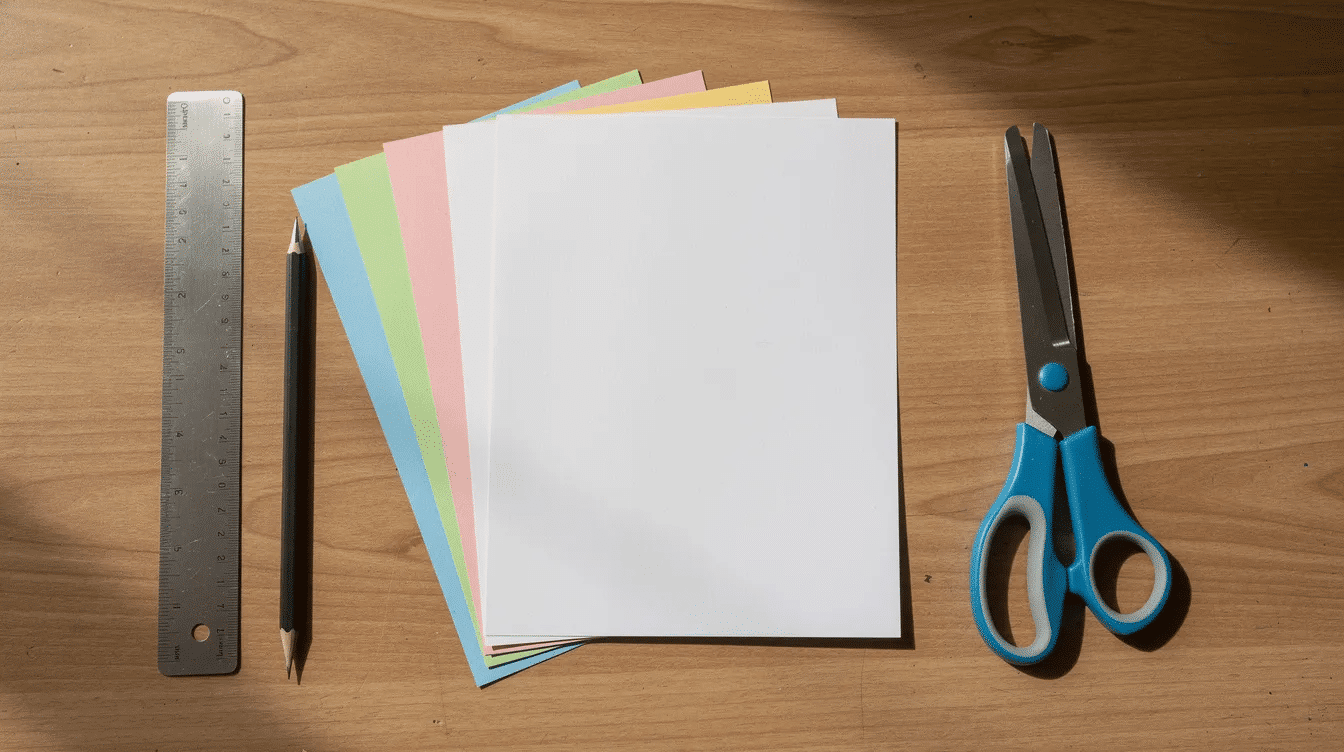
Materials You Need (for Lid and Base)
Gather these items before you begin:
- 2 sheets of A4 or US Letter printer paper (80–90 gsm works best)
- Scissors with a sharp, precise blade
- Ruler for straight cutting lines
- Pencil for marking cut points
- Glue stick (optional, for extra strength)
- Decorative markers or washi tape (optional)
One sheet becomes the lid, the second becomes the base. Both must be turned into perfect squares before folding—this is critical for clean paper boxes that sit flat and close properly.
If you want a gift-ready finished box, consider using colored or patterned paper that coordinates with your paper birthday decorations. Scrapbook paper in the 120–160 gsm range adds visual appeal, though anything heavier than 200 gsm may tear during folding. Plain white paper works perfectly for practice runs.
From a standard A4 sheet, expect your finished box to measure roughly 8–9 cm square, depending on your trimming precision.
Step 1 – Turn Your Paper into a Perfect Square
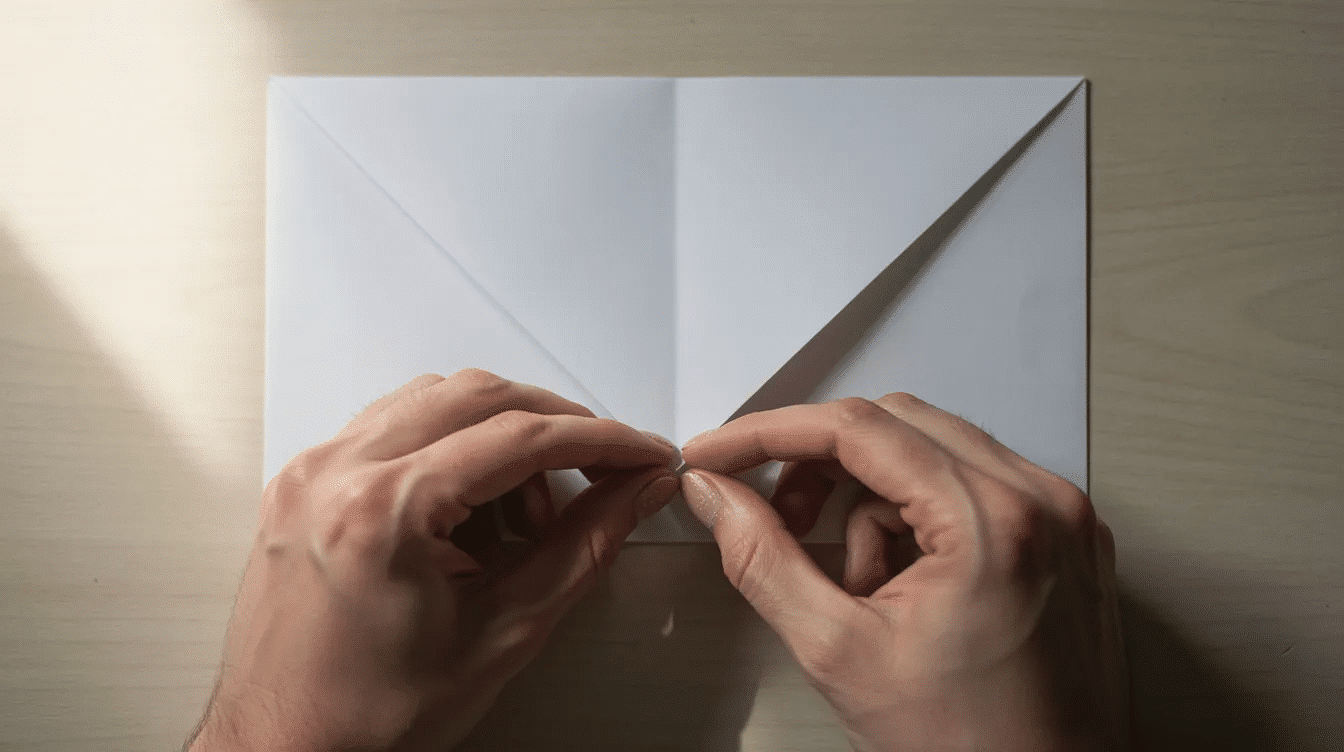
Starting with an accurate square paper is the foundation of this entire project. Here’s how to create one from any rectangular piece of paper:
- Place your A4 or Letter sheet horizontally in front of you
- Take the bottom-left corner and fold it diagonally up to meet the top edge
- Align the left and right sides of the folded triangle precisely—the side edges should line up perfectly
- Use your ruler to draw a straight line where the excess strip shows
- Cut along this line with your scissors
The strip you remove will be approximately 87 mm on A4 paper. After cutting, unfold your diagonal crease to reveal a perfect square (roughly 210 x 210 mm).
Important tip: Aim for less than 1 mm variance in your square. Misalignment here compounds into 3–5 mm errors in your final box, causing walls to lean and lids to fit poorly. Take an extra moment to measure and verify your edges form a true 90 degrees.
You’ll repeat this process for the second sheet when making the base, but with one adjustment we’ll cover later.
Step 2 – Fold the Crease Guide for the Lid
This step creates the grid of fold lines that will guide your entire box structure. Think of it as drawing invisible blueprints onto your paper.
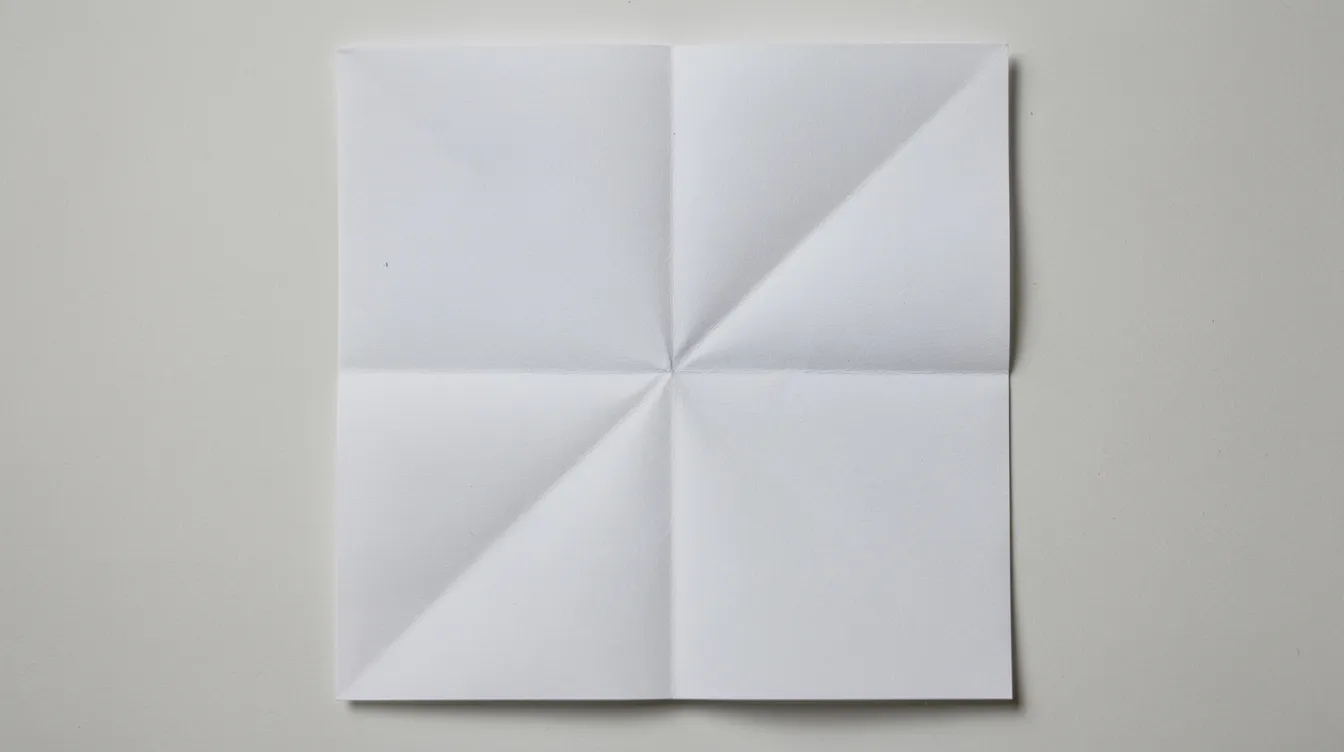
Create the horizontal and vertical creases:
- Fold your square paper in half horizontally, bringing the top and bottom edges together
- Crease firmly along the fold line
- Unfold completely
- Fold in half vertically, bringing the left and right sides together
- Crease and unfold
You should now see a plus-sign crease pattern through the center of your square.
Add the diagonal creases:
- Fold one corner to the opposite edge diagonally
- Crease along the diagonal line and unfold
- Repeat with the other two corners
Your paper now displays intersecting horizontal, vertical, and diagonal lines meeting at the middle—eight crease lines total forming a grid pattern.
Pro tip: Run a fingernail, bone folder, or the back of a spoon along each crease. This compresses the paper fibers and creates sharper fold lines that last through repeated manipulation, much like when you create precise folded paper stars. Sharp creases make things easier in the collapsing steps ahead.
Step 3 – Form the Corners and Sides of the Lid
Now you’ll begin shaping the actual structure of your box lid using the crease guide you just created.
Fold the four corners to the center:
- Take one corner and fold it precisely to the center point where all crease lines meet
- Repeat with the remaining three corners
- All four corner points should meet exactly in the middle
You now have a smaller square shape with four triangular flaps layered in the center. Notice how each fold follows the existing diagonal crease lines—this is why accurate creases matter.
Create the wall fold lines:
- Choose two opposite edges of your current shape
- Fold one side edge straight to the center line (over the triangles)
- Crease firmly
- Unfold this edge fold
- Repeat with the other side of the pair
After unfolding, you’ll see new horizontal crease lines that mark where your side walls will form. The visible grid of creases now shows exactly where cuts and collapses will happen in the next step.
Leave the four corner flaps folded to the center—only unfold the two edge folds you just made.
Step 4 – Cut and Collapse the Paper into a Lid
This step transforms your flat, creased paper into a three-dimensional box lid. The cuts are minimal but strategic.
Making the cuts:
- Locate the two opposite sides where you made edge folds in the previous step
- On each of these sides, you’ll make two short slits along existing crease lines
- Each cut should be approximately 1–1.5 cm long
- Stop exactly at the next crease intersection—do not cut beyond this point
You’ll make four cuts total (two on each side). Cutting past the crease intersections weakens your corners by 20–30%, so precision matters here.
Collapsing into the box shape:
- Unfold the two corner flaps that are on the cut sides
- Pull the long uncut flaps upward to form the first two walls at 90 degrees
- Fold the small corner tabs inward (mountain fold toward the box interior)
- Bring the remaining flaps over these tabs to lock the corners
- Press each corner firmly to secure the interlocking structure
The corners should now be self-locking, with overlapping layers holding everything in place. Pinch each corner so the lid stands on its own with straight, square edges—this attention to accuracy will also help when you explore other beginner-friendly origami designs.
Optional reinforcement: Add a tiny dot of glue on the inside of each corner flap if you want extra sturdiness. This isn’t necessary if your folds are tight, but it can help the box withstand heavier contents.
Step 5 – Make the Box Base Slightly Smaller
Here’s the key difference between your lid and base: the base must be slightly smaller to slide smoothly inside the lid.
Create a smaller square:
- Take your second sheet of printer paper
- Repeat the diagonal folding method from Step 1 to create a square
- Before proceeding, trim an additional 3–5 mm from the top edge
- Trim another 3–5 mm from one side
This small reduction (roughly 2–5% of the total paper size) ensures the base will fit inside the lid without buckling or jamming. The difference is barely visible but makes all the difference in function, just as tiny adjustments matter when folding clean, well-shaped origami ducks.
Fold the crease guide for the base:
- Fold in half horizontally (top and bottom edges meeting), crease, unfold
- Fold in half vertically (left and right sides meeting), crease, unfold
- Fold both diagonals, crease, and unfold
- Fold all four corners to the center point
You’re following the same steps as the lid—the only change is starting from a fractionally smaller square. The process should already feel more familiar.
Next, fold the two opposite edges into the middle, crease firmly, and unfold to set up the wall structure. You’re now ready to cut and collapse.
Step 6 – Fold and Secure the Base
The base follows the exact same cutting and collapsing process as the lid. Since you’ve done this once already, expect it to go faster.
Cut the base:
- Make the same four slits along crease lines on two opposite sides
- Each cut should be 1–1.5 cm, stopping at crease intersections
- Mirror the exact placement you used for the lid
Collapse into box form:
- Unfold the corner flaps on the cut sides
- Lift the long flaps to form the first pair of walls
- Tuck the corner tabs inward
- Pull the remaining flaps over to lock each corner
- Pinch corners firmly
Flatten the bottom: Press gently on each inside corner of the base to eliminate any bubbles or raised areas. The bottom edge should sit completely flat on your work surface.
If the walls feel loose or the corners don’t hold, apply a light line of glue under the corner flaps. Hold for a few seconds until the adhesive sets, then consider trying other simple and cute paper craft projects that build similar folding skills.
Note for beginners: Repeating the same motions a second time almost always feels easier and faster. Most people report their base takes 20–30% less time than their lid. Don’t worry if your first attempt was a bit rough—the process becomes intuitive quickly.
Step 7 – Fit the Lid and Base Together
The moment of truth: bringing your two pieces together into one complete origami box.
Testing the fit:
- Place your empty base on a flat surface
- Position the lid directly above it
- Gently slide the lid down over the base
- The fit should be smooth and snug—not too tight, not too loose
A correctly sized pair should open and close easily with minimal force (less than 2 newtons, if you’re curious). The lid should hold securely when you lift the closed box.
Troubleshooting a tight fit:
- Slightly pinch the base walls inward to reduce their profile
- Trim 1–2 mm from the top edge of the base and refold the affected creases
- Check that no paper bubbles are pushing the walls outward
Troubleshooting a loose fit:
- Your base square may have been trimmed too much
- Consider making a new base with only 2–3 mm trimmed instead of 5 mm
Quick function test: Place a few paper clips, wrapped candy, or a folded note inside your finished box. Close the lid and lift the entire box. It should hold its shape under this light weight without the lid popping off or the walls collapsing.
Ideas for Decorating and Customizing Your Paper Box
Once you’ve mastered the basic technique, the fun really begins. The same skills open the door to many creative paper crafting projects. Here are practical ways to make your paper boxes stand out:
Simple decoration techniques:
- Use colored printer paper in coordinating shades
- Draw geometric patterns with fine-tip markers
- Add washi tape bands around the side walls (this also adds 10–20% structural rigidity)
- Stamp designs before folding for a professional look
Seasonal and gift ideas: Crafting these boxes pairs beautifully with other thoughtful handmade paper gifts.
- Red and green boxes for holiday gifts
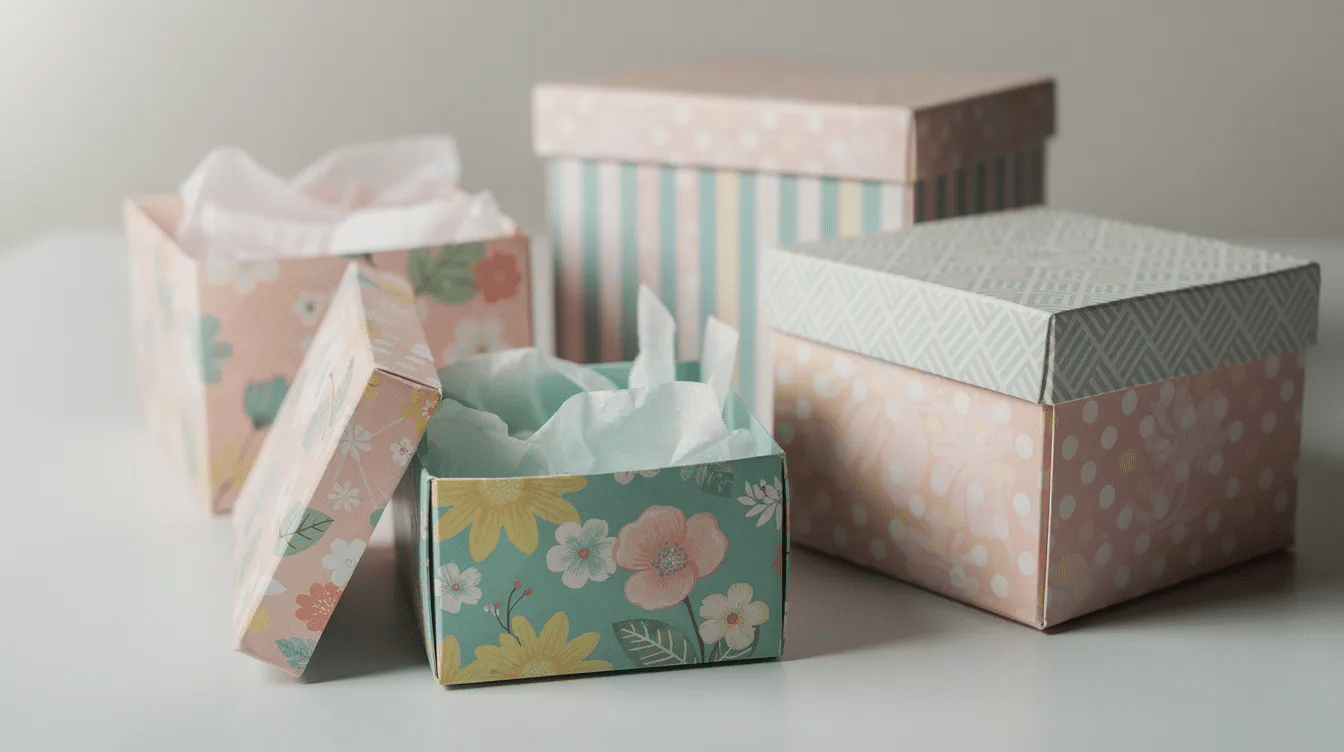
- Pastel paper for spring celebrations
- Black-and-gold combinations for New Year’s Eve party favors
- Patterned scrapbook paper for wedding favors or shower gifts
Scaling your boxes: If you enjoy dimensional projects, you might also like making tissue paper flowers for any occasion.
You can create larger or smaller boxes by starting with different size paper. The proportions scale linearly—a 30 x 30 cm square yields roughly a 10 x 10 x 10 cm box. Just remember: always keep your base a few millimeters smaller than your lid regardless of overall size.
Coordinating lid and base:
For the most polished look, use two sheets from the same patterned paper pack. The slight size difference between lid and base won’t affect the pattern match noticeably, but will ensure that perfect slide-on fit.
These boxes work beautifully for small things like earrings, rings, or small gifts and can complement creative wrapping paper ideas when you’re assembling a complete gift. They’re also fantastic for organizing small office supplies or creating custom favor boxes for events.
Final Thoughts
You now have all the steps to create sturdy, reusable paper boxes whenever you need them. The technique becomes faster with practice—most people can fold a complete lid and base in under ten minutes after a few tries.
I hope this tutorial helps you create something fantastic. Whether you’re wrapping a small gift, organizing your desk, or just enjoying a fun paper craft, these boxes deliver real utility from simple materials.
Have questions about any step? Notice something that could make the instructions clearer? Drop your thoughts in the comments below. And if you create some beautiful decorated versions, we’d love to hear what designs worked best for you—especially if you pair them with useful printable tags or inserts you’ve designed or printed at home.