Paper crafts are one of those rare hobbies that genuinely work for everyone. Whether you’re entertaining a restless toddler on a rainy Saturday or winding down after a long week, a few sheets of paper and some basic supplies can fill an afternoon with something satisfying. In 2026, with more families looking for screen-free activities and sustainable ways to keep busy, easy crafts with paper have become a go-to choice for good reason.
The beauty of these projects is their accessibility. About 95% of households already have the basic materials on hand—printer paper, old magazines, maybe some construction paper left over from a school project. You don’t need to invest in expensive tools or clear out a dedicated craft room. A kitchen table, a pair of scissors, and a glue stick are enough to get started.
This guide walks you through specific, concrete DIY ideas for every age group—from simple projects for little ones just learning to hold scissors, to relaxing techniques for teens and adults who want something meditative. You’ll also find seasonal inspiration and tips to make your finished pieces look polished. Pick a project, gather your simple supplies, and you can be crafting within minutes.
- Basic Tools and Supplies for Easy Paper Crafts
- Super-Easy Paper Crafts for Younger Kids (Preschool & Early Elementary)
- Easy Paper Crafts for School-Age Kids and Families
- Relaxing Paper Crafts for Teens and Adults
- Seasonal and Holiday Paper Crafts You Can Make All Year
- Simple Tips to Make Your Paper Crafts Look Polished
Basic Tools and Supplies for Easy Paper Crafts
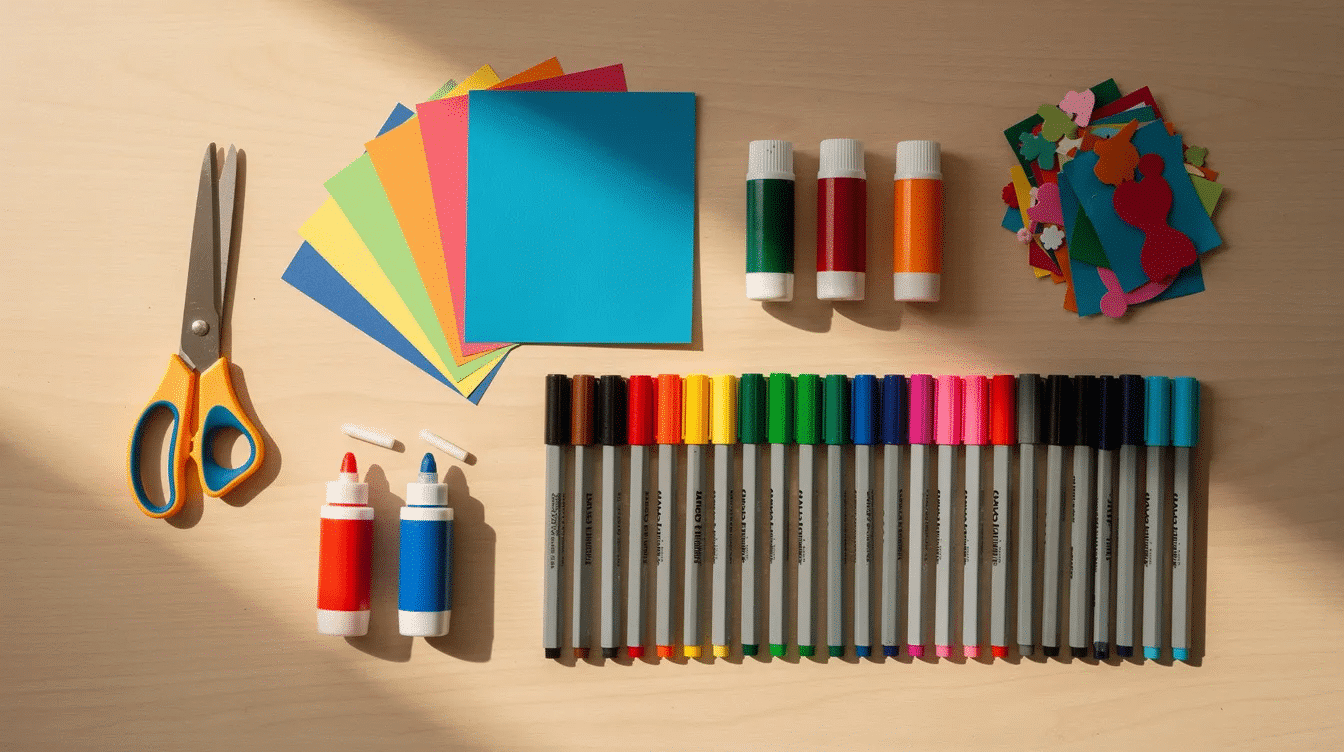
You don’t need a full craft room to dive into papercraft. A cleared kitchen table, a few essentials, and maybe an old tray to catch scraps are all the space you need. Here’s what to keep within arm’s reach.
Core Tools
Start with child-safe scissors featuring rounded tips and plastic guards—they run about $1-2 each and prevent most accidental nicks while still cutting through standard paper. Keep a pair of regular adult scissors (sharp stainless steel, around 8 inches) for more precise cutting and detailed shapes. A glue stick dries in 1-2 minutes and stays mess-free, while liquid glue offers a stronger bond but needs 10-20 minutes to set. Clear tape (half-inch to one-inch wide) handles quick joins when you don’t want to wait for glue. A plastic ruler gives you accuracy for measuring and folding, and an HB pencil lets you draw light guidelines that erase cleanly. For adults tackling intricate cuts, an optional craft knife with a #11 blade makes detailed work easier.
Papers to Keep on Hand
Different projects call for different weights. Printer paper (60-80 gsm) is versatile and great for folding. Colored construction paper (120-160 gsm) holds creases well and comes in every shade. Cardstock (200-300 gsm) provides sturdiness for bases, frames, and anything that needs to stand up. Old magazines and newspapers add interesting textures for quilling or collage. Paper plates (around 250 gsm with their coating) are ideal for 3D projects, and toilet paper rolls—free from your recycling bin—make excellent structures for animals and characters.
Nice-to-Have Extras
Markers and crayons work for adding details, while colored pencils give you more control for shading and fine lines. Washi tape adds decorative borders without extra cutting. Stickers can jazz up any project in seconds. String, yarn, or ribbon let you hang finished pieces or create garlands.
Setting Up and Cleaning Up
Lay down an old tray, a silicone mat, or even a few sheets of newspaper to contain spills and catch scraps. Keep a small bowl nearby for paper bits—you’ll reduce waste by about 50% and have a ready supply of confetti or collage material. When you’re done, a damp cloth handles glue residue in under five minutes. Getting kids involved in cleanup builds good habits and makes the whole process feel like a shared activity rather than a chore.
Super-Easy Paper Crafts for Younger Kids (Preschool & Early Elementary)
These projects are designed for ages 3-7 with adult help, and most wrap up in under 20-30 minutes. The focus here is on building confidence with scissors, practicing folding and gluing, and creating something kids can actually play with or display. Each craft uses minimal materials and involves just a few simple steps.
Safety matters at this age. Let little ones use child-safe scissors, and handle any tricky cutting yourself. The process of folding, gluing, and decorating helps develop fine motor skills—studies from child development researchers suggest these activities can improve hand-eye coordination by 15-20% with regular practice.
Paper Plate Jellyfish
Grab a paper plate and cut it in half—this becomes the jellyfish’s body. Let your child paint or color the rounded side in their favorite shade (purple and blue are popular choices). While the paint dries, cut strips of tissue paper or construction paper, each about 1 inch wide and 6 inches long. You’ll need 10-15 strips for good tentacle coverage.
Once the plate is dry, flip it so the decorated side faces outward and glue the strips along the straight edge, letting them dangle down. Add two big googly eyes (or draw circles with black marker) and a curved smile. The whole project takes about 15 minutes plus drying time.
To display, punch a hole at the top and thread through a 12-inch loop of string. Hang your jellyfish in a bedroom or classroom for an “under the sea” effect. Kids love watching the tentacles sway when a breeze comes through.
Toilet Roll Zoo Animals
Toilet paper rolls are surprisingly easy to transform into a whole menagerie. Start by wrapping a roll in colored paper—secure it with a thin line of glue or tape. From there, the animal possibilities open up.
For a lion, wrap the roll in yellow paper. Cut a dozen 3-inch strips of orange construction paper and fringe one edge of each. Glue these strips around the top of the roll to form a fluffy mane, then draw on a face with marker—two dots for eyes, a triangle nose, and whisker lines.
A panda uses white paper for the base. Cut two oval black patches for eyes and two round black ears. Glue them in place and add a small black nose and a curved smile.
Encourage kids to create several animals and line them up on a “zoo shelf” for pretend play. This project reuses recycling, requires only scissors, glue, and paper, and gives kids practice with both straight and curved cuts—skills that occupational therapists note can improve manual dexterity by about 20%.
Simple Paper Crowns
Cut a long strip of construction paper, about 2 inches wide and 22 inches long (tape two shorter strips together if needed). Wrap it around your child’s head to measure, then tape or glue the ends with a half-inch overlap to form a ring.
Along the top edge, glue triangles or rounded shapes to create points. Let kids decorate with drawn “jewels” using crayons, or attach stickers and glued-on paper shapes in different sizes. The whole process takes about 10 minutes.
These crowns are perfect for pretend royal tea parties, birthday photo props, or story time when you’re reading about kings and queens. Because you’re measuring around a real head, kids get a sneaky lesson in circumference without even realizing it.
Easy Paper Crafts for School-Age Kids and Families
These projects suit ages 7 and up, or make great family craft nights where adults and kids can work together. They involve slightly more precise cutting and folding but still rely on basic supplies. Think of these as weekend projects, holiday break activities, or classroom crafts that produce something worth keeping.
Fruit Slice Corner Bookmarks
Start with a 4-inch square of paper. Fold it diagonally to form a triangle, then fold the two side corners up to meet the top point, creating a smaller diamond shape. Unfold those corners, then tuck them inside the pocket you’ve created. You now have a corner bookmark that slips over a page.
To decorate as a watermelon, cut a pink triangle and glue it on the front pocket. Add a thin green strip along the edge for the rind and dot black marker seeds across the pink. For an orange slice, layer a white circle over an orange one with radiating lines drawn in. A kiwi slice uses green paper with a starburst of white lines and tiny black seed dots.
These bookmarks are perfect for getting kids excited about reading—research suggests children are significantly more likely to pick up a book when they have a custom marker waiting inside. They also make great gifts for classmates at the start of the school year or around the holidays.
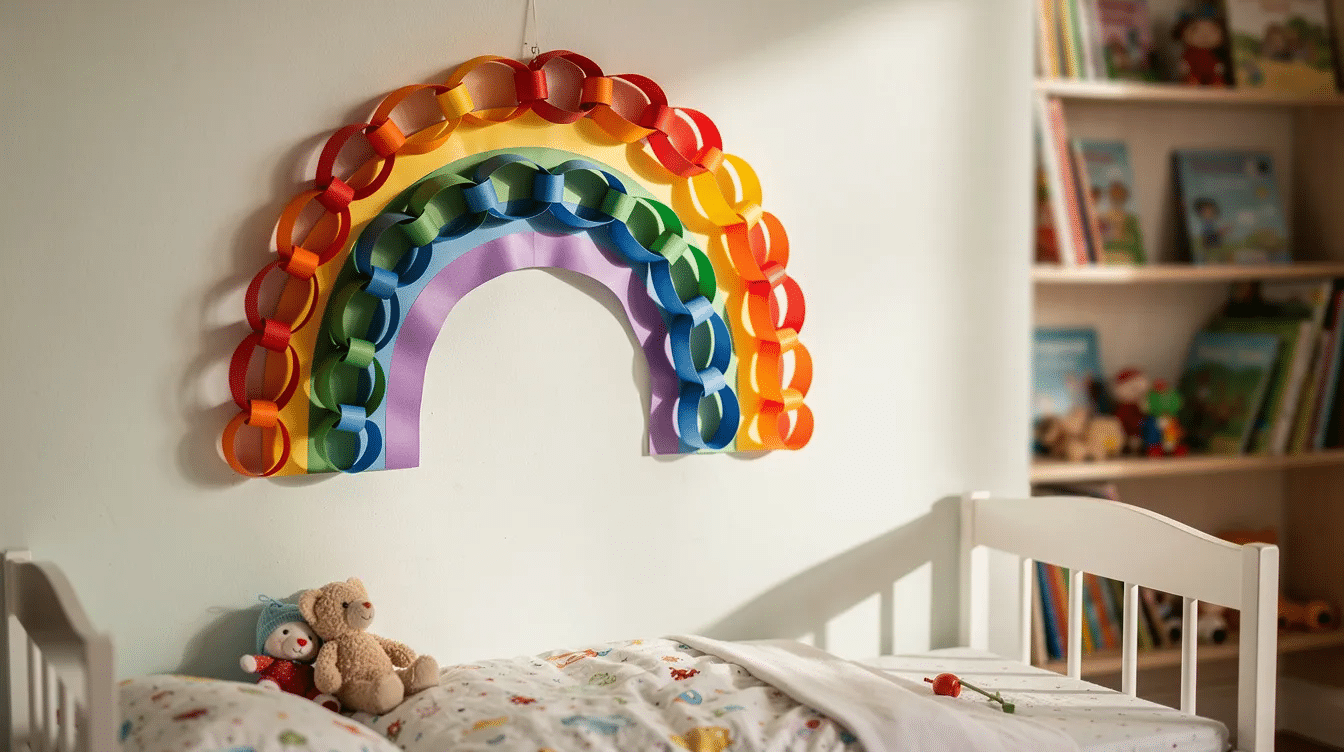
Paper Chain Rainbow Wall Hanging
Cut strips of colored paper about 6 inches long and 1 inch wide. For a rainbow effect, you’ll need strips in red, orange, yellow, green, blue, indigo, and violet. Plan for 7-10 loops per color, depending on how long you want each chain.
Form each strip into a loop by gluing or taping the ends together with about a 1-inch overlap. Thread the next strip through the loop before closing it, building a chain. Create one chain per color.
When all seven paper chains are ready, slide them onto a wooden dowel, a straight stick, or even a wooden skewer (about 9 inches long). Space them evenly, then tie a length of yarn to each end of the dowel for hanging. Mount it on a wall to brighten a child’s room or a classroom reading nook.
Before cutting, encourage kids to sketch out their color pattern on scrap paper—it’s a fun way to sneak in some sequencing and math practice without calling it homework.
Paper Pinwheels for Garden Decorations
Start with a 6-inch square of sturdy craft paper or cardstock. Using a ruler, draw lines from each corner toward the center, stopping about 1 inch from the middle. Cut along these lines.
Bring every other corner (you’ll have four alternating points) to the center and secure them with a small brad, pushpin, or a drop of hot glue. Attach the pinwheel to a paper straw or wooden dowel by pushing the brad through or gluing the back.
These pinwheels are decorative—they may spin gently in a breeze if made from lighter paper. Before assembling, let kids color or stamp patterns on the paper for extra personalization. If using pins or brads, adult help is wise for younger crafters to keep fingers safe.
Paper Ice Cream Cone Banner
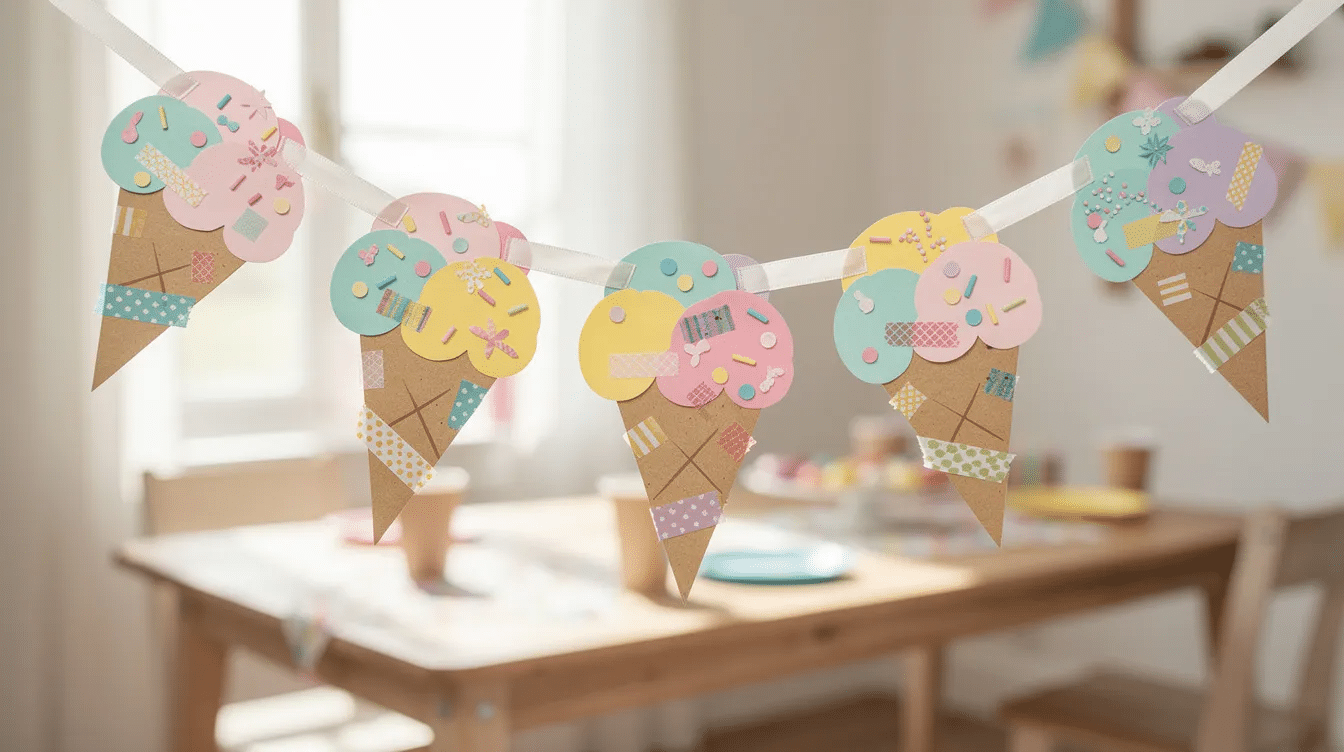
Cut tan isosceles triangles (about 4 inches tall) from construction paper or kraft paper to serve as cones. For scoops, cut 3-inch circles from pastel or bright paper—two or three scoops per cone looks great.
Glue the scoops on top of each cone, overlapping slightly. Add “sprinkles” using markers, small paper dots, or even bits of washi tape. Once you have several cones assembled, tape each one along a length of string or ribbon, spacing them about 12-18 inches apart.
Hang this banner for summer birthday parties, ice cream socials, or last-day-of-school celebrations. Older kids can help younger siblings with the cutting while the little ones handle the decorating—it’s a surprisingly easy team project.
Relaxing Paper Crafts for Teens and Adults
Paper crafts aren’t just for kids. For teens and adults, they offer a calming, screen-free way to spend an evening or weekend. The repetitive motions of folding, rolling, and layering can reduce stress hormones like cortisol by up to 30%, according to research from the University of Sussex on crafting therapies. Many finished pieces can be framed, gifted, or used as home decor.
These projects generally take 30-60 minutes and use straightforward techniques. They’re ideal for listening to a podcast, catching up with a friend, or simply enjoying some quiet time.
Accordion-Folded Paper Flowers
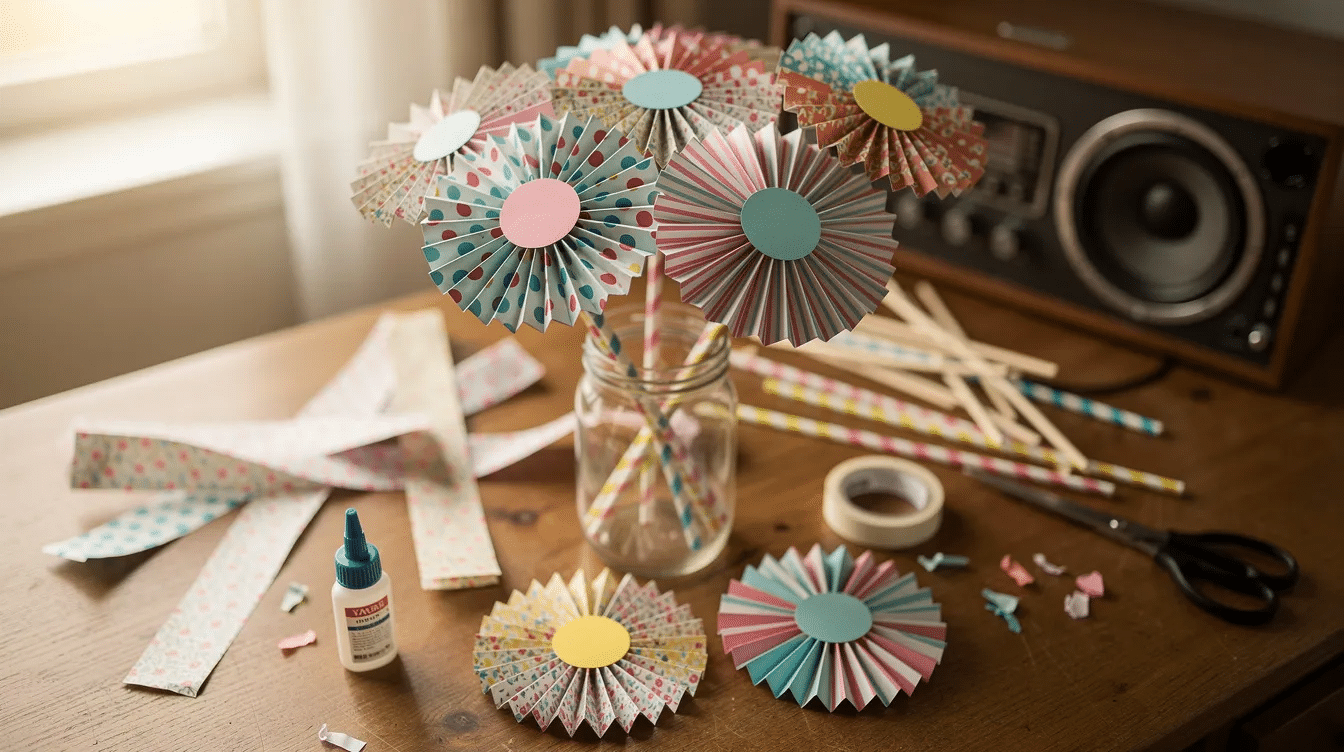
Cut strips of colored paper about 1 inch wide and 12 inches long. Fold each strip accordion-style with pleats about half an inch wide—you’ll end up with 10-15 folds per strip. Pinch one end together and secure it with a bit of glue or tape, then fan out the other end and join the two ends to form a circle.
Add a small paper circle (about 1 inch diameter) to the center to complete the rosette. Glue these paper flowers onto wooden skewers or paper straws to create a bouquet, perfect for a desk or dining table centerpiece.
Mixing patterns—polka dots with stripes, or solids with florals—creates a modern, playful look. This is the kind of repetitive, rhythmic craft that’s ideal for unwinding while music plays in the background.
Simple Paper Quilling Hearts or Leaves
Quilling sounds fancy, but it starts with something basic: cutting narrow strips of paper (about a quarter-inch wide) and rolling them around a toothpick or the barrel of a pen. Once you have tight coils, you can pinch them into shapes—hearts, teardrops, leaves, or simple circles.
Arrange your finished shapes on a piece of cardstock to form a design: a small heart wreath, an initial, or a floral cluster. Once you’re happy with the layout, glue each piece in place.
Frame the finished quilled design as a handmade gift for birthdays, anniversaries, or Mother’s Day. This craft is easy to start with basic shapes and becomes more intricate as confidence grows—many quillers find themselves exploring increasingly elaborate patterns over time.
Handmade Greeting Cards with Layered Paper
Fold a piece of cardstock in half to create a standard card (about 5.5 x 8.5 inches when folded). Layer smaller rectangles or shapes of patterned paper on top, building visual interest through color and texture.
For a birthday card, cut oval shapes in different sizes and colors, arrange them as a cluster of balloons, and draw strings with a fine pen. For a thank-you card, layer petals to create a simple flower and add a green paper stem.
Write messages by hand in black pen for a clean, modern style, or use simple letter stickers for a graphic look. Creating a small batch of cards at once—maybe 5-10—is satisfying and costs a fraction of store-bought options.
Paper Silhouette Wall Art
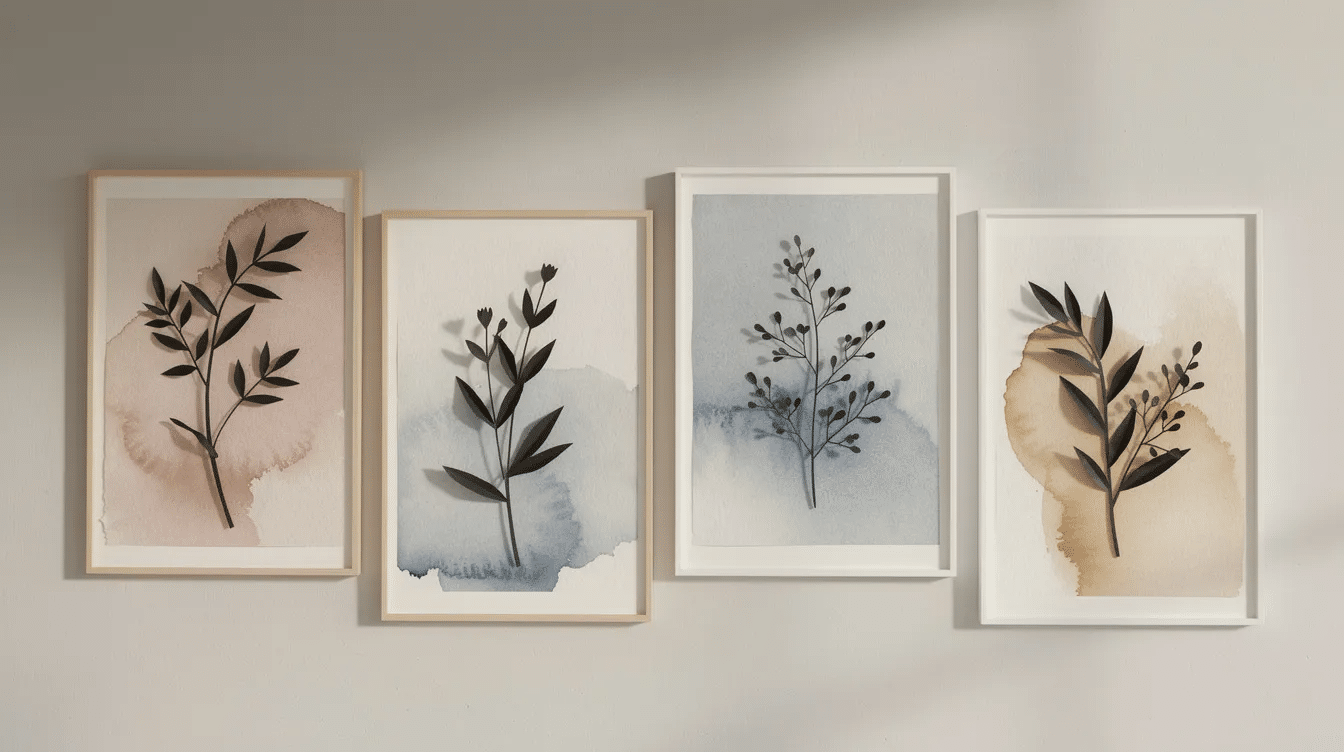
Trace an outline onto black cardstock—try a city skyline, a favorite animal, a houseplant, or even an abstract shape. Cut it out carefully using sharp scissors or a craft knife (adults only for the blade).
Mount your silhouette on a contrasting background. Watercolor washes work beautifully, as does patterned paper or even a page from an old book. Frame the finished piece for display.
This project looks more advanced than it actually is, making it perfect for teen rooms, living room gallery walls, or thoughtful gifts. You could create a series—three different houseplant silhouettes in matching frames, for example—for a cohesive display.
Seasonal and Holiday Paper Crafts You Can Make All Year
The same basic paper techniques—cutting, folding, layering, gluing—adapt to any season with just a shift in color and motif. These projects are ideal for quick decorating in 15-45 minutes, mostly using scrap paper you already have.
Winter: Snowflakes and Paper Ornaments
Fold a square of white or blue paper into triangles (fold in half diagonally, then in half again, then once more). Cut small shapes along the folded edges—diamonds, curves, triangles—then unfold to reveal a symmetric snowflake. Tape these to windows or string them as garlands.
For simple 3D ornaments, cut several circles from cardstock (8-12 per ornament), fold each in half, and glue the halves together in sequence, sandwiching a loop of string at the top. Metallic or glitter paper adds sparkle without requiring special equipment.
Have kids date the back of a snowflake—“Winter 2026”—to create a yearly memory. Store them flat between books and bring them out each December as part of your decorations.
Spring: Paper Flowers and Butterflies
Layer paper flower petals in pastel colors—cut 5-7 circles in graduating sizes, curl the edges slightly by rolling them around a pencil, and stack them with a brad or glue. Tape these onto branches for an indoor spring display or attach them to gift bags for Easter or spring birthdays.
For butterflies, cut wing shapes from brightly colored paper or old magazines. Score a line down the center and fold wings upward slightly to create a 3D effect. Attach these to cards, walls, or window frames.
Create a “spring wall” where kids add new paper flowers and butterflies each week through March and April—it becomes a growing, evolving art project that marks the season’s progress.
Summer: Kites and Party Banners
Cut diamond shapes from colorful paper to create decorative kites. Add yarn tails with tiny paper bows tied along the length. These aren’t meant to fly, but they look charming taped to walls or windows.
For party banners, cut triangles or ice cream shapes (like the cones described earlier) and string them along twine or ribbon. These can be made as a quick pre-party activity on a hot July afternoon—kids stay busy while decorations practically assemble themselves.
Autumn: Paper Leaf Garlands and Pumpkin Lanterns
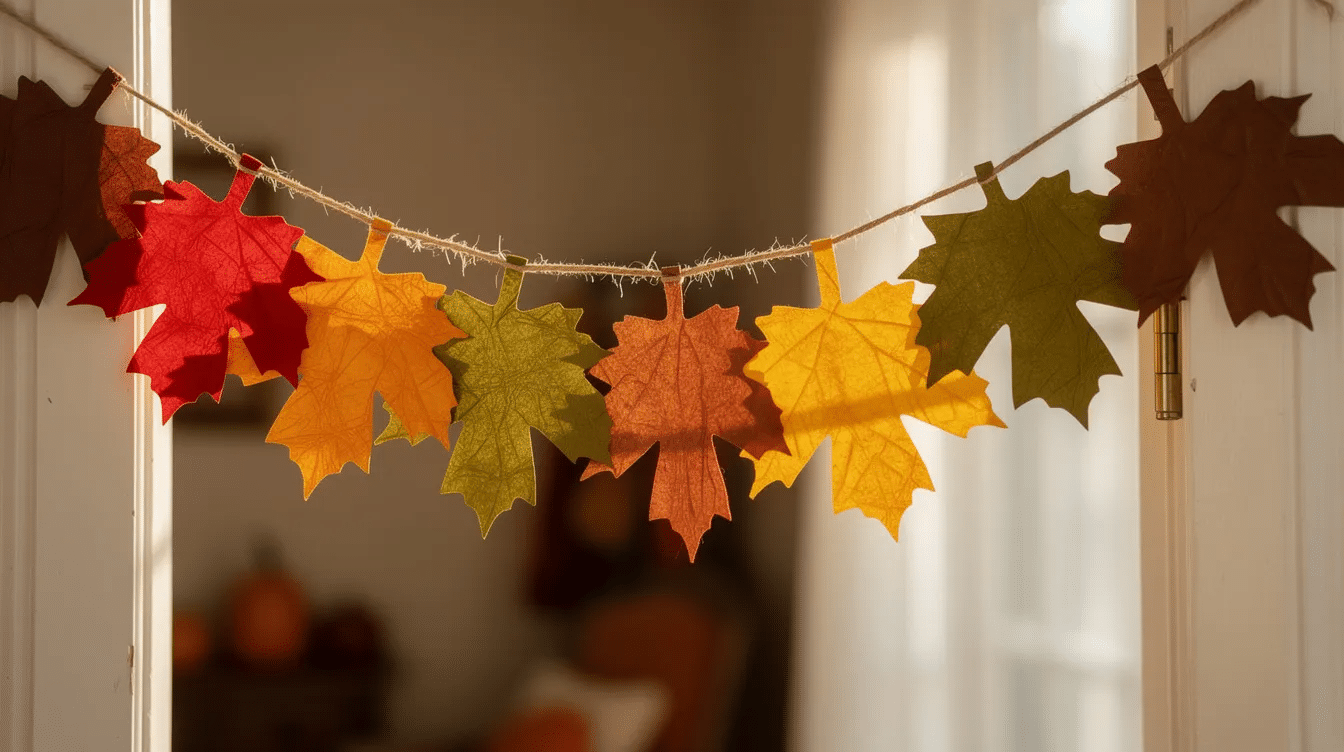
Trace real leaves (or use printable templates) onto red, orange, and yellow paper. Cut out 20-30 leaves and tape them onto a length of string for a doorway garland. This craft helps kids notice seasonal changes—take a walk first to collect leaf shapes and talk about why colors shift in fall.
For pumpkin lanterns, cut vertical slits in a sheet of orange paper (leaving about an inch uncut at top and bottom), then roll it into a cylinder and secure with tape. The slits create a lantern effect when the cylinder expands. Add a green paper stem and a handle cut from a strip.
Place a battery-powered tea light behind (not inside) the lantern for a safe glow around October and November. These make fun table decorations and are a safe alternative to real candles.
Simple Tips to Make Your Paper Crafts Look Polished
Small habits make even beginner projects look impressive. The difference between a craft that looks handmade-in-a-good-way and one that looks sloppy often comes down to a few easy techniques.
Use the Right Scissors
Adults should use sharp scissors and hone them every 10 projects or so—it extends their life significantly and keeps cuts clean. Kids do better with rounded safety scissors appropriate for their age. Dull scissors tear paper instead of cutting it, which shows in the finished product.
Draw Light Pencil Lines
Before cutting curves or detailed shapes, sketch guidelines with a light pencil (2B works well). These lines erase completely afterward with a clean eraser, leaving no trace of your planning.
Fold Against a Ruler Edge
For crisp lines, place a ruler along where you want the fold and press the paper up against it. This gives you 1mm accuracy and professional-looking creases—much better than eyeballing it.
Press Glued Pieces Under a Book
After gluing layers together, slip the project under a heavy book for 5-10 minutes. This keeps paper flat as it dries and prevents warping or bubbling.
Use Thin Glue Layers
A thick layer of glue causes wrinkles and takes forever to dry. Spread a thin, even coat—you need less than you think. Glue sticks are easier to control than liquid glue for most projects.
Organize Your Scraps
Keep a small box or folder of colorful scraps sorted by color. When inspiration strikes, you won’t waste time searching—just grab what you need and start creating. This simple habit cuts project start time dramatically.
Let Projects Dry Completely
Before hanging, gifting, or displaying any craft, make sure glue is fully set. Rushing this step leads to pieces falling apart or warping after the fact.
Practice and experimentation matter more than perfection. Every project teaches you something, and by your fifth attempt at any technique, you’ll notice real improvement. The creative process itself is where the fun lives—don’t let perfectionism steal that from you.
Pick one project from this list and try it this weekend. Gather your materials tonight, clear a space at the kitchen table tomorrow, and see what you can create. Share your results in the comments below—we’d love to see what you make.