Introduction to Cutter Paper Machines
A cutter paper machine is a powered industrial device designed to cut stacks of paper into precise sizes with clean, straight edges. These machines serve as essential infrastructure in print shops, packaging plants, and in-house print rooms where daily cutting volumes range from hundreds to tens of thousands of sheets. The economic significance is straightforward: a high-capacity cutter reduces labor costs, minimizes waste through precision cutting, and enables facilities to handle more diverse job types efficiently.
This guide focuses on industrial and commercial paper cutting machines—stack cutters, guillotine cutters, and programmable units—rather than small hobby trimmers used for scrapbooking or photo projects. The distinction matters because commercial machines operate on different principles, using hydraulic or servo-driven systems to generate the clamping and cutting forces needed for thick stacks of coated or specialty stocks.
Typical use cases include book production, packaging blanks, labels, marketing collateral like business cards and brochures, and large-volume office work. By the end of this guide, you’ll understand the main machine types, key specifications such as cutting width, stack height, and speed, along with safety requirements and buying criteria that help you select the right model for your workload.
- What Is a Cutter Paper Machine?
- Main Types of Cutter Paper Machines
- Key Specifications and Features to Compare
- How to Choose the Right Cutter Paper Machine for Your Workload
- Examples of Cutter Paper Machines and Typical Use Cases
- Installation, Operation, and Maintenance Best Practices
- Frequently Asked Questions About Cutter Paper Machines
- Next Steps: Selecting and Implementing Your Cutter Paper Machine
What Is a Cutter Paper Machine?
A cutter paper machine is a powered device designed to cut stacks or reels of paper into precise sizes, typically using a guillotine blade and programmable back gauge. These machines range from compact tabletop units handling light office work to massive floor-standing systems built for multi-shift commercial production.
The main components include a hardened steel blade (often made from tool steel or premium Solingen steel on higher-end models), a hydraulic or mechanical clamp that holds the stack firmly during cutting, a back gauge that positions material for each cut, a control panel (ranging from simple keypads to full-color touchscreens), safety guards or infrared light beams, and a heavy cast-iron or welded steel frame that absorbs cutting shock and maintains alignment over years of use. Modern machines add digital displays, programmable memory for storing job configurations, and automated positioning systems that eliminate manual back gauge adjustment.
The difference between a simple manual guillotine used on a table and a floor-standing industrial cutter is substantial. Manual paper cutters rely on lever leverage and operator muscle, while industrial machines use electric motors or hydraulic pumps to deliver consistent cutting force regardless of stack height or paper density. Commercial models typically offer cutting widths from 16.9 inches to 45 inches or more, with stack heights ranging from 2 inches to 4 inches—capable of cutting 300 to 1,000+ sheets in a single pass depending on paper weight.
Main Types of Cutter Paper Machines
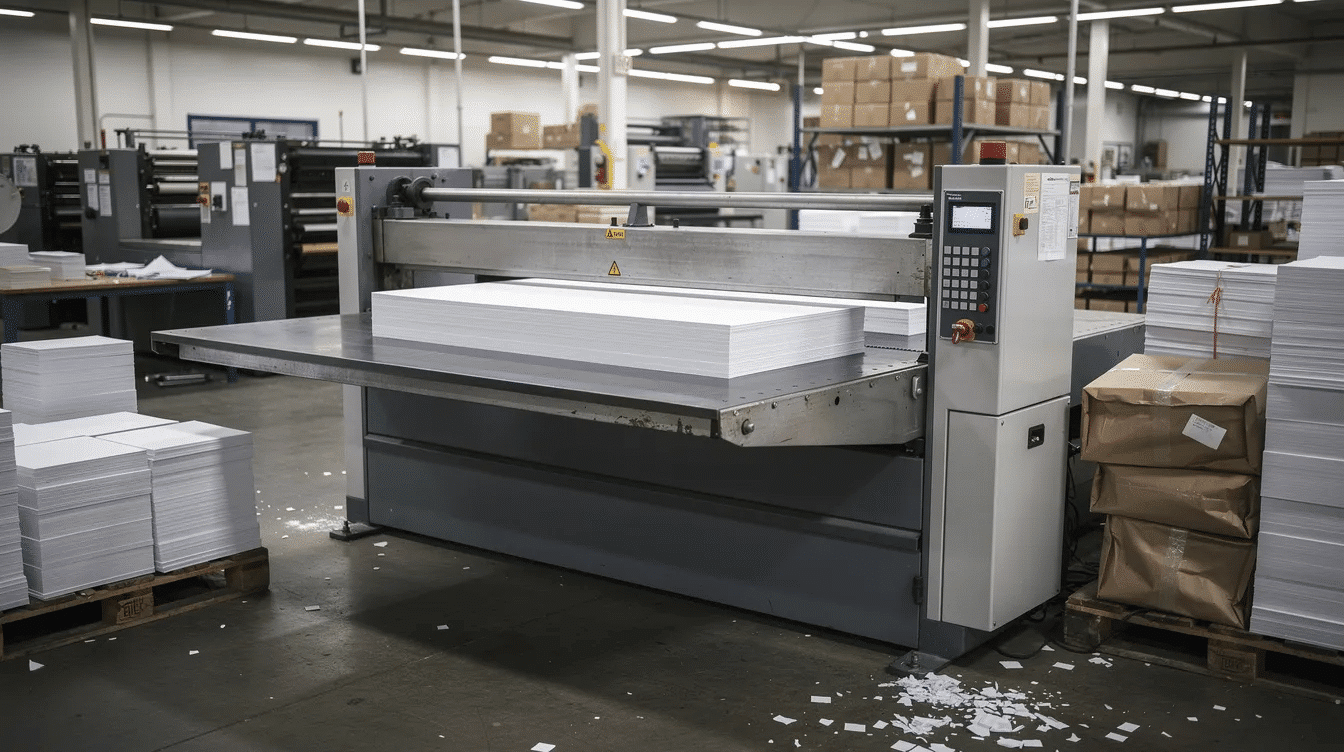
The term “cutter paper machine” encompasses a broad category of devices that differ fundamentally by drive method, automation level, and intended production scale. Manual units rely on hand-operated levers, electric programmable machines use motor-driven blades with digital controls, and fully hydraulic systems deliver maximum force for the thickest stacks and toughest materials.
Choosing the right type depends on three interconnected factors: daily sheet volume, maximum format size (such as SRA3, B2, or B1), and whether jobs are one-off tasks or highly repeatable production runs where stored programs provide significant efficiency gains. The following sub-sections break down the most common types by drive method and application volume, covering everything from light office use to heavy industrial operations. You’ll find the pros and cons of each category along with typical price and feature ranges to guide your decision.
Manual and Lever-Style Guillotine Cutters
Manual and lever-style guillotine cutters are tabletop or small floor units operated entirely by hand, suitable for low-volume environments where cutting needs are sporadic rather than continuous. No electricity is required—the cutter operates on mechanical leverage, converting arm strength into downward cutting force.
Typical specifications for this category include cutting widths of 12 to 17 inches, making them well-suited for A4 and A3 office formats. Stack capacity usually ranges from 100 to 400 sheets (approximately 1 inch to 1.6 inches of material), depending on the specific model and paper thickness. Common applications include cutting flyers, classroom materials, in-house handouts, certificates, and small marketing runs under 500 sheets.
Key advantages make these machines attractive for certain buyers. Upfront cost is low, often under $250 to $500 for decent quality models. There’s no power requirement, so they can operate anywhere with space. Maintenance is minimal—occasional lubrication of pivot points and basic cleaning suffice. The machines are often portable and easy to move between locations.
Limitations are equally clear. Throughput is inherently limited when cutting 50 sheets requires 10 to 15 operations if capacity is only 3 to 4 sheets per cycle. User fatigue becomes a real issue on repetitive tasks. Cut accuracy varies more than on powered equipment, particularly on thick stacks where uneven pressure leads to slightly angled cuts. Advanced safety features are often absent, with most relying on mechanical blade guards that operators must manually engage.
Electric Programmable Paper Cutters
Electric programmable paper cutters use an electric motor to drive the blade downward, eliminating operator fatigue and providing consistent cutting force regardless of stack height or paper density. The “programmable” aspect refers to digital or electronic control of the back gauge position, allowing operators to input or recall dimensions for specific jobs and have the gauge automatically position itself accurately before each cut.
Example capabilities in this category include cutting widths from 17.7 to 26 inches (accommodating SRA3 digital press formats through smaller B2 offset formats), stack heights of 1.5 to 2.3 inches (roughly 300 to 500 sheets of standard paper per operation), and cutting cycles around 20 to 30 per minute. Programmable memory typically stores 20 to 99 different job configurations with multiple cutting steps each.
Typical features include push-button operation, digital readout or touchscreen interface, automatic clamp operation, LED laser line or visual indicator showing the cut line on material, front and rear safety shields, and two-hand control buttons requiring simultaneous operation to activate the cut. Some models include infrared light curtains that stop the blade if interrupted.
These machines balance affordability and productivity, making them popular in quick-print shops, in-plant print rooms, and small packaging lines handling daily volumes in the thousands of sheets. Programmability saves significant setup time for recurring jobs like business cards, brochures, or book blocks—a quick-printer producing 100 business card sets weekly can program the dimensions once and recall the program each morning, potentially saving 10 to 15 minutes daily in setup time.
Hydraulic Heavy-Duty Guillotine Cutters
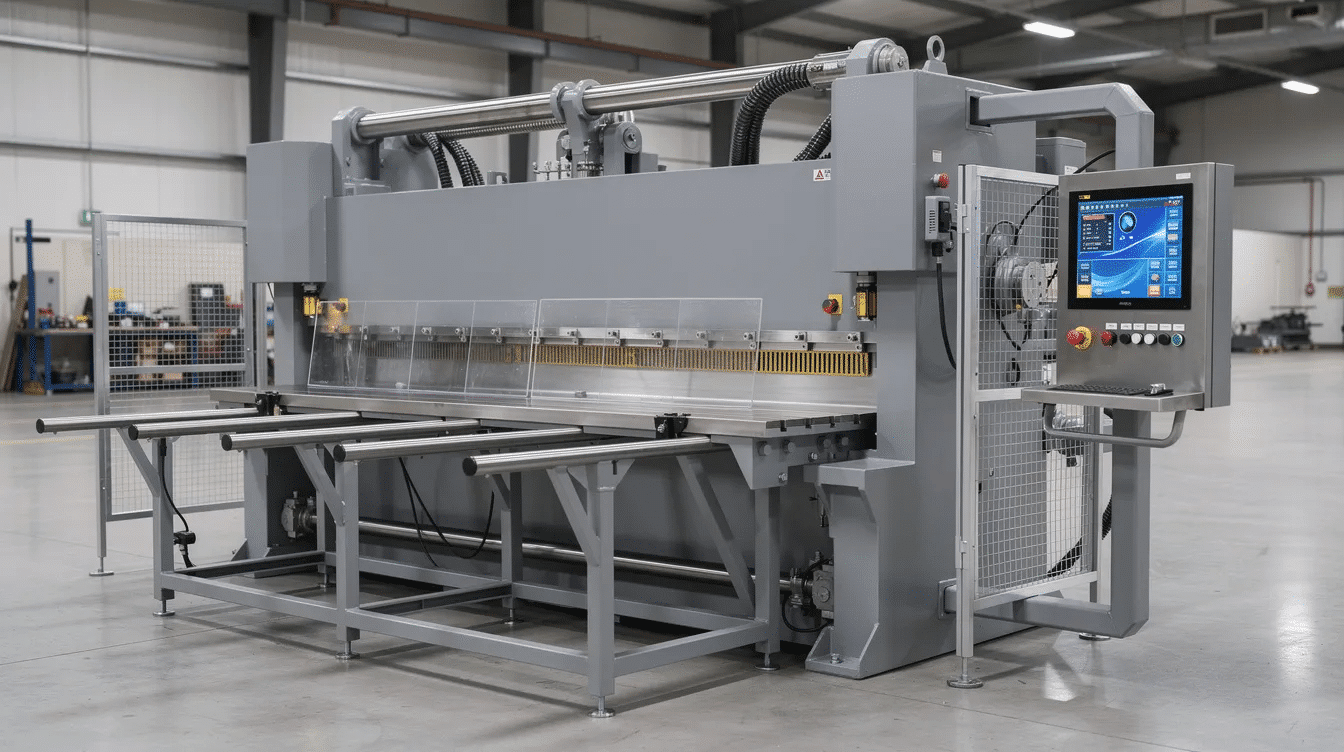
Hydraulic heavy duty guillotine cutters represent the industrial tier of paper cutting equipment, using hydraulic fluid and pumps to generate the high forces needed for clamping and cutting large stacks of heavy or specialty materials. The hydraulic system delivers consistent, powerful pressure across the entire cutting width, ensuring thick stacks are cut cleanly without deflection or creep.
Realistic specification ranges include cutting widths from 26 to 45 inches or more (accommodating B2 and B1 offset formats), stack heights of 3 to 4 inches (representing 600 to 1,000+ sheets of standard paper or significant thicknesses of coated, laminated, or specialty stocks), and heavy frames often exceeding 1,000 kg. These machines require solid floor loading capacity and dedicated electrical and hydraulic utility connections.
Advantages include the ability to cut thick stacks of coated stock or cardboard without deflection, excellent cut accuracy across the full width, and durability under intensive multi-shift use. The hydraulic clamp exerts even pressure across the full material width, preventing the stack from shifting mid-cut—critical for multi-color or pre-printed stock where misalignment ruins the job.
Key safety and convenience features commonly found include two-hand cut buttons, infrared light-beam guards, programmable job memory (often 99+ jobs with multiple steps), air tables that use compressed air to slightly lift stacks for easier positioning, side tables to support large sheets, automated jogging systems, and diagnostic displays. These machines require professional installation, proper electrical and hydraulic service, trained operators, and are typically purchased as long-term capital equipment with professional support contracts.
Specialized and Integrated Cutting Systems
Beyond standalone guillotine cutters, the paper cutting industry includes specialized and integrated systems designed for very specific high-volume workflows. These systems layer multiple capabilities into coordinated equipment that reduces manual handling, improves workflow continuity, and achieves productivity levels that standalone cutters cannot match.
Three-knife trimmers for book production make three simultaneous trim cuts on gathered and collated book blocks (head, foot, and fore-edge) in a single pass, saving time compared to sequential cuts on a standalone cutter. Paper sheeters convert large rolls of paper into cut sheets of standard sizes at very high speed, typically found in paper mills, distribution centers, or large print plants with integrated converting operations.
Integrated cutting lines combine a main guillotine cutter with auxiliary equipment such as pile lift tables, automated joggers, side tables, conveyors, and sometimes numbering, perforation, scoring, or embossing functions. These systems reduce manual handling and operator fatigue while improving consistency—a standalone cutter might require two operators, while an integrated system with automated discharge might require only one.
Purchasing integrated systems is typically a strategic decision made at the plant level. The upfront cost is significantly higher than standalone cutters—systems can easily exceed $30,000 to $50,000 or more depending on automation level. Buyers should consider stepping up from standalone cutters when processing 5,000+ sheets daily of consistent product types, needing multiple finishing operations on the same material, operating multi-shift environments, or facing chronic labor shortages where automation becomes a practical necessity.
Key Specifications and Features to Compare
Specification sheets for cutter paper machines can look overwhelming, but the essential values boil down to a manageable list of decision criteria. Each specification maps directly to real-world impact on daily workflow, machine suitability for particular jobs, and total cost of ownership.
This section highlights the technical criteria buyers should review before shortlisting models and explains how those specs map to real jobs. Keep your largest sheet size, typical stock thickness, and daily cutting volume in mind while reading—later sections will apply these specs to practical purchasing scenarios comparing small copy shops to regional print plants.
Cutting Width and Format Size
Cutting width (also called cutting length) is the maximum distance from the blade to the back gauge, which determines the largest sheet the machine can cut in a single pass. Understanding this distinction is critical because it directly affects which sheet formats a machine can accommodate.
Common widths map to standard printing and packaging formats:
Cutting Width | Accommodates |
|---|---|
~18 inches | SRA3 digital press output |
26-32 inches | B2 offset sheets |
35-45+ inches | B1 and larger packaging layouts |
Choose a width that comfortably exceeds your largest sheet size, allowing for bleed and trim margins. If the largest finished product is 23 inches wide, a 26-inch cutter provides only 3 inches of margin before material edges reach the back gauge clamp—leaving little room for positioning errors or future design changes. A 32-inch cutter would be more prudent.
Avoid undersizing. Running near maximum width constantly slows work, limits new job types, and complicates imposition layouts. Consider future expansion too—if planning to upgrade from A3 to B2 presses within 2 to 3 years, size the cutter for B2 now rather than requiring equipment replacement shortly after purchase.
Cutting Height and Stack Capacity
Cutting height (stack capacity) indicates how many sheets or how thick a pile the cutter can handle in one stroke, typically expressed in inches, millimeters, or as a sheet count based on standard 70-80 gsm paper.
Example ranges across machine classes:
Machine Type | Stack Height | Approximate Sheet Capacity |
|---|---|---|
Small manual units | 1-1.6 inches | Up to 400 sheets |
Mid-range electric | 1.5-2 inches | 300-500 sheets |
Heavy hydraulic | 3-4 inches | 600-1,000+ sheets |
Higher stack capacity directly boosts throughput. A run of 10,000 sheets with a 40-sheet capacity cutter requires 250 separate cutting cycles, while a machine capable of 300 sheets per cut requires only 34 cycles. At 30 seconds per cycle including setup and repositioning, the difference translates to hours of labor time across a work week.
Note that very thick stacks of coated or laminated stock may require derating the nominal height—the actual stack the machine can reliably cut may be less than the specification for specialty materials. Real-world vendor demonstrations can confirm performance on your actual substrates.
Accuracy, Repeatability, and Control Systems
Accuracy refers to how close the actual cut dimension is to the intended target—if programming a cut at 4.000 inches, does the machine deliver exactly 4.000 or 3.998 or 4.005? Repeatability refers to consistency over many cuts and over time—does the machine still cut at 4.000 inches on Friday afternoon after hundreds of cycles?
Both are critical for commercial print and packaging where finished products must fit into folding machines, binding equipment, or packaging lines downstream. Programmable back gauges, leadscrews, and servo or stepper drives contribute to positioning accuracy, often down to 0.1 mm increments on higher-end machines.
Control panel types range from simple numeric keypads with basic digital readouts to full-color touchscreens that display job programs, cutting sequences, and graphic layouts showing how large sheets will be divided. Shops doing multi-step cutting (such as finished brochures from large sheets) benefit greatly from stored programs that automatically position the back gauge for each cut in sequence without operator intervention.
Check for features like fine adjustment knobs, calibration options, and readout units (mm/inches) that match your workflow preferences.
Safety Systems and Compliance
Modern cutter paper machines must comply with regional safety standards to protect operators. In Europe, CE marking and machinery directives are required. In North America, UL or CSA certification is expected. These standards mandate specific safety features, documentation, and operational safeguards.
Typical safety features include two-hand cut controls requiring simultaneous button presses, front and rear safety shields preventing access to moving parts, infrared light curtains that stop the blade when interrupted, emergency stop buttons accessible from multiple positions, and key locks preventing unauthorized operation. Some entry-level machines rely only on mechanical guards, while industrial units integrate multiple redundant systems and self-diagnostics that verify safety circuit integrity on startup.
Factor in insurance and regulatory requirements, especially for schools, government agencies, and large corporations with strict safety policies. Include operator training and clear SOPs as part of any new installation rather than relying solely on built-in protections—accidents often result from operator error or deliberate circumvention of safety features, not equipment failure.
How to Choose the Right Cutter Paper Machine for Your Workload
The ideal cutter paper machine depends on volume, format, materials, operator skill, and available budget. No single specification determines the best choice—instead, weigh these factors and find the optimal fit for your specific situation.
This section turns earlier technical specs into practical selection steps using concrete scenarios and decision points. Before contacting sales representatives or requesting quotes, gather key data about your work: largest sheet size, typical run lengths, number of jobs per day, and material types. Balance current needs with realistic growth over the next 3 to 5 years to avoid under- or over-investing in equipment that quickly becomes inadequate or sits underutilized.
Assessing Your Volume and Application
Start by estimating daily and monthly cutting volume in sheets and jobs, distinguishing between sporadic tasks and continuous production. Track jobs over a representative week, noting each cut job, format, and stack size to create a data-driven requirement list.
Concrete scenarios map to machine classes:
Scenario | Volume | Recommended Machine Class |
|---|---|---|
Small office or school | Few hundred sheets per week | Manual/lever guillotine |
Copy center or in-plant print room | 1,000-2,000 sheets per day | Electric programmable |
Digital quick-print shop | 5,000-10,000 sheets per day | Mid-range electric programmable |
Regional commercial printer | 15,000-25,000+ sheets per day | Industrial hydraulic |
For small businesses with sporadic cutting needs, manual paper cutters provide adequate capability at minimal investment. Organizations experiencing higher volumes benefit from automatic features that reduce operator fatigue and improve throughput.
Realistic volume estimates are essential for determining ROI and justifying investment to management or stakeholders. A machine generating $25,000 in annual net benefit would pay for itself in one year at $25,000 cost, in two years at $50,000 cost.
Material Types and Future Requirements
List all materials you cut or plan to cut: standard uncoated paper, heavy coated stock, cardstock, cardboard, synthetic substrates, laminated sheets, and other specialty items. Material type significantly influences machine selection.
Denser or tougher materials demand more clamping force and cutting power, pushing choices toward electric or hydraulic machines rather than manual options. A shop cutting primarily 70-80 gsm uncoated paper can use a mid-range electric cutter, while shops cutting heavy coated stock or cardboard should step up to hydraulic machines designed for those materials.
Consider future expansion into packaging, wide-format trimming, or on-demand book production, which may require different capacities or accessories. Some specialized materials like plastic films or certain synthetics may need specific blade types or alternative cutting technologies entirely—discuss options with vendors before committing.
Bring sample materials to demonstrations or trials to confirm real cutting performance and quality on your actual substrates. A machine that looks perfect on a spec sheet may not perform as expected on your specific stock at your expected volume.
Budget, Total Cost of Ownership, and Support
Purchase price is only part of the cost. Ongoing expenses include blades, sharpening services, spare parts, consumables like cutting sticks, hydraulic oil for hydraulic machines, and potential downtime for maintenance or repairs.
Rough price brackets provide planning guidance:
Machine Type | Approximate Price Range |
|---|---|
Compact manual guillotine | $200-$500 |
Entry-level electric programmable | $2,000-$5,000 |
Mid-range electric with wider format | $5,000-$15,000 |
Industrial hydraulic | $15,000-$25,000+ |
Local or regional service support matters significantly for installation, calibration, preventive maintenance, and emergency repairs. A lower-priced machine from a vendor with no local presence may become expensive if problems develop and equipment must be shipped to distant service centers.
Ask potential vendors about parts availability timelines, warranty terms, optional service contracts, response time for emergency calls, and expected machine lifespan under typical use. Calculate payback by comparing improved throughput and labor savings against lease or finance payments—most buyers target payback within 3 to 5 years.
Examples of Cutter Paper Machines and Typical Use Cases
The following examples ground earlier concepts with real-world style scenarios of machine classes and typical applications. These are representative profiles rather than endorsements of specific brands, using realistic dimensions and capabilities similar to widely sold equipment.
Compact Office and School Cutters
A typical compact manual guillotine cutter features around 12 inches of cutting length and 15 to 25 sheet capacity, suitable for A4 office documents, handouts, and photo trimming. These machines weigh 10 to 30 kg and fit on a standard desk or utility table.
School staff, small offices, and home-based businesses use these cutters for occasional tasks like trimming reports, certificates, craft projects, and classroom materials. Benefits include low upfront cost (often under $300), minimal space requirements, easy storage, and simple operation requiring minimal training.
While ideal for infrequent use, these machines are not designed for continuous day-long cutting or large marketing runs. Organizations expecting to grow their print volume should view this category as an entry point rather than a long-term production solution—outgrowing the equipment typically happens within 1 to 2 years of increased activity.
Mid-Range Digital Print Shop Cutters
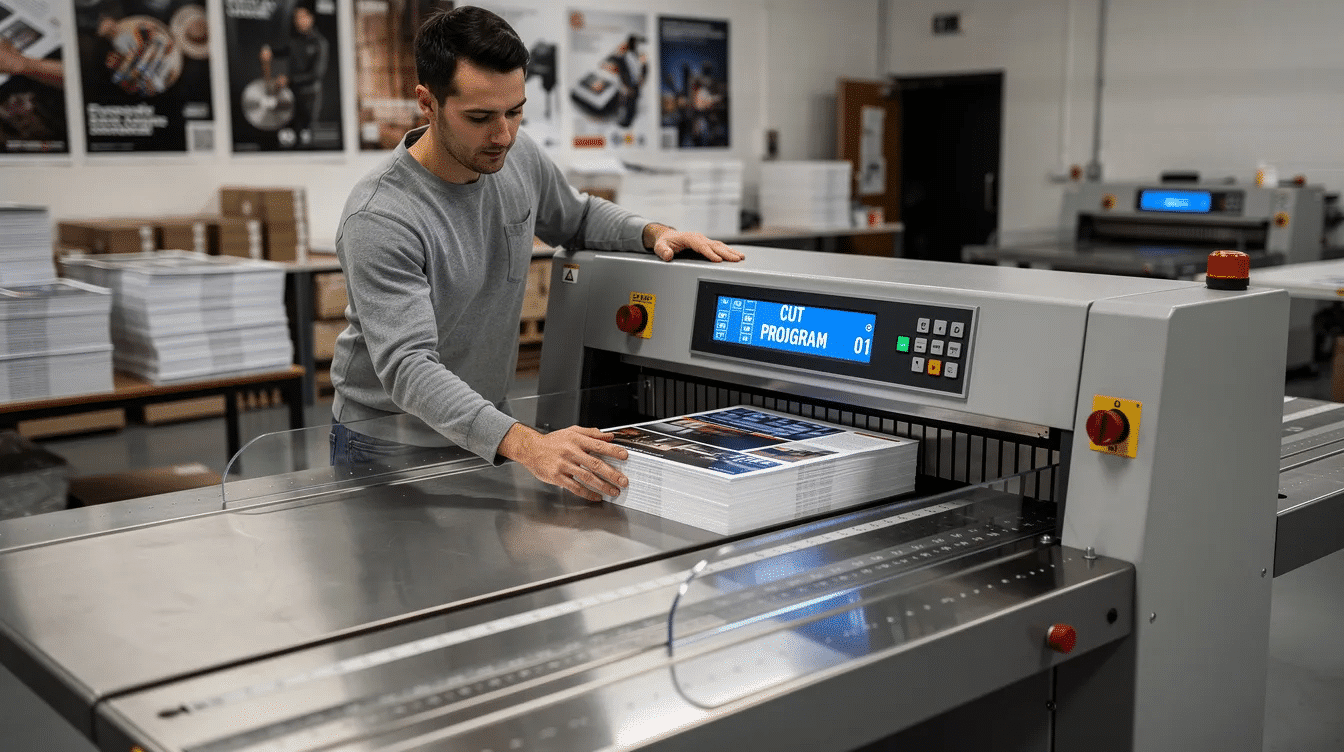
A mid-range electric programmable cutter typically offers 17.7 to 18.9 inch cutting width and 1.5 to 2 inch stack height, commonly paired with digital presses producing SRA3 and similar formats. These machines balance capability and cost for facilities handling thousands of sheets daily.
Use cases include cutting business cards, brochures, postcards, and short-run book blocks where job programs and repeatability save setup time. A regular client printing business cards monthly can have dimensions programmed once and recalled every order—saving minutes per job that accumulate to hours weekly.
Features that matter in this setting include programmable memory for recurring clients, safety light beams, LED cutting line indicators, and moderate floor space requirements. Copy shops, quick printers, and in-plant print rooms inside universities or corporations handling daily but not industrial-scale volume find these machines practical. Focus selection on ease of use, reliable service support, and intuitive controls to accommodate multiple operators across shifts.
Large Industrial Guillotine Cutters for Commercial Print
Heavy-duty hydraulic cutters with 26 to 45 inch cutting width and up to 4 inch stack capacity serve commercial offset print and packaging production lines. These machines often run multi-shift operations, trimming large parent sheets into final formats for books, magazines, folding cartons, or labels.
Advanced options common at this level include air-assisted tables for easier stock handling, side tables supporting oversize sheets, automated joggers, pile lift tables, programmable cutting sequences, and integration into automated handling systems with conveyors and robotic loading.
Professional installation, comprehensive operator training, and strict adherence to safety protocols are essential in these environments due to machine power and speed. Operations managers should consider plant layout, material flow, and potential future automation when selecting this class of machine—adding joggers, lifts, or conveyor integration later is often possible with proper planning.
Installation, Operation, and Maintenance Best Practices
Buying the right cutter paper machine is only part of success. Proper installation, operator training, and ongoing maintenance are critical for safety, cut quality, and equipment longevity. Consistent procedures reduce downtime, improve results, and ensure compliance with internal safety policies and external regulations.
This section offers high-level guidance on preparing sites, training staff, and setting up maintenance schedules. Vendor support or qualified technicians should handle commissioning, calibration, and complex troubleshooting.
Site Preparation and Installation
Check floor loading capacity and available space before delivery, especially for large hydraulic units weighing over 1,000 kg that require reinforced concrete or specialized platforms. Ensure clearance around the machine for safe operation and material handling.
Verify utilities match requirements: correct electrical supply (voltage, phase, amperage), potential compressed air connections for air tables, and environmental considerations like dust control, temperature, and humidity. Extreme conditions can affect hydraulic fluid viscosity and machine performance.
Plan material flow logistics—where pallets or carts will stage before and after cutting, how operators will safely move heavy stacks to reduce strain and injury risk. Schedule installation during low-production periods and have key staff present to observe, ask questions, and learn basic adjustments from the technician.
Document machine settings, network connections if applicable, power shut-off locations, and emergency procedures as part of the installation process.
Operator Training and Safe Use
Formal training sessions for all operators, including new hires, should cover both basic operation and safety procedures. Key training topics include understanding guards and light curtains, correct hand placement, using two-hand controls, setting back gauge positions, and performing test cuts on scrap material.
Develop written SOPs and place clear signage near the machine summarizing start-up, shutdown, and emergency steps. Create a culture where operators report unusual noises, resistance, or cut quality issues immediately so problems can be addressed before causing damage or injury.
Refresher training should occur at regular intervals—annually or after incidents—and whenever new features or accessories are added. Operators who disable safety features, bypass controls, or work while fatigued create risks that built-in protections cannot fully prevent.
Routine Maintenance, Blades, and Consumables
Sharp blades are critical for clean cuts, reduced clamp pressure requirements, and operator safety. Dull blades require more force, can cause material to tear rather than cut cleanly, and strain machine components. Establish regular sharpening or replacement schedules based on usage intensity—annual sharpening might suffice for light office use while monthly service may be needed for industrial operations running 16+ hours daily.
Typical consumables include blades, cutting sticks (which wear as the blade passes through them thousands of times), hydraulic oil for hydraulic machines, lubrication for pivot points, and occasional electronic components. Keep at least one spare blade on hand to avoid downtime during sharpening cycles.
Create a maintenance log documenting inspections, blade changes, lubrication, and service visits. Patterns emerge over time that help plan preventive work and identify recurring issues. Work with equipment suppliers to establish maintenance plans aligned with usage intensity, possibly including annual professional inspections to verify safety systems and catch wear before it causes problems.
Frequently Asked Questions About Cutter Paper Machines
This section addresses common questions businesses have before investing in cutter paper machines. Answers are practical and focused on typical commercial and industrial use cases rather than hobby applications.
Common Buyer Questions
Should a small to mid-sized digital print shop choose an electric programmable cutter or hydraulic? For typical digital print shops cutting 2,000 to 5,000 sheets daily of paper and light cardstock, an electric programmable cutter is usually sufficient and more cost-effective. Mid-range electric models offer adequate throughput, programmable job memory, and appropriate safety features. Hydraulic cutters become necessary when adding significantly heavier materials like thick cardstock, laminated sheets, or corrugated cardboard, or when experiencing chronic bottlenecks with electric models.
How do I interpret cutting width and cutting height on spec sheets? Cutting width is the maximum distance from blade to back gauge—determining the largest sheet dimension the machine handles. Match this to your largest planned sheet size plus margin. Cutting height indicates stack thickness per stroke. A 2-inch capacity cutting 200 sheets per cycle means 3,000 sheets requires 15 cycles. Multiply cycles by average cycle time (typically 20-40 seconds) to estimate total cutting time per job.
How many operators are typically needed to run a cutter? Most standalone electric or hydraulic cutters are operated by a single trained person who loads material, positions or recalls programs, initiates cuts, and removes finished stacks. At very high volumes exceeding 20,000 sheets daily, a second person may assist with loading or unloading. Highly automated systems with integrated handling may require only one person overseeing equipment that largely runs itself.
What safety features must a modern cutter have for compliance? Minimum expectations typically include mechanical guards preventing blade access, two-hand controls or interlocks preventing accidental activation, emergency stop buttons, and clear hazard labeling. Higher-risk settings like schools and government facilities often require additional features such as infrared light curtains and key locks. Older legacy machines can sometimes be retrofitted with guards or light curtains—consult equipment specialists for options.
What information should I provide when requesting a quote? Prepare maximum sheet width and length, estimated daily or weekly cutting volume in sheets, material types to be cut including weights and special characteristics, space constraints, and any integration needs with joggers, lifts, or conveyors. If specific job types repeat regularly, mention those so vendors can suggest appropriate models with suitable programmable features.
Next Steps: Selecting and Implementing Your Cutter Paper Machine
Selecting the right cutter paper machine requires matching machine types and specifications to real workloads. Key decisions involve choosing between manual, electric programmable, and hydraulic systems based on volume and materials, understanding how cutting width and stack height affect throughput, ensuring safety compliance, and calculating total cost of ownership including ongoing maintenance and support.
Document your requirements clearly before shopping. Track actual cutting jobs over a representative week, note maximum sheet sizes and typical run lengths, and list all material types you process or plan to add. Compare 2 to 3 shortlisted machine classes before requesting detailed quotes or demonstrations.
Arrange live demos when possible to see cutters handling real jobs using the same stock and formats you use daily. Machines that look perfect on spec sheets may perform differently on your actual materials. Planning for long-term success means including installation, training, and maintenance arrangements in the purchasing process rather than treating them as afterthoughts.
Consult with knowledgeable equipment specialists who can provide tailored recommendations based on your specific situation. Bring your gathered data on sheet sizes, daily volume, materials, and workflow goals to those conversations. The right cutter paper machine matched to your actual needs will deliver years of reliable service, improved productivity, and strong return on investment.