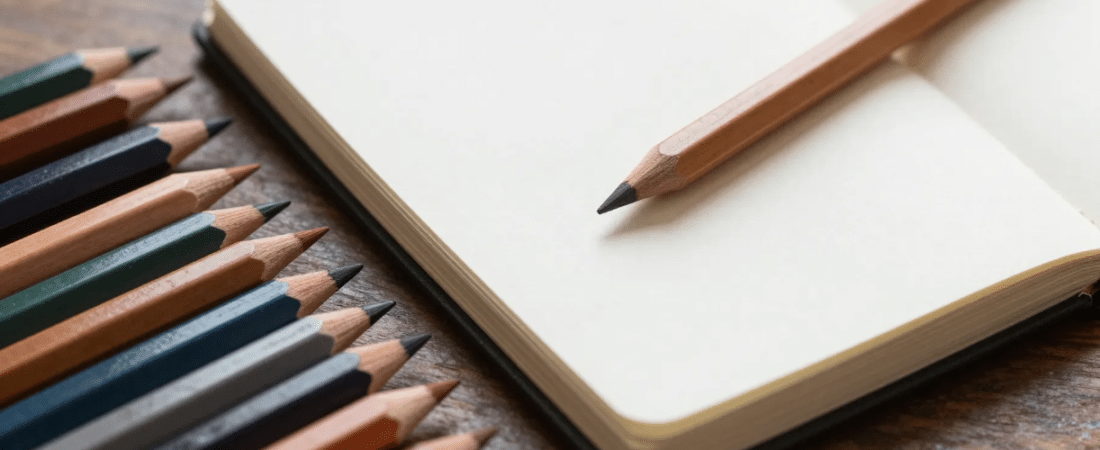
Finding the right pencils for your sketchbook can transform your daily drawing practice from frustrating to fluid. Whether you’re capturing quick gestures at a coffee shop or developing detailed studies at home, the pencils you choose directly affect how your marks feel on the page—and how much you enjoy the process.
This guide is for artists, students, and hobbyists looking to improve their sketchbook experience. The right pencil can make sketching more enjoyable and help you achieve better results.
Quick Answer: The Best Sketchbook Pencils in 2026#
If you’re short on time and want to know immediately which pencils belong in your sketchbook kit, here are the top picks based on hands-on use across urban sketching, life drawing, and daily studies.
Direct Answer:
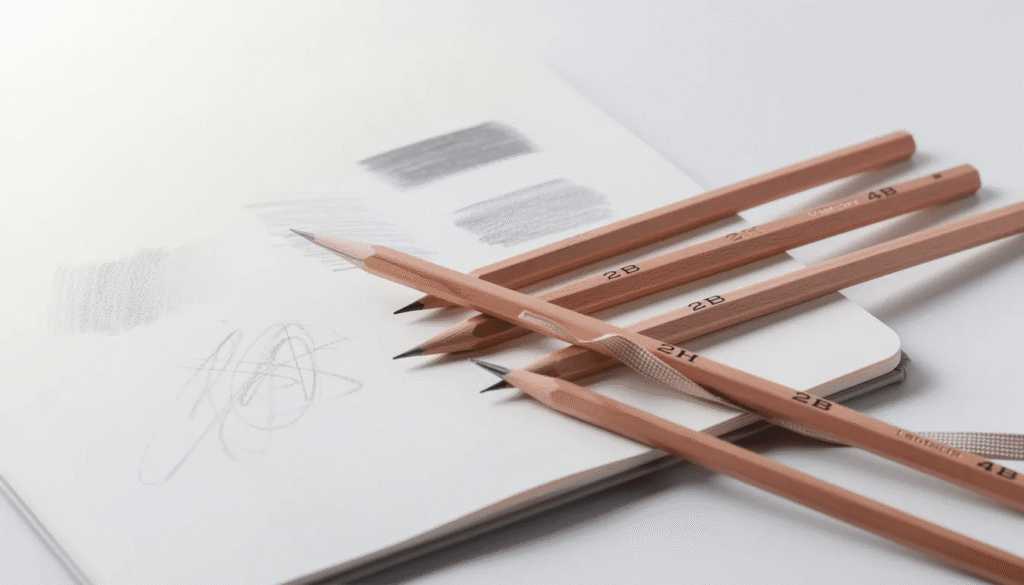
The best pencils for sketchbook work are generally softer graphite pencils—specifically 2B, 4B, and 6B—for rich, dark, and blendable lines. 2B and 4B pencils are generally considered the best all-purpose sketching pencils, balancing dark lines with fine details. A good range of pencils for beginners includes 2H, HB, 2B, and 6B grades to explore various techniques. Many artists buy a set that includes a range of grades to provide versatility in their work.
Top Picks at a Glance:
- Staedtler Mars Lumograph – The widest grade range available (10H–12B), exceptionally smooth cores, and reliable consistency make this the best all-around choice for most sketchbook artists.
- Faber-Castell 9000 – A dependable workhorse with strong SV-bonded cores that survive travel, offering predictable performance from thumbnails to finished spreads.
- Mitsubishi Hi-Uni – Premium Japanese graphite with a creamy, grit-free feel that turns everyday sketching into a tactile pleasure.
- Tombow Mono 100 – Dark, clean lines even in mid-grade pencils, with excellent glide that speeds up hatching and field work.
- Caran d’Ache Grafwood – Swiss precision with rich darks and a slightly waxy feel, ideal for portrait studies and dramatic chiaroscuro effects.
- Pentel P205 (0.5mm mechanical) – A reliable mechanical pencil for construction lines, notes, and precise details without needing a sharpener.
- Koh-I-Noor Hardtmuth Toison d’Or – Exceptional value at roughly half the price of premium brands, with professional-quality performance that punches above its weight.
These recommendations come from practical sketchbook use rather than laboratory tests. The best sketch pencils are the ones that feel right in your hand and keep you drawing consistently.
- What Makes a Great Sketchbook Pencil?
- Understanding Graphite Grades for Sketchbooks
- Best Traditional Graphite Pencils for Sketchbooks
- Mechanical Pencils vs. Wooden Pencils in Sketchbooks
- The Best Pencil Sets for Different Sketchbook Artists
- Managing Smudge, Shine, and Longevity in Sketchbooks
- How to Build Your Own Ideal Sketchbook Pencil Set
What Makes a Great Sketchbook Pencil?
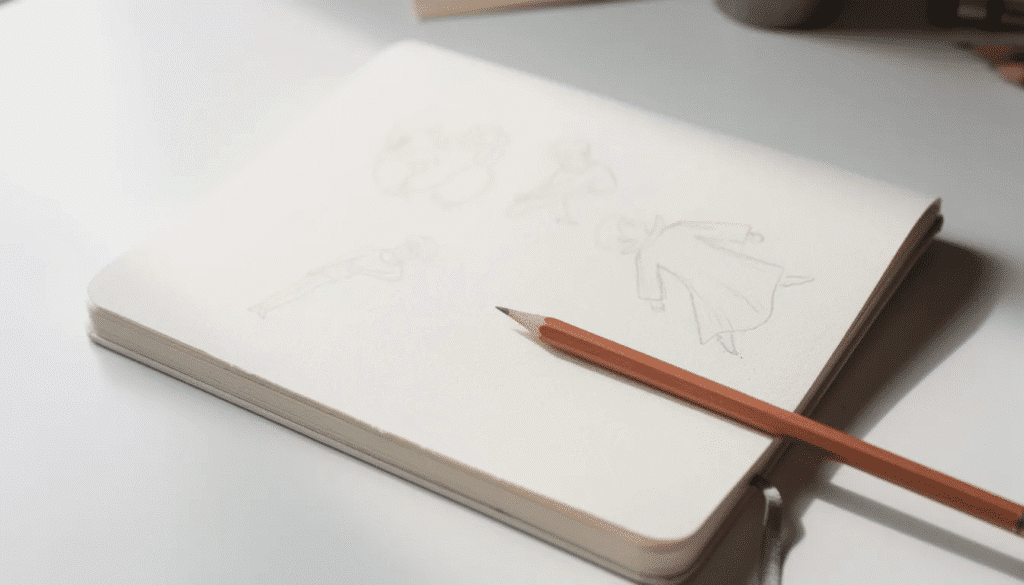
A sketchbook pencil isn’t just any pencil—it’s a tool optimized for everyday drawings, thumbnails, and studies that often happen on the go. The demands are different from studio work on large sheets, and understanding these differences helps you choose wisely.
- Graphite quality matters more than you think. Smooth, non-gritty cores allow you to sketch quickly without fighting the paper. Scratchy pencils slow you down and discourage the loose, exploratory mark-making that sketchbooks are made for.
- A good range of grades opens creative possibilities. Having at least 2H through 6B in your kit lets you build value even in casual sketches. You can start with light construction lines and push into dark shadows without switching brands.
- Durability saves frustration and money. Pencils that break constantly in your pencil case or crumble under pressure waste time and graphite. Look for pencil brands with strong bonded leads—Staedtler and Faber-Castell are particularly known for reliable core adhesion that prevents breakage.
- Point retention affects your workflow. If you’re sketching outside the studio, you don’t want to stop every few minutes to sharpen. Pencils with dense, well-milled graphite hold points longer. Mechanical pencil options eliminate sharpening entirely for certain tasks.
- Smudging and graphite shine need consideration. Sketchbooks close on themselves constantly. Soft pencils with excessive smudge can ruin facing pages. Similarly, heavy graphite shine from overworked areas can look distracting in photographs of your work.
- Comfort and barrel design affect long sessions. Hexagonal barrels prevent rolling and offer grip, while round barrels feel more natural to some artists. Lacquer texture varies between brands—some prefer a smooth, almost slippery finish, others like a bit of bite.
Essential Features of Sketching Pencils
When choosing sketching pencils, there are several key features to consider:
- Point Retention: Good sketching pencils hold a sharp point for longer, reducing the need for frequent sharpening and allowing for precise lines.
- Smooth Texture: A smooth, consistent graphite core ensures your marks glide easily across the paper without scratchiness or grit.
- Erasability: High-quality pencils erase cleanly, making it easier to correct mistakes or lighten construction lines.
- Lead Hardness: The hardness of the lead affects both the darkness of your marks and how well the pencil holds a point.
- Artist-Grade vs. Student-Grade: Artist-grade pencils offer better and more consistent graphite compared to student-grade pencils, which can be brittle or scratchy.
Essential features of sketching pencils include good point retention, smooth texture, and ease of erasability. When choosing sketching pencils, key features to look for are lead hardness, point retention, erasability, and smooth consistency. Artist-grade pencils offer better and more consistent graphite compared to student-grade pencils, which can be brittle or scratchy.
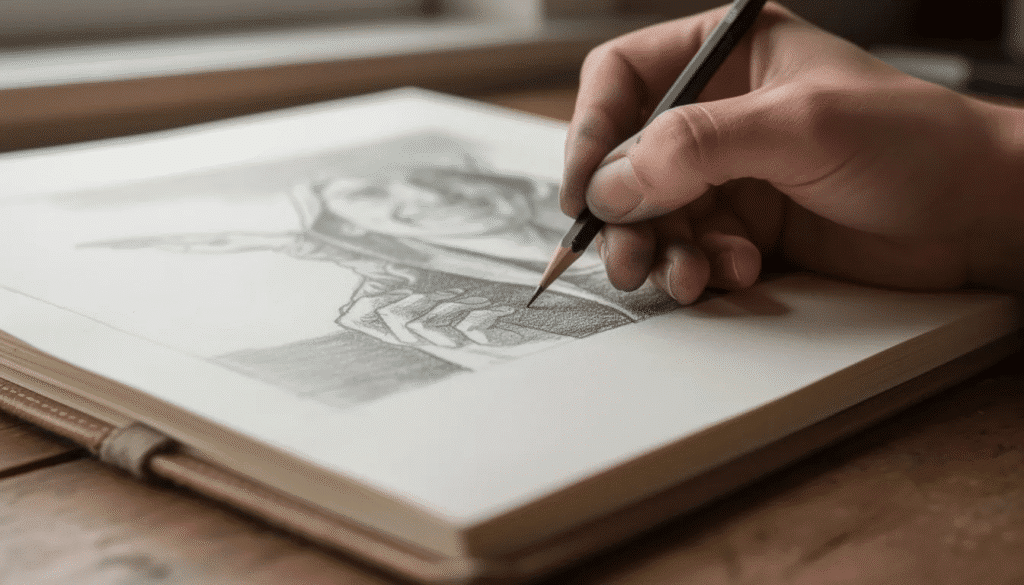
Understanding Graphite Grades for Sketchbooks
Many sketchbook frustrations stem from using the wrong graphite grade rather than the wrong brand. Understanding the grade scale helps you select pencils that match your intentions.
Pencil Grading System Explained:
The ‘HB’ grade is in the middle, the soft pencils are labelled ‘B’ for ‘black’ (B, 2B, 3B and so on), and the harder pencils begin with an ‘H’ for ‘hard’ (H, 2H, 3H etc). Pencils are graded on a scale that runs from the hardest grades, which have a lot of clay in them and make a very light mark, to the softest grades, which have the least clay and mark very darkly. Harder pencils produce lighter lines, while softer pencils create darker, bolder marks. The greater the number in the grading system, the lighter or darker the pencil is.
- The basic scale runs from approximately 10H to 10B, with HB as the midpoint. H grades contain more clay and create lighter, harder marks. B grades have higher graphite content for darker, softer lines. There’s no strict industry standard between manufacturers, so grades can feel different across brands.
- H and F grades (2H, H, F) excel at light construction lines and underdrawings. Use these for architectural sketches, perspective grids, and any marks you want to remain subtle or erase cleanly later. The hardest grades like 4H and above are rarely needed for typical sketchbook work.
- Mid-range grades (HB, B, 2B) handle most core sketching work. Gesture drawings, written notes alongside sketches, and general shading all benefit from this comfortable middle ground. Most artists spend the majority of their time with an HB 2B combination.
- Softer grades (4B–8B) deliver bold shadows and expressive lines. When you need to fill dark areas quickly or create dramatic contrast in a sketchbook spread, these softer grades lay down graphite efficiently. Very soft grades above 8B can be harder to control and smudge significantly.
- Brand-to-brand variation is real and sometimes dramatic. A Staedtler HB might feel as light as another brand’s F. Tombow Mono B grades often feel closer to other manufacturers’ 2B. Testing pencils yourself is the only way to know how they’ll perform for your style.
- A minimal sketchbook set of 3–4 grades covers most needs. Consider carrying 2H for construction, HB for general work, 2B for shading, and 6B for dark values. This combination handles everything from quick thumbnails to more developed studies without overloading your kit.
Best Traditional Graphite Pencils for Sketchbooks
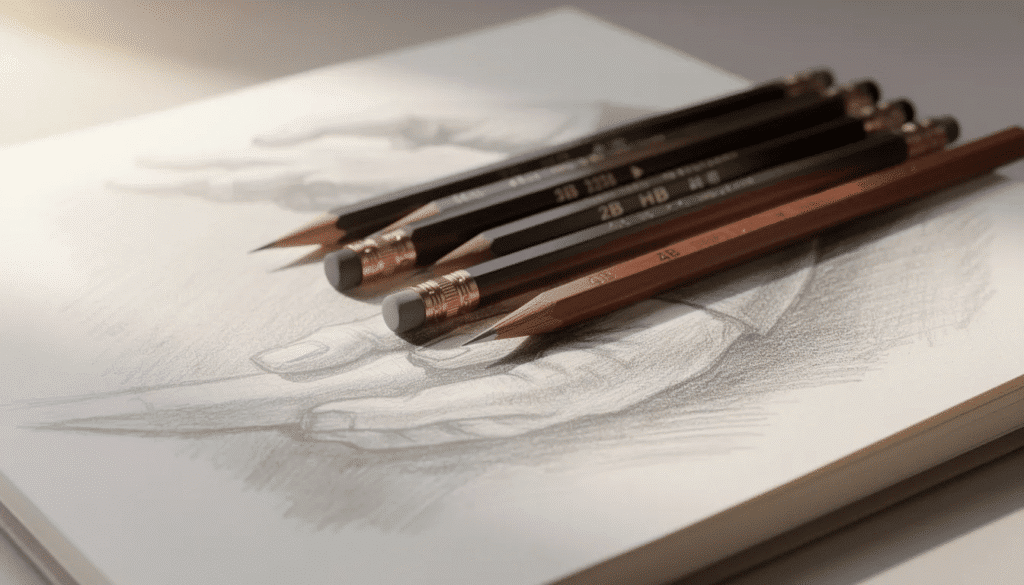
Classic wooden pencils remain the most versatile choice for most sketchbooks. They offer a full range of grades, organic line variation, and the satisfying feel that many artists prefer over mechanical alternatives.
Direct Answer:
2B and 4B pencils are generally considered the best all-purpose sketching pencils, balancing dark lines with fine details. The best pencils for sketchbook work are generally softer graphite pencils—specifically 2B, 4B, and 6B—for rich, dark, and blendable lines. A good range of pencils for beginners includes 2H, HB, 2B, and 6B grades to explore various techniques. Many artists buy a set that includes a range of grades to provide versatility in their work.
The pencils highlighted below are all artist-grade options—not school supplies or discount sets. Prices and availability reference US/UK markets around 2024–2026.
Staedtler Mars Lumograph (and Lumograph Black)
The Staedtler Mars Lumograph pencils represent a classic German range spanning 10H to 12B, used by graphite artists worldwide for decades.
- Feel: Very smooth, non-gritty cores—especially in H and HB grades—make these ideal for clean lines and technical sketchbook work. The consistency across the entire range is remarkable.
- Tonal range: The availability of grades up to 12B allows very dark accents without needing charcoal pencils. This wide tonal range in a single brand simplifies kit management.
- Point retention: Harder leads hold sharp points through long contour drawing sessions. You can sketch multiple pages before needing to sharpen.
- Smudging: Less prone to smudge than ultra-soft, waxier brands, though care is still needed when closing sketchbooks on fresh drawings.
- Mars Lumograph Black: A carbon-rich companion range with a more matte, charcoal-like black. These are excellent for reducing graphite shine in finished sketchbook pages where you want deep, non-reflective darks.
Urban sketchers and illustrators who value precision and want one brand covering their entire grade range will find Staedtler Mars Lumograph an excellent foundation.
Faber-Castell 9000
The Faber-Castell 9000 series (approximately 6H–8B) has been a studio staple since the early 20th century, and its reputation for reliability endures.
- Smoothness and reliability: Consistent grading and smooth laydown make this range predictable for daily sketching and visual note-taking. You know exactly what to expect each time you pick one up.
- Tonal character: The Faber Castell 9000 leans slightly lighter compared to some Japanese brands, which can be helpful when building values gradually in sketchbooks. You have more control before things get too dark.
- Build quality: Strong SV-bonded cores resist breaking in pencil rolls and sketch pouches. The wood casing sharpens cleanly without splintering.
- Sharpening: Good compatibility with long-point sharpeners makes maintaining a fine tip easy. A quality sharpener paired with these pencils yields excellent results.
The Faber Castell range works as an all-rounder for artists who want one reliable set for everything from thumbnails to finished sketchbook spreads. It’s a great pencil for artists at any skill level.
Mitsubishi Hi-Uni
Mitsubishi Hi-Uni represents a premium Japanese graphite range (10H–10B) often rated among the best graphite pencils for pure drawing feel.
- Core quality: Extremely smooth, creamy graphite with virtually no grit makes these excellent for flowing gesture work and subtle shading. The texture feels almost buttery.
- Dark values: B grades produce deep, rich blacks with less metallic sheen than many competitors. This makes Hi-Uni useful when turning sketchbook studies into frame-worthy pieces.
- Casing and ergonomics: Glossy maroon lacquer with crisp gold stamping gives these pencils a luxurious feel. Cores are cleanly centered in the wood.
- Price and availability: More expensive than European alternatives and sometimes harder to find in brick-and-mortar stores outside Japan. This makes them more of a deliberate upgrade than a casual purchase.
Artists who sketch heavily and want a luxury graphite experience for daily drawing will find Mitsubishi Hi-Uni worth the investment.
Tombow Mono 100
Tombow Mono 100 is another high-end Japanese range (9H–6B), originally designed for technical drawing and illustration.
- Line quality: Very dark, clean lines even in mid-grade pencils allow strong contrast in sketchbooks without jumping to very soft B grades. The darkness is impressive for the relative hardness.
- Glide: Cores glide over paper in a way that speeds up hatching and cross-hatching for field sketches. This smoothness is part of what makes Tombow Mono stand out.
- Point strength: Holds a point well despite delivering dark marks. This is particularly useful for small sketchbook formats like A5 or pocket journals where detail matters.
- Sharpening: Dense cores benefit from high-quality or electric sharpeners to avoid chipping. Cheap sharpeners can struggle with these.
Comic artists, designers, and illustrators who want crisp, dark marks and fast coverage in their sketchbooks will appreciate Tombow’s characteristics.
Caran d’Ache Grafwood
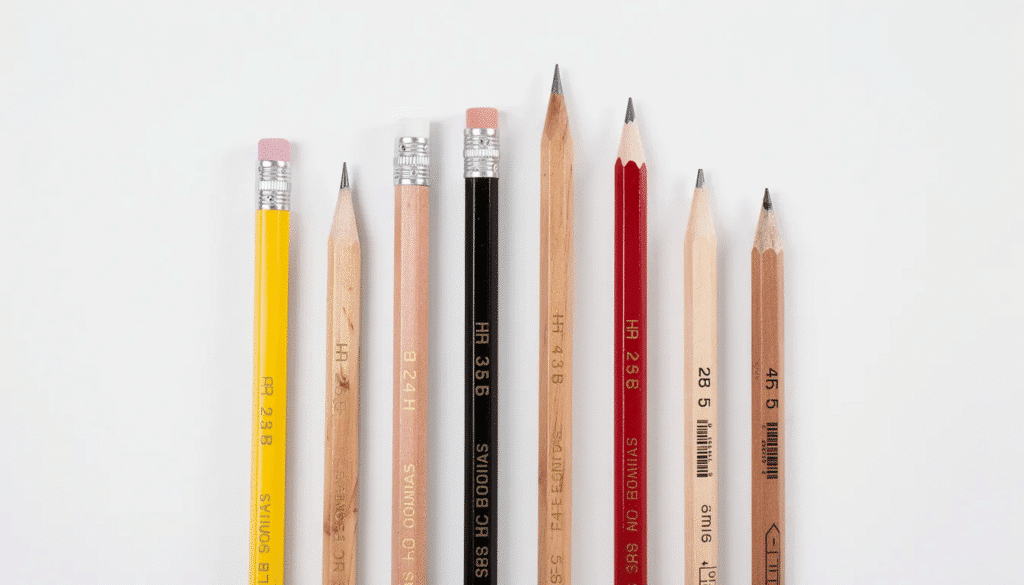
Caran d’Ache Grafwood is a Swiss premium range (typically 4H–9B) with distinctive barrel colors matching graphite grades for easy identification.
- Feel: Slightly waxy, substantial graphite that can feel polarizing. Some sketchers love the smooth, almost creamy quality; others prefer drier, more “bitey” leads.
- Darkness: Softer grades (4B–9B) get very dark quickly, allowing dramatic chiaroscuro effects in sketchbook spreads. The dark shadows you can achieve rival charcoal.
- Pencil size and comfort: A slightly thicker barrel provides comfortable grip for longer sessions or work in larger sketchbooks.
- Cost: One of the more expensive options per pencil. Better suited for artists who already know they like its feel rather than those experimenting.
Portrait studies, figure drawing, and any sketchbook work where rich darks and smooth shading take priority will benefit from Grafwood’s characteristics.
Derwent Graphic
Derwent Graphic pencils are a well-known UK range (9H–9B) widely stocked and familiar to many art students.
- Feel: Some users report grittiness in harder grades and slightly inconsistent texture between individual pencils in the same box.
- Strengths: Dark B grades blend well and work for expressive, loose sketching and tonal blocking. The Derwent Graphic pencils remain a solid choice for bold work.
- Weaknesses: More graphite dust and more frequent sharpening in softer grades can create mess in portable sketchbooks.
Derwent works as a practical, mid-priced choice for beginners and intermediate artists, especially when it’s the most locally available brand. Other pencils may outperform it in smoothness, but availability matters.
Mechanical Pencils vs. Wooden Pencils in Sketchbooks
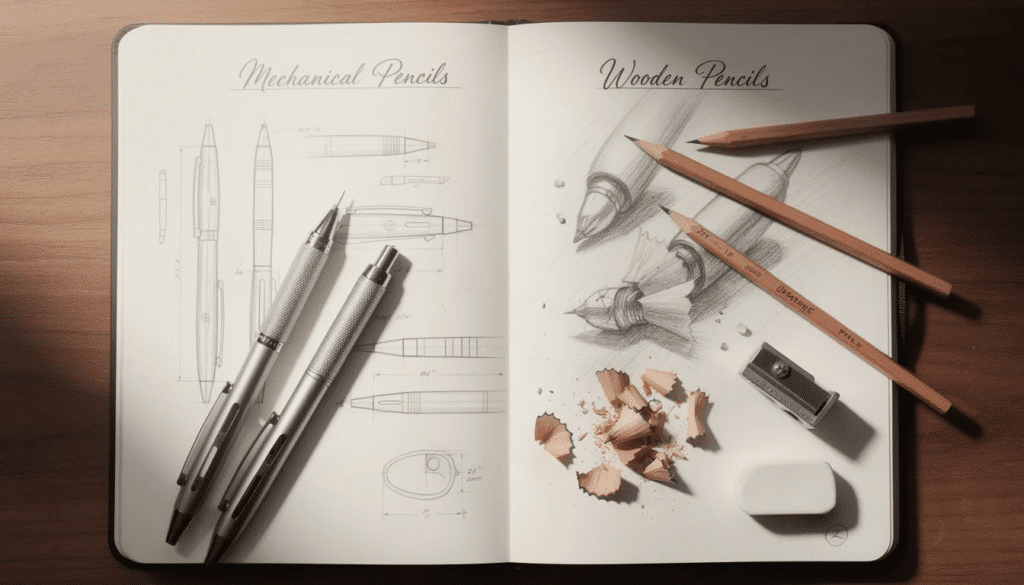
The debate between mechanical pencil users and traditional wooden pencils advocates often comes down to personal preference and sketching context. Both have legitimate places in a sketchbook kit.
- Mechanical pencil advantages: Constant line width without variation, no need to carry a sharpener, extremely portable, excellent for writing notes alongside sketches. A 0.5mm mechanical pencil can handle fine details indefinitely.
- Mechanical pencil limitations: Most leads are only available in a few grades—typically HB, B, and 2B. This can feel too light or too uniform for expressive shading and building a wide tonal range.
- Wooden pencil advantages: Much broader grade range, more organic line variation through pressure changes, easier to fill large dark shapes quickly. The feel of wood in hand appeals to many artists.
- Hybrid setups often work best: Use a 0.3 or 0.5mm mechanical pencil for construction lines, perspective guides, and text notes. Carry 2–3 wood-cased pencils (HB, 2B, 6B) for building values and creating different effects.
- Recommended mechanical options: The Pentel P205 or Staedtler Mars 780 with HB or B leads handles everyday sketchbook line work reliably. Lead holders with 2mm leads offer a middle ground with sharpenable points and available grades from 4B to 4H.
Neither type is universally better. Your drawing technique and sketching context should guide the choice.
The Best Pencil Sets for Different Sketchbook Artists
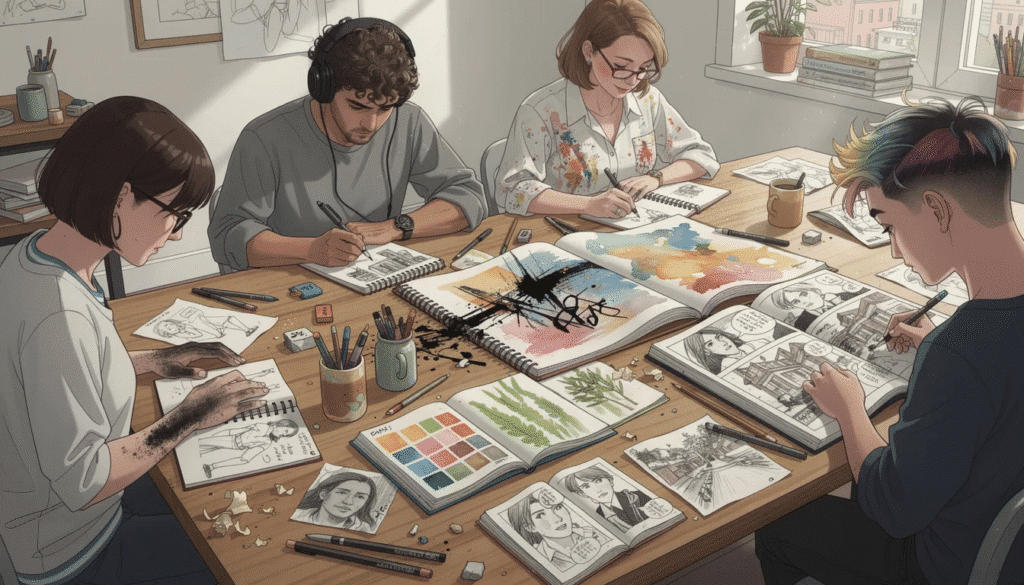
The “best” pencils vary depending on how and where you sketch. A home studio setup differs from what you’d carry in a messenger bag for urban sketching. Here are specific recommendations for typical scenarios.
Beginner Sketchers: Simple, Forgiving Sets
Starting with too many grades creates confusion. A focused kit builds fundamentals faster.
- Recommended grades: 2H, HB, 2B, 6B (just four pencils)
- Suggested brands: Faber-Castell 9000 or Staedtler Mars Lumograph offer reliable performance without premium prices. Koh-I-Noor Hardtmuth Toison d’Or provides excellent quality at even lower cost.
Beginners benefit from smoother, less scratchy leads. Scratchy graphite pencils encourage heavy pressure, which is harder to control and limits tonal subtlety.
Starting with fewer grades forces you to learn pressure control and layering rather than constantly switching pencils. This builds better drawing technique over time.
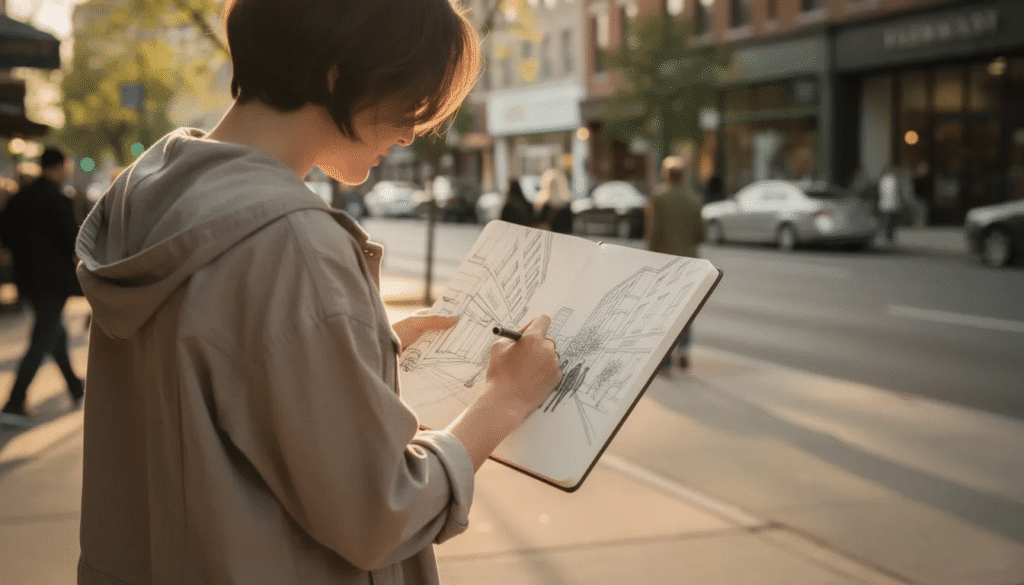
Urban Sketchers and Travel Artists
Portability and speed matter when you’re sketching on location with limited time and space.
- Recommended kit: 0.5mm mechanical pencil (HB or B lead), one HB or F wood-cased pencil, one 4B–6B for shadows
- Suggested brands: Mars Lumograph or Tombow Mono 100—durable brands with strong cores that survive travel in a pencil case
Quick, clean lines and minimal smudge are priorities since sketches are often made on location and sketchbooks close immediately after. Harder pencils from reliable brands reduce the risk of graphite offsetting onto facing pages.
Pack a small, high-quality sharpener and a kneaded eraser that won’t crumble debris into your sketchbook. These erasers lift graphite cleanly without residue.
Figure Drawing and Portrait Study in Sketchbooks
Rendering skin, subtle transitions, and rich value ranges requires slightly different priorities.
- Recommended ranges: Mitsubishi Hi-Uni, Tombow Mono 100, or Caran d’Ache Grafwood for smooth application and deep mid-tones
- Suggested grades: HB or F for construction, 2B and 4B for general modeling, 6B–8B for final accents
Smooth, easily blended graphite helps when rendering subtle transitions in fine art drawing. The softer grades in these premium ranges layer beautifully without becoming waxy or unworkable.
Consider keeping a separate “gesture” pencil—perhaps a 4B—dedicated to fast warm-up sketches. This prevents your finer pencils from wearing down during loose, high-volume practice.
Architects, Designers, and Technical Sketchers
Precision, clean erasure, and controlled lines define technical sketchbook work.
- Recommended grades: 2H, H, F, HB in precise ranges like Staedtler Mars Lumograph or Faber-Castell 9000
- Pair with: 0.3 or 0.5mm mechanical pencil for fine structural lines and notations
Low smudge, crisp edges, and good erasing are crucial for diagrams and technical thumbnails. These harder grades from quality brands erase cleanly and maintain sharp lines.
Avoid very soft grades in small sketchbooks where they can muddy details. If you need dark accents, use them sparingly and let them dry before closing pages.
Managing Smudge, Shine, and Longevity in Sketchbooks
Sketchbooks are constantly handled, flipped through, and closed on fresh drawings. Protecting your graphite drawing work requires attention that single-sheet work doesn’t demand, and choosing the best sketchbook for your drawing style plays a major role in how well your pages hold up over time. .
- Graphite shine becomes visible with heavy pressure and very soft grades. Overworked areas can reflect light distractingly, especially when photographing sketchbook pages for social media or portfolios.
- Layering technique matters more than pencil choice. Apply values in light layers, building up with softer grades rather than pressing hard with a single pencil. This creates richer darks without excessive shine or surface damage.
- Blend sparingly. Paper stumps and tissue can over-polish graphite on sketchbook paper, creating slick areas that resist further mark-making. Use blending tools only where necessary.
- Protect finished pages. Interleave tracing paper or glassine between highly rendered pages to prevent graphite from offsetting onto facing sheets. This is especially important in travel sketchbooks.
- Fixative helps but requires care. Light, even coats of matte fixative reduce smudging significantly. Apply outdoors or in well-ventilated areas. A good fixative is particularly valuable in travel sketchbooks that get handled frequently.
- Storage matters for long-term preservation. Let heavily worked pages dry completely after applying fixative before closing the sketchbook. Store filled sketchbooks upright away from direct sunlight and humidity.
The paper you choose also affects pencil performance. Sketchbook papers range from smooth (like Leuchtturm) to slightly textured (like Maruman Soho or Clairefontaine Goldline). Smooth papers reduce tooth for soft pencils while textured surfaces grab more graphite but may wear points faster.
How to Build Your Own Ideal Sketchbook Pencil Set
Experimentation matters more than adherence to a single “best” brand. Personal preference ultimately determines which pencils work for your hand, your pressure habits, and your artistic goals, and varied drawing ideas for every skill level can give you a reason to pick up your sketchbook and test different setups regularly. .
- Start simple and expand thoughtfully. Begin with one solid brand like Staedtler or Faber-Castell. Buy 3–4 key grades (2H, HB, 2B, 6B). After using these regularly, add a second brand with a different feel—perhaps a Japanese option like Tombow or Mitsubishi—to compare textures and tonal qualities.
- Track what you use. Note in the front or back of your sketchbook which pencils appear on each page. Over time, patterns emerge showing which grades and brands you reach for most often.
- Create swatch pages. Dedicate a spread inside your sketchbook to testing all your grades side-by-side, labeled clearly. This reference helps when you’re sketching and need to quickly grab the right pencil for dark shadows or light construction lines.
- Compare thoughtfully. Other brands like Conté à Paris, coloured pencils for mixed-media work, or even charcoal pencils can expand your options once you’ve established your graphite preferences. Don’t feel limited to one type of drawing tool.
- Remember that skill matters most. Owning every grade from every premium brand won’t make you a better artist. Consistent sketching habits and deliberate practice create improvement. But good pencils make the process more enjoyable and predictable—and that enjoyment keeps you coming back to the sketchbook.
The best drawing pencils are the ones that disappear from your attention while you work, letting you focus on what you see rather than fighting your tools. Start drawing with quality materials, develop your preferences through regular practice, and build a kit that serves your unique artistic voice.