Key Takeaways
- This beginner’s guide shows how to start scrapbooking without overthinking it: choose an album, organize photos, plan simple scrapbook pages, and protect the finished pages.
- You only need a few core scrapbook supplies at first: an album with page protectors, acid free cardstock, patterned paper, basic adhesives, and pens.
- Organizing photos by event, dates, or family members before you begin makes every scrapbook page faster and more fun to create.
- Scrapbook sketches, simple layouts, and limited embellishments help beginners avoid clutter while still leaving room for more photos.
- Acid free products and clear page protectors help preserve your first album so your memories can be enjoyed for years.
What Scrapbooking Is (and Why It’s Worth Starting)
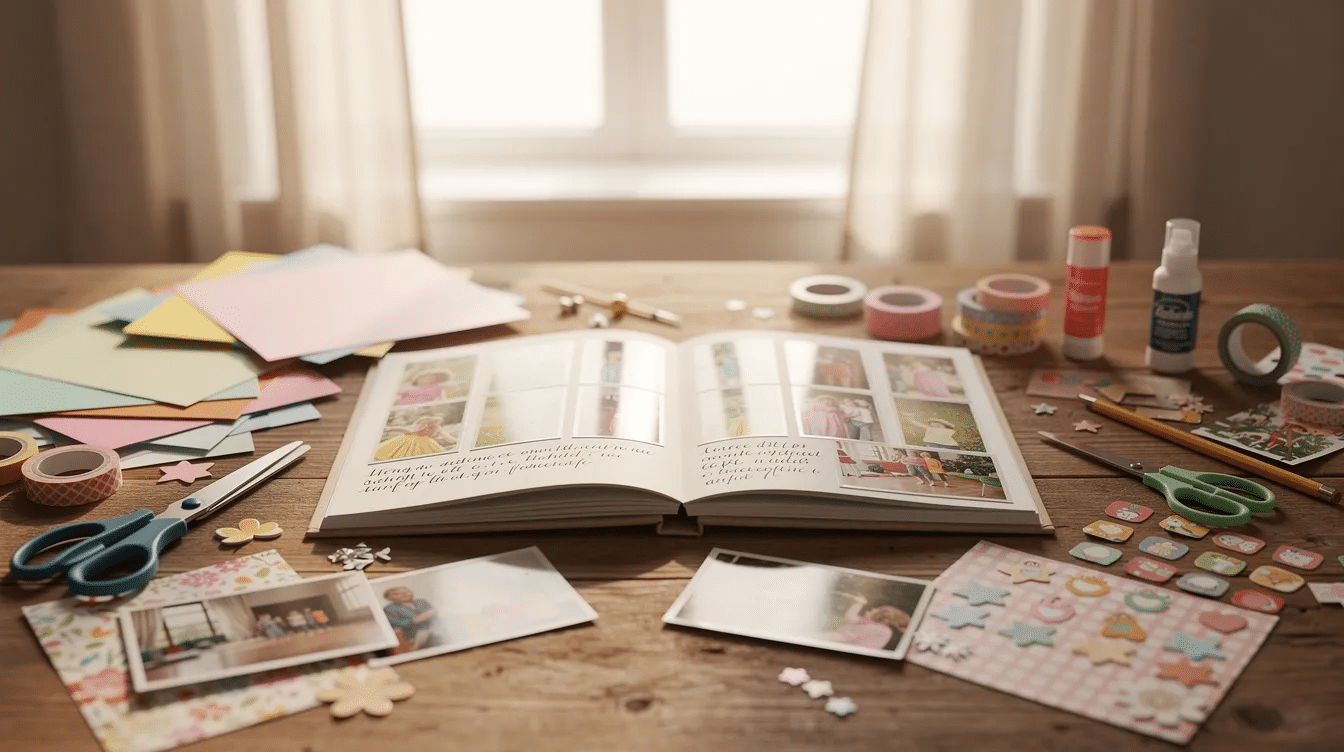
Modern scrapbooking is more than placing pictures in photo albums. A scrapbook combines photos, stories, scrapbook paper, journaling, ticket stubs, love letters, stickers, and small details into a personal time capsule. You might create “Summer 2025 Road Trip,” “Baby’s First Year,” “Grandma’s 80th Birthday,” or even a project life album about ordinary life at home. Unlike a digital camera roll, a curated scrapbook page uses a few photos, dates, a title, and comments to tell one focused story.
If you feel nervous, there are no strict rules. This blog post is a simple guide from an enthusiastic scrapbooker who has made many everyday family albums, not just special-occasion books.
- Gather Your Essential Scrapbooking Supplies
- Choose the Right Album, Page Protectors, and Paper
- Pick a Theme and Story for Your First Scrapbook
- Sort, Select, and Print Your Photos
- Plan Simple Layouts Using Scrapbook Sketches
- Build Your First Scrapbook Page Step by Step
- Journaling: Tell the Story Behind Your Photos
- Embellish Smartly Without Overwhelming Your Layouts
- Protect, Store, and Enjoy Your Finished Scrapbook
- Common Beginner Mistakes (and How to Avoid Them)
- FAQ
Gather Your Essential Scrapbooking Supplies
You do not need a craft store’s worth of supplies to get started. A small toolkit is enough for your first 10–20 scrapbook pages.
- Start with a 12”x12” binder-style album, which is the standard choice for scrapbooking, or choose 8.5×11 if you want less space to fill.
- Essential scrapbooking supplies include an album, page protectors, cardstock, patterned paper, stickers, stamps, adhesives, and pens.
- Clear plastic sleeves, known as page protectors, are used to keep finished scrapbook pages clean.
- Use acid free and lignin-free cardstock and patterned paper to prevent fading and discoloration of scrapbook pages over time, choosing high-quality craft paper supplies for creative projects that are designed for scrapbooking.
- A good pair of scissors and a paper trimmer are essential tools for cutting scrapbook materials accurately and efficiently.
- Archival-safe adhesive runners or double sided tape are recommended for securing photos in scrapbooks.
- To avoid damaging photos, beginners should avoid using liquid glues in scrapbooking; use tape runners, glue dots, or photo corners instead.
- Choose one album size for your first album: 12×12 gives more space for collage layouts, while 6×8 or traveler’s notebook style projects finish faster.
- Pick a simple palette, such as white cardstock, kraft, teal, and mustard, so your pages look coordinated.
- Save low-cost embellishments like ticket stubs from a 2024 concert, postcards, kids’ drawings, or subway passes, which can work beautifully with vintage paper craft ideas that turn old ephemera into art.
Creating a dedicated workspace for scrapbooking can enhance both your mental and creative space, making it easier to focus on your projects. A well-organized scrapbooking space should include nearby storage for supplies, and natural light is beneficial because it helps you see details clearly and can inspire creativity, especially when you browse paper crafting ideas and tutorials for all skill levels and want to try new techniques.
Choose the Right Album, Page Protectors, and Paper
The album and paper format you choose now affects every layout you make later. Before you buy albums in bulk, choose one style and finish a small collection first. A 12×12 D-ring album fits standard page protectors and gives room for photos, journaling, and embellishments. An 8.5×11 album feels like a school binder, while 6×8 or 9×12 albums are easier for quick projects.
Page protectors slide into the album and protect raised embellishments, ink, and photos from fingerprints, spills, and tears. Buy at least one matching pack when you purchase the album so you do not run out halfway through the year.
Cardstock is the sturdy base for each scrapbook page. Patterned paper is usually used for accents, photo mats, strips, and titles. Using complementary colored scrapbook patterned paper to matte your photos can help them stand out on the page. If you want to experiment beyond basics, explore the best types of paper for craft and their uses. Start with one or two coordinated paper collections from 2024 or 2025 instead of dozens of random sheets, then store scrapbook paper vertically in a magazine file or clear bin near your workspace.
Pick a Theme and Story for Your First Scrapbook
A theme helps in selecting matching papers and embellishments for scrapbook layouts. It also tells you which photos to print, what colors to use, and what to write.
- Try “Year in Review 2025,” “Our Wedding Story – October 2023,” “Baby’s First Year – 2024,” “High School Senior Year,” or “Family Vacations 2018–2024.”
- Start with a finite project, such as 20–30 layouts about one year, instead of an “everything in my life” album.
- Write 10–15 page ideas: first day of school, Christmas morning, Sunday dinners with grandparents, beach day with friends, or a title page for the whole album.
- Choosing a layout that works for your theme is essential; you can opt for clean grids, lots of layering, or a mix of styles to create a unique scrapbook page.
- Even if you later add more photos, this list keeps you from getting stuck on the first page.
Sort, Select, and Print Your Photos
- Gather all your photographs from smartphone camera rolls from 2022–2025, family shared albums, old envelopes in drawers, photo CDs, USB drives, and any printer folders on your computer.
- When preparing to scrapbook, gather all your photographs and sort them into piles for different pages, considering how many photos you want on each page.
- Organizing photos into piles by theme or date can help streamline the scrapbooking process, allowing you to easily select which images to include in your scrapbook.
- Using clear plastic bins to sort and label photos can make it easier to find specific images when creating scrapbook pages.
- Create digital folders such as “Summer 2023 Vacation,” “Holidays 2024,” or “Everyday Life 2025.”
- Choose 3–5 favorite images per event instead of printing hundreds; fewer photos often create stronger layouts.
- When creating scrapbook pages, consider how many photos you want to include; you can choose to feature a single central photo or create a collage of multiple images.
- Get photos printed in 4×6 and 3×4 sizes, preferably matte or luster to reduce fingerprints.
- Mix color with black-and-white for variety.
- Scan irreplaceable old photos before cutting or attaching them, especially a one-of-a-kind photograph from the past.
Plan Simple Layouts Using Scrapbook Sketches
Scrapbook sketches are structural diagrams that show where elements go on a scrapbook page. Think of rectangles for photos, strips for patterned paper, a box marked “title,” and another box for journaling.
- Choose 3–5 scrapbook sketches and reuse them across the whole first album.
- Rotate or mirror a sketch to make it feel new.
- Begin with one-photo and two-photo layouts before trying complex collages.
- Keep a notebook of sketches at your site of work, whether that is a desk, kitchen table, or corner of the house, or dedicate one of the best sketchbooks for planning layouts and designs to your scrapbook ideas.
- Use sketches to include more photos without making the page feel crowded.
Build Your First Scrapbook Page Step by Step
Your first page does not need to be perfect. The goal is to create momentum and learn the basic course of building a layout from loose pieces.
- Choose white cardstock, cream, or kraft as your background, then place it beside a page protector.
- Select 1–3 photos from one event, such as a birthday party in March 2025.
- Add patterned paper as a horizontal band, vertical strip, or photo mat.
- Place a simple title like “Weekend at the Lake” using letters, die-cuts, or neat handwriting.
- Leave room for journaling on a label, tag, card, or corner.
- Before you glue anything, move pieces around until the style feels balanced.
- Adhere everything with repositionable adhesive, archival tape runner, double sided tape, or glue dots.
- Add a few embellishments only after the photos are secure.
Journaling: Tell the Story Behind Your Photos
Journaling turns a silent photo album into a story future family members can understand. Journaling in scrapbooks should include the date, location, names of people, and meaningful memories associated with the photos.
Journaling in scrapbooks allows you to write down not just the who, what, and where of a photo, but also your feelings and thoughts about the moment captured, adding depth to your memories. Include key phrases, funny captions, or reflective thoughts, such as “It rained all morning, but we still ate ice cream under umbrellas.”
You can incorporate journaling into your scrapbook pages in various creative ways, such as writing directly onto the cardstock, using tags, or hiding your journaling in envelopes. Printable labels, date strips, and creative things to print on paper for every occasion can also make journaling faster and more fun. Test ink on scrap paper first, and use archival or acid free pens. If handwriting worries you, remember that your family may treasure your real handwriting from 2026 more than a perfect font. I was glad my husband wrote one messy caption in our vacation album; it became my favorite part of the page.
Embellish Smartly Without Overwhelming Your Layouts
Embellishments should support the story, not compete with the pictures. Beginner-friendly options include flat stickers, enamel dots, labels, washi tape, chipboard shapes, die-cuts, and small paper flowers, and you can even add accents made from handmade paper sheets for special creative projects.
Use the rule of three: place three small clusters around the focal photo and title. Keep bulky flowers, thick chipboard, and wood veneers away from page edges so scrapbook pages still slide into page protectors. Stick to 2–3 types of embellishment per page. Then step back and ask, “Do I notice the people first?” If not, remove a few pieces. That restraint is often what makes beautiful work.
Protect, Store, and Enjoy Your Finished Scrapbook
Once several layouts are complete, slide them into page protectors and enjoy the album like a real book. Let glued pieces dry completely first so nothing smears or sticks.
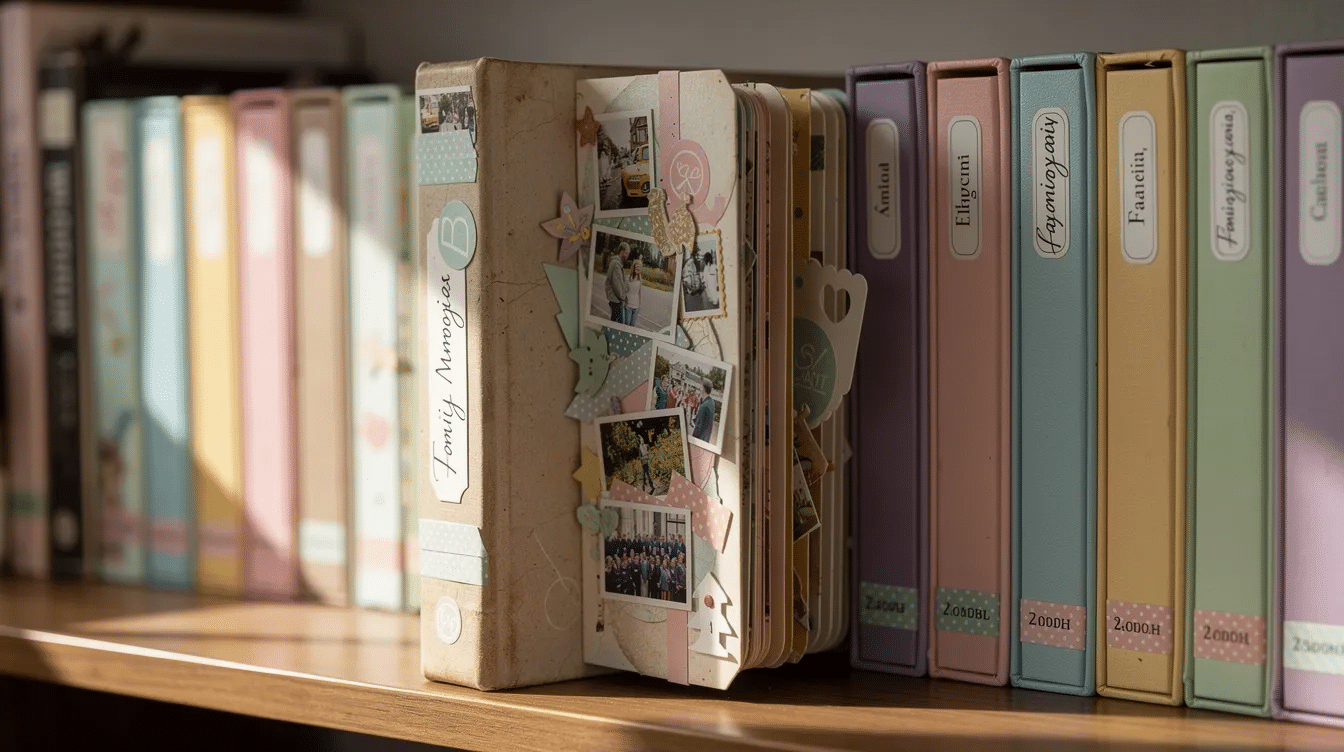
If a page is dimensional, use looser page protectors or trim a tiny fraction from the cardstock edge so it can slide in smoothly. Store albums upright on a shelf, away from sunlight, radiators, damp basements, and attics. A few times a year, such as January and July, flip through albums with family members and add sticky notes for missing pages. As your collection grows, organize albums by year or theme: vacations, kids, heritage, pets, or everyday life.
Common Beginner Mistakes (and How to Avoid Them)
Every scrapbooker makes mistakes. Knowing the common ones will save supplies, time, and frustration.
- Buying too many scrapbooking supplies before starting: finish 10–15 layouts with a small kit before adding more products.
- Trying to fit every photo on one page: choose the best 3–6 images and place extra prints in pocket pages or photo albums.
- Skipping journaling because it is not perfect: write simple captions now and revise on a card later if needed.
- Using unknown old stickers or non-archival glue on vintage photos: scan originals and use archival-safe products.
- Comparing your first 2026 layouts to advanced scrapbookers online: look for inspiration, but measure progress across your own pages.
FAQ
How many photos should I plan for my first beginner scrapbook?
Plan for 20–30 scrapbook pages with an average of 2–4 photos per page. That means roughly 60–100 photos total for a “Year in Review” or “Baby’s First Year” album.
Do I have to use 12×12 pages, or can I start smaller?
No. 12×12 pages are standard and work well with most page protectors, but many beginners prefer 6×8 or 9×12 albums because they finish faster and take less space.
Can I scrapbook if most of my photos are on my phone?
Yes. Phone photos are perfect for scrapbooking. Choose favorites monthly, edit lightly for brightness, then print in batches every few months through a local lab or online service.
What’s the difference between a scrapbook and a regular photo album?
A traditional photo album usually holds photos only. A scrapbook combines photos, dates, titles, patterned paper, embellishments, and journaling to tell fuller stories.
How long does it take to complete a beginner scrapbook?
A simple page using a sketch can take 30–60 minutes once supplies and photos are organized. A 20-page album may take a few weekends or a couple of months of relaxed evening sessions. Start small, keep it fun, and let your creativity grow with every page.