This guide focuses on really easy origami you can start today, even if you’ve never folded paper before. These easy origami models are suitable for beginners and children, and many can be completed in under 10 minutes. All you need is a square sheet of paper and 5–10 minutes per model to create something satisfying. By the end of this article, you’ll know how to make a classic paper boat, jumping frog, tulip, puppy face, corner bookmark, and even a traditional crane—so let’s explore the world of paper folding together.
Origami is a Japanese word that combines ‘Ori’ which means ‘folding’ and ‘kami’ which means ‘paper’.
- What You Need to Get Started with Really Easy Origami
- Super-Simple First Folds (5-Minute Projects)
- All-Time Favorite Really Easy Origami Models
- Really Easy Origami Animals for Beginners
- Simple Origami Flowers & Leaves You Can Fold Today
- Useful Really Easy Origami: Bookmarks, Boxes, and Envelopes
- Seasonal & Holiday-Themed Easy Origami Ideas
- Step-by-Step Tutorials: How to Read Origami Diagrams
- A Short, Simple History of Origami
- Tips for Success with Really Easy Origami (and What to Do Next)
What You Need to Get Started with Really Easy Origami
Before you begin any origami project, gather these basic supplies:
- Square paper (15×15 cm / 6×6 inches is ideal for beginners)
- Lightweight origami and other craft papers (40–60 gsm) or standard printer paper trimmed to a square
- A flat surface like a table or hardcover book to fold on
- Optional: crayons, pens, or markers for decorating faces and patterns
- No glue, tape, or scissors required for traditional simple models
If you don’t have origami paper, you can easily create square paper from a rectangular sheet. Simply fold one corner diagonally to meet the opposite edge, then trim the excess rectangle. This process itself serves as a gentle introduction to folding paper.
Avoid thick cardstock—it resists folding and prevents the crisp creases essential for clean results. Lightweight paper holds sharp edges without tearing, making your first projects look polished from the start.
Super-Simple First Folds (5-Minute Projects)
These quick wins are perfect for beginners, kids, or anyone wanting a relaxing craft break. Each uses simple folds and can be complete in under five minutes, and they overlap with several of the top origami designs for every skill level.
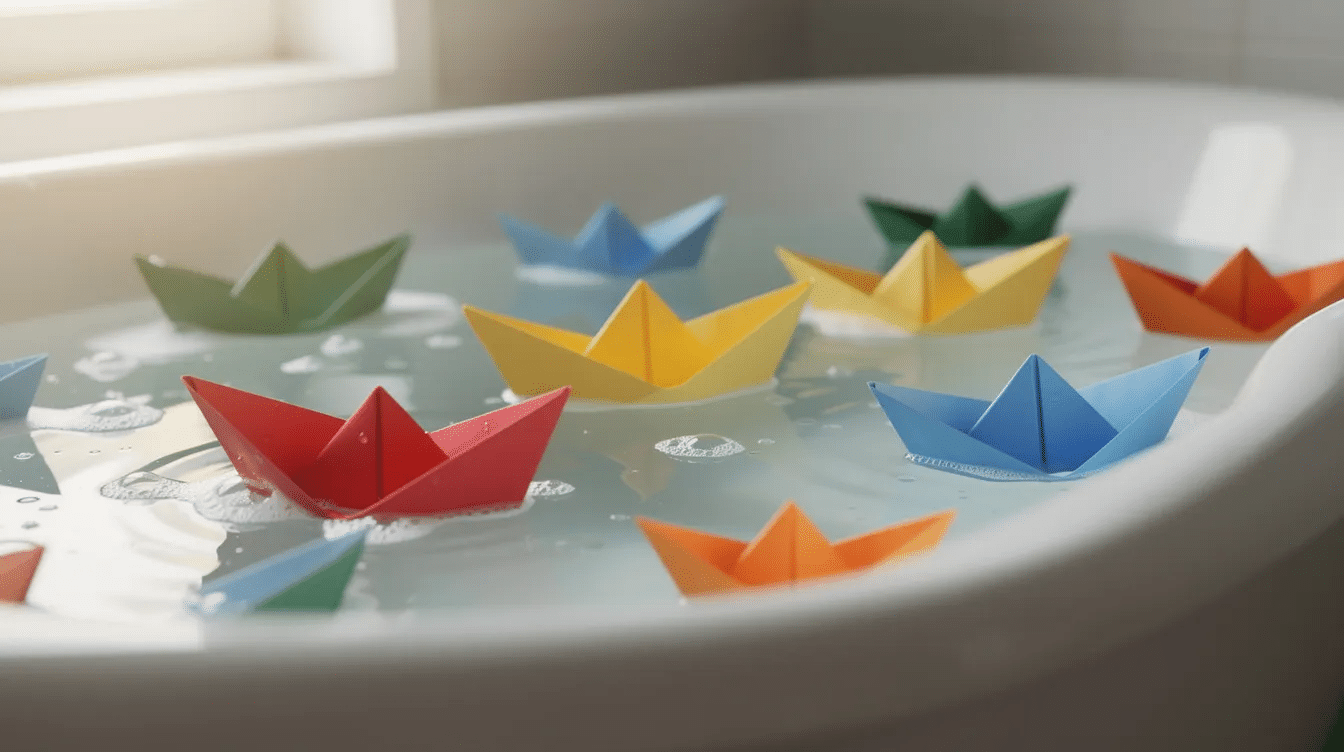
Classic Paper Boat This foundational model floats reliably on water due to its air-trapped compartments. With about 8–10 valley folds, you’ll create a stable hull that teaches bilateral symmetry. It’s beginner friendly and satisfying to test in the sink or bathtub.
Fortune Teller (Cootie Catcher) Fold a square into a smaller square via corner-to-corner diagonals, then pinch corners inward to create four numbered flaps. This interactive toy works for silly fortune games and builds fine motor skills in 10–12 simple steps.
Paper Hat Create a wearable pirate or cowboy hat in just 4–6 folds. Adjust the fit by varying how tightly you crease the brim. Kids love wearing these immediately after finishing.
Each of these very simple origami projects should have diagrams showing the view from above, with arrows indicating fold direction and dashed lines for valley creases.
All-Time Favorite Really Easy Origami Models
These classic origami models are beloved worldwide and help you build core folding skills like precision alignment and crease sharpening.
Model | Estimated Time | Skill Builder |
|---|---|---|
Traditional Crane | 10–15 minutes | Petal folds, shaping |
Jumping Frog | 8–12 minutes | Inside-reverse folds |
Simple Butterfly | 5–10 minutes | Symmetry, color reversal |
Easy Star | 8–10 minutes | 3D volume from flat paper |
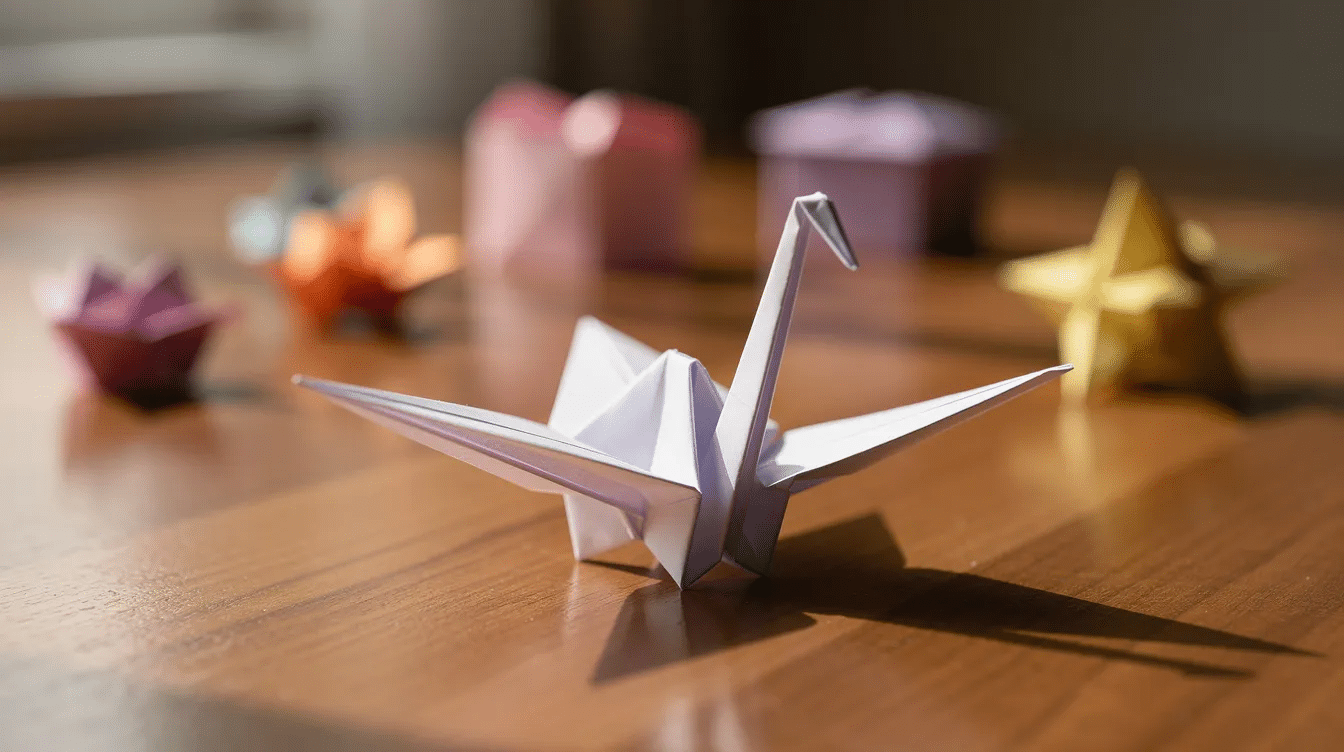
The traditional crane symbolizes peace and longevity in Japan. It requires about 15–20 folds and rewards patience. Your first attempt may look a bit lumpy, but by the third or fourth try, you’ll see marked improvement—the charm of practice becoming visible. | ||
The jumping frog is pure fun origami. A kinetic marvel, it hops forward when you press its back. The butterfly demonstrates beautiful color reversal when you use double-sided paper, and the easy star serves as a gateway to modular origami where multiple shapes interlock. |
Really Easy Origami Animals for Beginners
Animals are often the most requested projects, and these easy origami animals use only basic folds that any beginner can master.
Puppy or Dog Face – Complete in 6–8 steps and about 5 minutes. Fold the midline crease, create triangular ears, and shape a muzzle. Add drawn whiskers and a tongue for extra cuteness.
Cat or Tiger Face – Mirror the puppy technique, then use markers to add stripes for a tiger pattern.
Easy Origami Rabbit – Add floppy ear triangles and a pink nose dot to create an adorable bunny face.
Easy Origami Fish – Build from a kite base to create fins and a tail. Add dotted scales for a realistic touch, or imagine playful dolphins and other sea creatures.
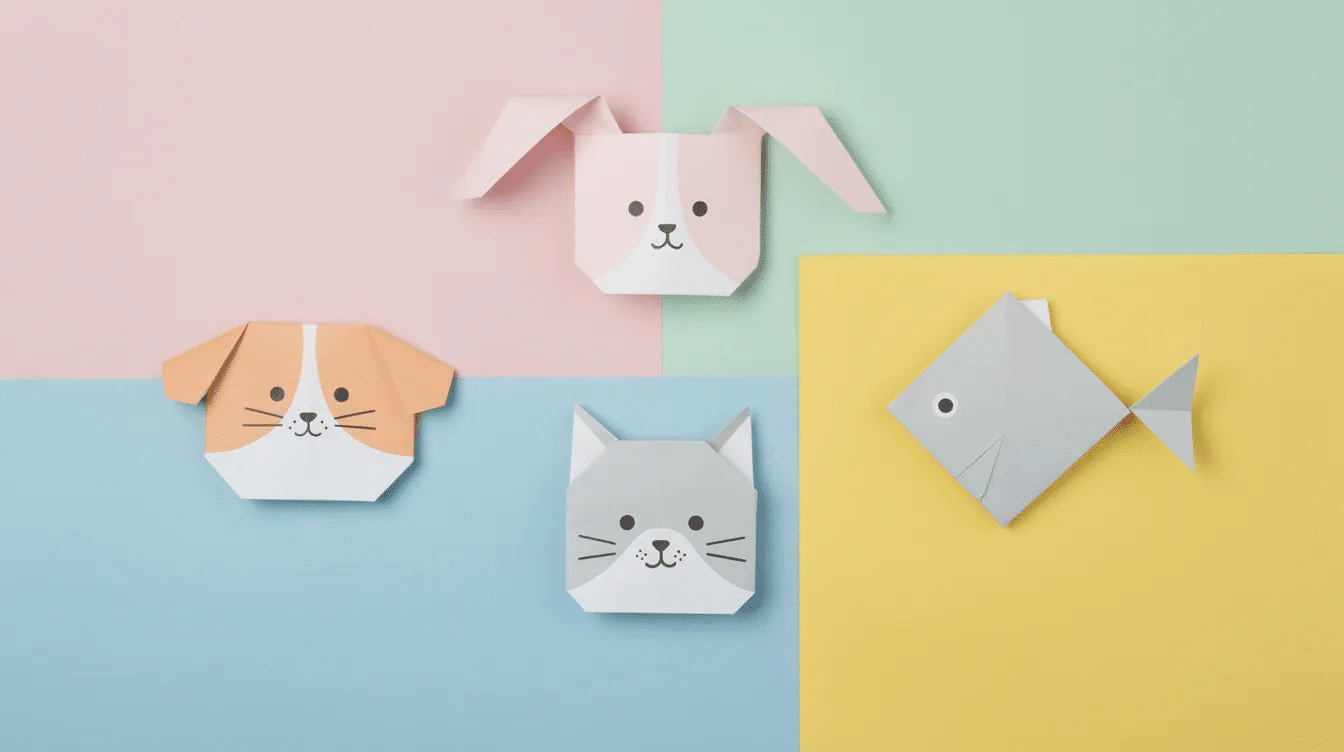
These paper animals work best as flat “face” models, minimizing 3D complexity while maximizing expressiveness. Encourage kids to invent their own expressions—research on craft therapy links this creativity to improved focus in children.
Easy Jumping Frog and Other Action Models
Action origami can move, flip, or hop, making it especially fun for kids and anyone who wants more than a static display piece.
The jumping frog assembles in 12–15 folds and activates via a simple press on its rear. On a smooth surface, it can propel forward 30–50 cm. For best results, use medium-weight paper (60–80 gsm)—thinner paper lacks springiness while thick stock won’t compress properly.
Other action models include:
- Flapping bird – Pull the beak to make wings move
- Basic flexagon – A fidget toy that flips between faces with corner pinches
Mini game idea: Race your frogs across a table, or draw a “pond” on paper and see whose frog can jump closest to the center. This turns a simple origami project into play that kids will want to repeat.
Simple Origami Flowers & Leaves You Can Fold Today
Easy origami flowers are beautiful, giftable, and surprisingly achievable when broken into steps, and they pair nicely with tissue paper flower decorations for any occasion. Single-sided colored paper works especially well for showing the shape of petals and leaf veins.
Classic Tulip This model uses a waterbomb base folded into a cup shape, optionally with a stem from a rectangle twist-fold. Expect 12–15 steps over about 10 minutes. Multiple tulips can be combined into a small bouquet without glue.
Simple Flat Flower Build from a blintz base (corners folded to center) with petal spreads. These work beautifully as garlands or decorations on greeting cards.
Basic Leaf Diagonal pleats create a realistic midrib and veins. Combine with flowers for complete arrangements.
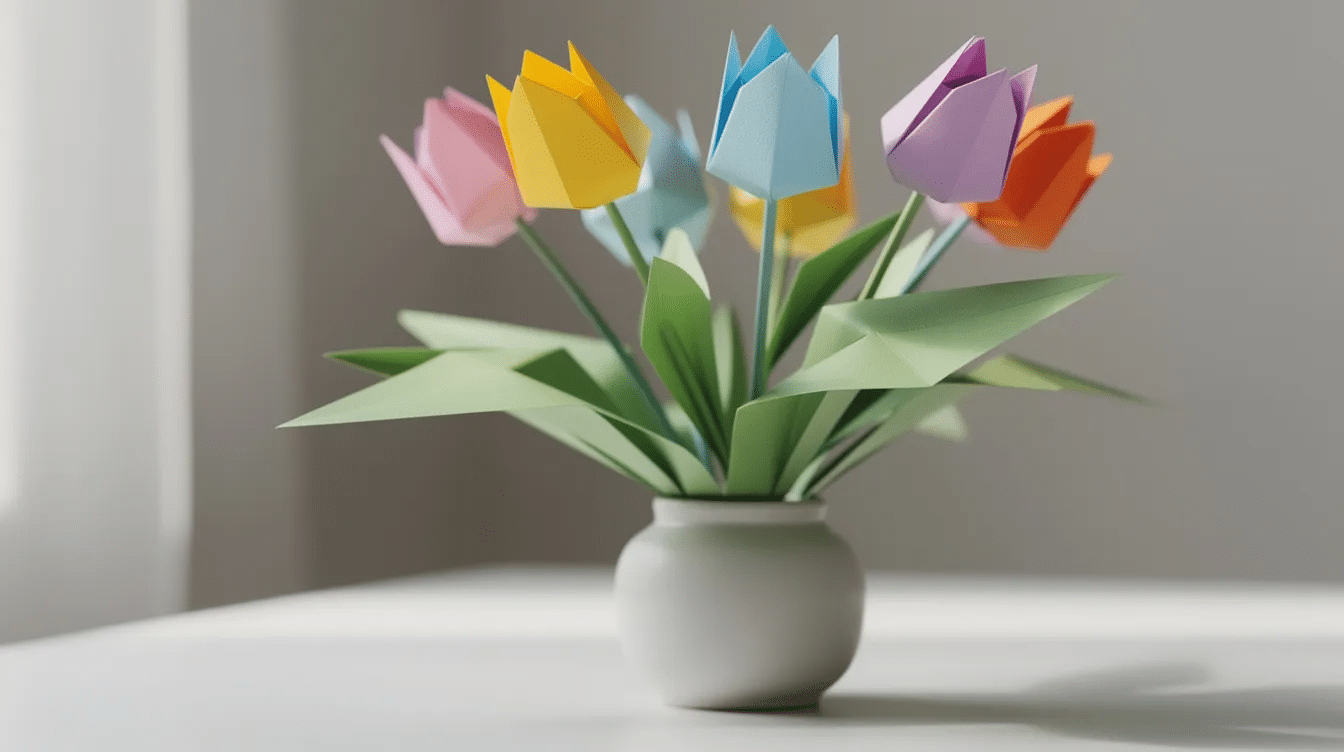
Decorating tip: Add dotted centers with pens, or combine different paper colors into a mini “garden” display for birthdays, Mother’s Day, or simply to celebrate your creativity.
Useful Really Easy Origami: Bookmarks, Boxes, and Envelopes
Practical origami models can be used daily, not just displayed. These projects turn folding origami into something genuinely useful and fit well alongside other fun paper activities for creative minds.
Project | Use Case | Folds Required |
|---|---|---|
Corner Bookmark | Slides onto page corners | 8 folds |
Simple Open Box | Holds paper clips, candies | 10–12 folds |
Folded Envelope | Notes, money, vouchers | 8–10 folds |
The corner bookmark is perfect for bookmarks lovers who want something more personal than a stick of cardboard. Decorate it as animals or cute characters—a turtle, rabbit, or any face you imagine. | ||
The masu-style box creates a container with 1–2 inch capacity from 6-inch paper, ideal for desk organization or small gifts. |
The folded envelope tucks flaps securely to hold notes or money. No glue needed—the geometry of the folds keeps everything in place.

Seasonal & Holiday-Themed Easy Origami Ideas
Simple folds transform into quick decorations for specific times of year. These seasonal easy origami ideas keep the craft fresh throughout the calendar, especially when you mix them with different styles of paper stars for garlands and displays.
Winter holidays:
- Christmas trees from triangle pleats with star tops
- Modular star puffs for garlands (string 10–20 together)
- Hang them from windows or add to gift wrap
Halloween:
- Easy bats with wing flaps
- Pumpkins via blintz segments with drawn faces
Valentine’s Day:
- 3D hearts from massed corner folds
- Create clusters of pink and red hearts for table centerpieces
Most seasonal models use the same basic techniques you’ve already learned. The magic lies in paper color choice and grouped displays—a cluster of paper hearts has far more visual impact than one alone, just like many other cute paper craft ideas for easy DIY projects.
Step-by-Step Tutorials: How to Read Origami Diagrams
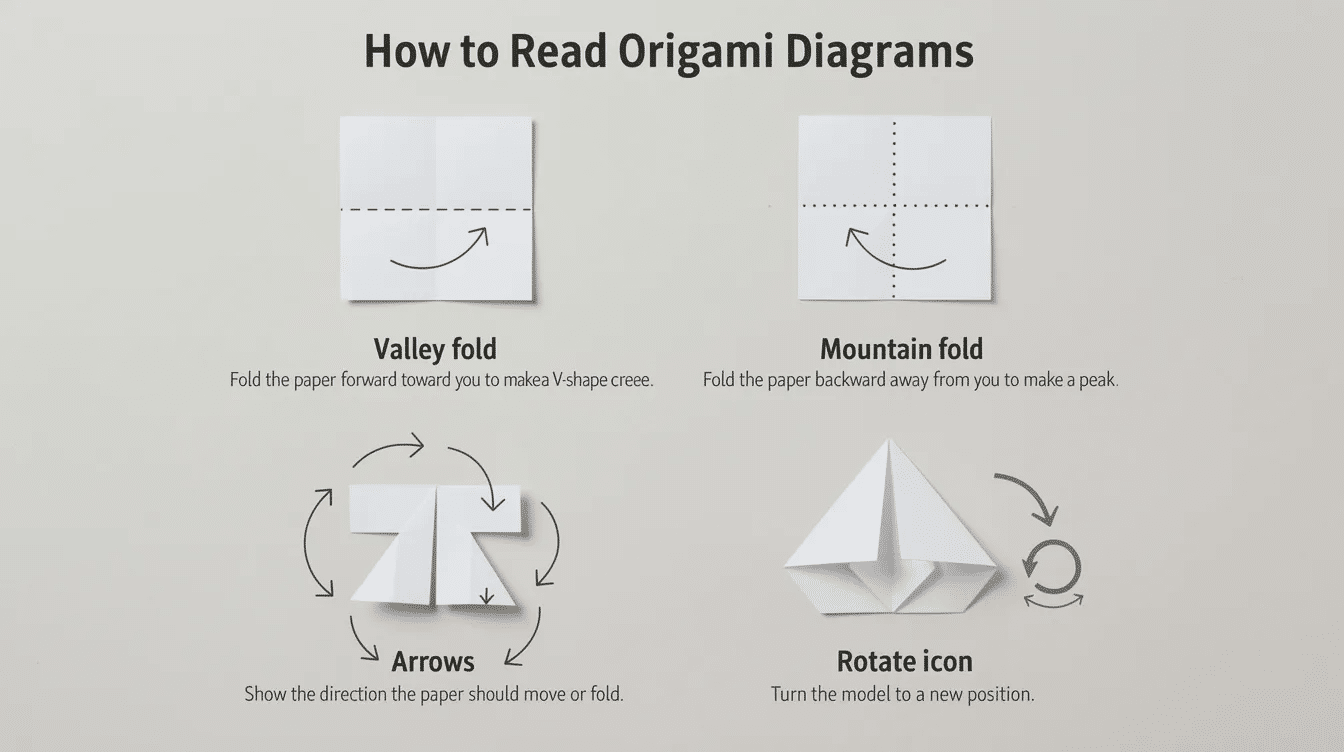
Once you can read diagrams, you can follow almost any origami tutorials online or in books. Understanding these basic symbols unlocks the entire world of folding.
Essential symbols:
- Valley fold (dashed line) – Fold the paper forward toward you, creating a crease that looks like a valley. Valley folds involve folding paper forward to create a “V” shape.
- Mountain fold (dotted line) – Fold the paper backward away from you, forming a ridge. Mountain folds involve folding paper backward to create a peak.
- Arrows – Show the direction paper should move
- Rotate icon – Indicates turning the model to a new position
Basic techniques like valley folds and mountain folds are fundamental for creating more complex origami models.
Simple example: To fold a square into a triangle, you’ll see a dashed diagonal line with an arrow curving from one corner to the opposite. This valley fold brings corner to corner, creating your first shape.
Go slowly. Match each fold to the diagram before moving on. Watch YouTube videos if you need to see the motion in action—many origami instructions come alive when you can observe hands at work.
A Short, Simple History of Origami
The history of origami traces back to 6th-century Japan, after paper arrived from China around 610 AD. Initially ceremonial and reserved for nobility who could afford costly washi paper, folding paper gradually became accessible to everyone, much like modern simple paper crafts communities make creative projects available to all ages today.
During the Edo period (1603–1868), mass production made paper affordable, and recreational “orikata” (folded shapes) flourished. The term “origami” combines “ori” (folding) and “kami” (paper), formally adopted around the 1880s when the craft was integrated into kindergarten education.
Today’s simple models make this centuries-old tradition accessible to children and beginners worldwide. When you fold a crane or frog—or experiment with other animals like easy origami ducks—you’re participating in a craft with deep roots in Japanese culture—now a global practice embraced for relaxation and creativity.
Tips for Success with Really Easy Origami (and What to Do Next)
Small improvements in accuracy will quickly make your folds look better. Don’t forget these fundamentals as you practice:
- Line up corners carefully – A 1mm misalignment compounds with each subsequent fold
- Make each crease sharp – Run your fingernail or a bone folder along each fold
- Work on a flat surface – A book or table prevents warping
- Refold immediately if something goes wrong – Don’t try to continue with a mistake
- Practice the same model multiple times – Boats improve noticeably in symmetry after 3 tries
The challenge of origami isn’t about natural talent—it’s about patience and repetition. Studies show spatial reasoning improves 20–30% with regular paper folding practice, and the meditative repetition offers genuine relaxation.
Once you feel comfortable with these really easy origami projects, explore slightly more detailed models. Consider taking a course, trying complementary arts like beginner paper quilling techniques, or watching advanced YouTube folders demonstrate their techniques. The skills transfer directly—every complex model is simply a sequence of the basic folds you’ve already learned.
Every origami expert began with simple shapes just like these. The fun is in the process as much as the finished model. So grab a sheet of paper, find a quiet moment, and let your hands create something from nothing but folds. Your rest might just become your new favorite hobby.