
When sewists talk about patterns to print on paper, they’re referring to the entire ecosystem of getting sewing instructions onto physical sheets you can pin to fabric and cut around. This includes classic tissue paper patterns that arrive ready to use in an envelope, professional A0 prints from copy shops, and tiled PDFs you assemble at home from your inkjet printer.
The goal of this guide is simple: help you quickly choose the best way to get your sewing patterns onto paper so you can start cutting and sewing right away. Whether you’re planning to make jeans, wrap dresses, boxy jackets, knit tops, or tote bags, understanding your options will save you time and frustration.
Here’s what we’ll cover:
- Classic printed patterns you can use straight from the envelope
- Why makers still love paper sewing patterns
- A0 and copy shop printing for large-format patterns with no taping
- Print-at-home patterns on Letter or A4 paper
- Choosing the right format for your next project
- Storing, tracing, and reusing your paper patterns
- Classic Printed Paper Patterns You Can Use Straight from the Envelope
- Why Makers Still Love Paper Sewing Patterns
- A0 and Copy Shop Printing: Large-Format Patterns with No Taping
- Print-at-Home Patterns on Letter or A4 Paper
- Choosing the Right Pattern-on-Paper Format for Your Project
- Storing, Tracing, and Reusing Your Paper Patterns
Classic Printed Paper Patterns You Can Use Straight from the Envelope
Traditional printed patterns arrive as lightweight tissue or bond paper, folded neatly into envelopes and ready to pin, trace, or cut immediately. These paper patterns have been the backbone of home sewing for over a century, and they remain a reliable choice for sewists who want to skip the printing process entirely.
Classic patterns come already printed to scale, with multiple sizes nested on each sheet (typically ranging from 0 to 30 in modern indie designs). A single pattern often includes multiple views—a dress with top and tunic variations, for example—giving you several project options from one purchase.
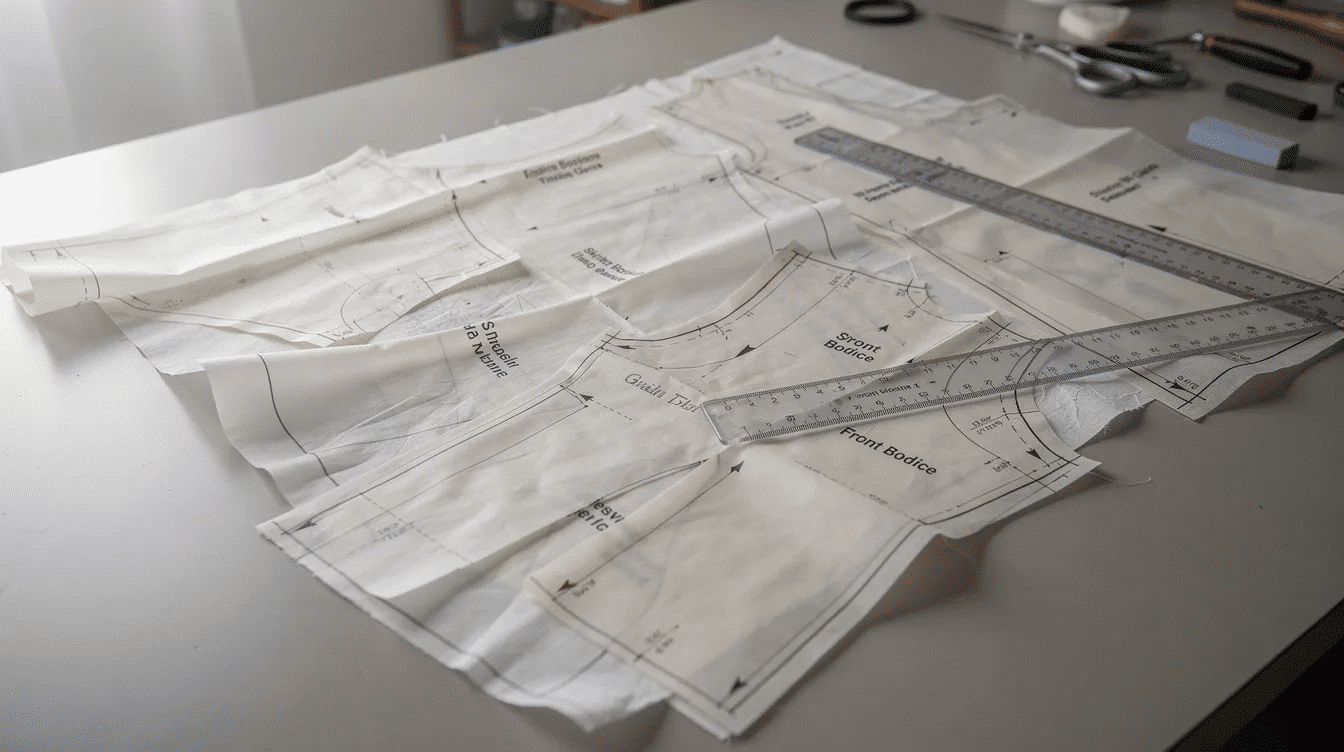
- Typical garments: 5-pocket jeans, button-up shirts, fit-and-flare dresses, chore jackets, pajama sets, and elastic-waist skirts
- No equipment needed: You don’t need a printer, tape, or any assembly—just unfold and start
- Immediate visualization: Lay out full pieces on fabric to see the garment shapes before you make a single cut
- Instructions included: Construction steps, seam allowances (commonly 1/2 to 5/8 inch), grainlines, and notches are printed in booklets or on separate sheets for easy reference
- Beginner-friendly: Classic printed patterns are ideal for first garments like a simple woven top or gathered skirt where you want to focus on sewing, not file management
Why Makers Still Love Paper Sewing Patterns
There’s a tactile ritual to working with paper patterns that digital alternatives can’t replicate. Unfolding the crisp tissue, smoothing out the creases, pinning pieces to fabric, and tracing adjustments with a pencil—these actions connect sewists to a tradition that spans generations.
- Clarity on fabric: Physical pattern pieces are easy to position on linen, cotton lawn, denim, or rayon challis without screen glare or device distractions
- Easy to mark and adjust: Use a pencil or frixion pen to note darts, notches, grainlines, and alteration details directly on the paper (e.g., “+2 cm at hip – July 2025”)
- Long-term reusability: Careful folding and storage allow the same pattern to be used for years—sewists often return to a favorite T-shirt pattern every season from 2024 onward
- Screen-free workspace: Many makers deliberately keep their cutting and sewing areas free of devices to reduce eye strain and stay focused
- Better understanding for beginners: Paper patterns help new sewists visualize construction steps and seam allowances more clearly than squinting at a screen
- Emotional satisfaction: There’s something deeply satisfying about holding a complete, ready-to-use product that represents a future garment
A0 and Copy Shop Printing: Large-Format Patterns with No Taping
A0 printing represents a modern solution for sewists who want full-size patterns without the assembly hassle. The A0 standard measures 841 mm × 1189 mm (33.1” × 46.8”), while U.S. equivalents often run 36” × 48”. These large-format prints arrive folded and ready to pin or trace—no trimming, no taping, no frustration.
Sewists upload their PDF patterns to online services or local copy shops, select the required sizes and options, and receive professional prints on bond paper within days. This method has become increasingly popular as pdf patterns have come to dominate the indie sewing market.
- Ideal for complex garments: Trench coats, tailored trousers, full-skirt dresses, blazers, lined coats, and complex jumpsuits where accuracy across long seams matters
- Must print at 100% scale: Always check the test square (1” or 5 cm) on delivery to confirm accuracy before cutting fabric
- Typical turnaround: 1–3 business days plus shipping, fitting easily into planning for a weekend project
- Batch ordering: Order multiple patterns in one shipment to save on shipping costs and build a printed library quickly
- Paper quality: Professional services use 18–20 lb bond paper that resists tearing when folded and ironed
Professional A0 Printing for Precise Garments
Professional A0 printing is especially beneficial for fitted or technical garments where precision matters—jeans, blazer jackets, lined coats, and complex jumpsuits. Calibrated plotters ensure accuracy down to fractions of an inch, printed on durable bond paper that folds neatly for storage.
- Prepare your file carefully: Select only required layers (e.g., sizes 10–14, B–F cup options), confirm page dimensions, and remove extraneous pages like instructions before upload
- Longer patterns on continuous sheets: Wide-leg trousers or maxi dresses may be printed on a single extra-long sheet when using 36” wide paper stock
- Check maximum length limits: Pages over 72” may incur extra fees or be split into two sheets—review service notes before placing your order
- Verify scale on delivery: Measure the test square with a ruler before you pick up scissors and start cutting
- Choose calibrated services: Professional print shops with plotters designed for architectural or engineering drawings typically offer the highest accuracy
Copy Shop Printing Options to Match Different Patterns
Different garments call for different print configurations. Knowing your options helps you find the best match for each pattern design.
- A0 sheets for tops and skirts: Most bodice and skirt pieces fit comfortably on standard A0 dimensions
- 36” × 48” sheets for outerwear: Coats, long jackets, and capes often require the larger U.S. format
- Single long sheets for pants or overalls: Many trouser patterns print on continuous rolls, reducing tape lines to zero
- Two-page patterns: Some designs span two A0 pages requiring only one tape line down the center—far less work than assembling 20+ home-print tiles
- Save the “copy shop” PDF: Many designers provide a separate file optimized for large-format printing—save it with clear labeling (e.g., “Copy Shop PDF – Designer Name – July 2026”)
- Add notes to your envelope: Write “Printed A0 – July 2026 – includes sizes 2–24, B–F cup options” directly on your storage envelope
- Compare services: Check local print shops and online services for price per page, turnaround time, and paper weight options
Print-at-Home Patterns on Letter or A4 Paper
Tiled PDFs are designed for home printers using standard U.S. Letter (8.5” × 11”) or A4 paper. After printing, sewists trim or fold margins and tape the printed pages into a full-size pattern sheet on a large table or floor. It’s more work than other options, but it offers instant access to any pattern and can share your printer with creative and functional printables for everyday use.
This method is ideal for smaller projects where the page count stays manageable: knit tees, camisoles, children’s clothing, zipper pouches, and tote bags. A child’s dress might require 22–30 pages, while a simple accessory could be just 6–10.
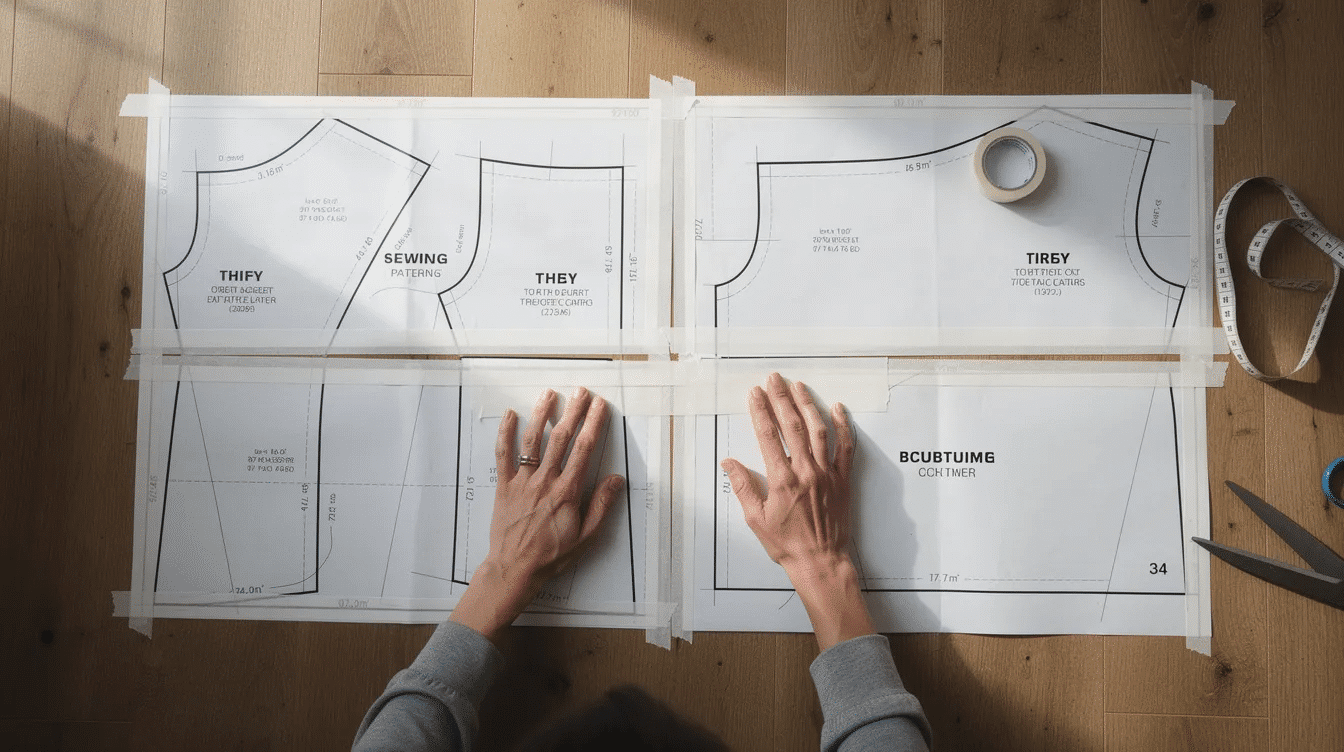
- Print at 100% scale: Never select “Fit to Page”—this common mistake throws off every measurement
- Measure the test square first: The pattern file includes a 1” or 2 cm test square that must be verified after printing the first page before running the full document
- Letter vs. A4 differences: Margins may shift slightly between formats, potentially cropping pattern lines—check that all elements are fully visible on each page
- Assembly basics: Match symbols (half-circles, triangles), label rows and columns (A1, A2, B1, B2), use clear tape, and press seams flat
- Storage options: Roll the assembled pattern around a cardboard tube or fold into a large envelope labeled with project name and print date (e.g., “Wrap Skirt – printed May 2025”)
- Time investment: Expect 1–3 hours for taping depending on pattern size, but you gain instant download and access
Managing Home-Printed Tiles Efficiently
Tiling doesn’t have to be tedious. A few strategies can reduce frustration and speed up the assembly process.
- Cut only one margin per page: Trim the right and bottom edges, then overlap the left and top margins—this creates straight, consistent seams
- Work in rows: Assemble horizontal rows first, then tape rows together vertically
- Press seams flat: Use a ruler or bone folder to smooth taped areas and prevent bumps that catch pins
- Print only needed layers: When the PDF allows layer selection, turn off all sizes except yours to avoid confusing nested lines that make true lines hard to follow
- Store assembled patterns efficiently: Hang on large hanger clips, roll onto cardboard tubes, or fold into labeled envelopes with project name and print date
- Reprint strategically: When major size changes occur, reprint only frequently-altered pieces (bodice fronts, waistband pieces) rather than the whole pattern
- Note adjustments on tiles: Write directly on the paper—“lengthened 1” – June 2025”—so future reprints can skip past fitting work
Choosing the Right Pattern-on-Paper Format for Your Project
There’s no single “best” way to get a pattern on paper. The ideal choice depends on your project type, timeline, budget, and access to printers. Mixing approaches often works better than committing to one format exclusively.
Each format has scenarios where it shines. Understanding these helps you make quick, confident decisions about how to handle your next project.
- Choose classic printed patterns when: You’re making your first garment, teaching a class, gifting a pattern, or want a fully tested paper product ready to use in 2024–2026 and beyond
- Choose A0 or copy shop prints when: You’re tackling complex garments (blazers, lined coats, tailored trousers), have longer timelines, dislike taping, and have access to online or local print services
- Choose print-at-home tiles when: You need instant access for a last-minute weekend project, you’re making small accessories, or you live far from copy shops
- Mix approaches freely: Use printed paper patterns for core wardrobe items (jeans, button-up shirts) and tiled PDFs for experimental designs or kids’ sizes that change quickly
- Consider your workspace: Taping requires floor or table space; A0 sheets need room to unfold; classic patterns work anywhere you can spread fabric
Budget and Time Considerations
Understanding relative costs and time investments helps you pick the option that fits your resources.
Format | Typical Cost | Time to Ready |
|---|---|---|
Classic printed patterns | $15–30 per design (shipped) | Immediate upon delivery |
A0/copy shop prints | $2–5 per sheet + shipping | 1–3 business days + shipping |
Print-at-home tiles | $1–5 in paper and ink | Immediate + 1–3 hours assembly |
- Shipping vs. instant access: Printed patterns and A0 prints require shipping time; tiled PDFs are available the moment you download
- Example scenario: Order A0 prints by Wednesday to sew a linen shirt on the weekend, or print and tape a knit top pattern on Friday evening for Saturday sewing
- Factor in reusability: A durable printed pattern or professionally printed A0 sheet can be used repeatedly over several years of sewing, making the highest price per unit more economical long-term
- Digital patterns cost less upfront: PDF patterns typically run 30–50% below paper equivalents, with no shipping costs
- Ink adds up: Heavy home printing consumes ink quickly—compare cartridge costs against A0 service fees for large patterns
Storing, Tracing, and Reusing Your Paper Patterns
Building a physical pattern library from 2024 onward transforms scattered papers into a valuable sewing resource. Organized storage means you can find and reuse favorite patterns for years without searching through piles or re-downloading files.
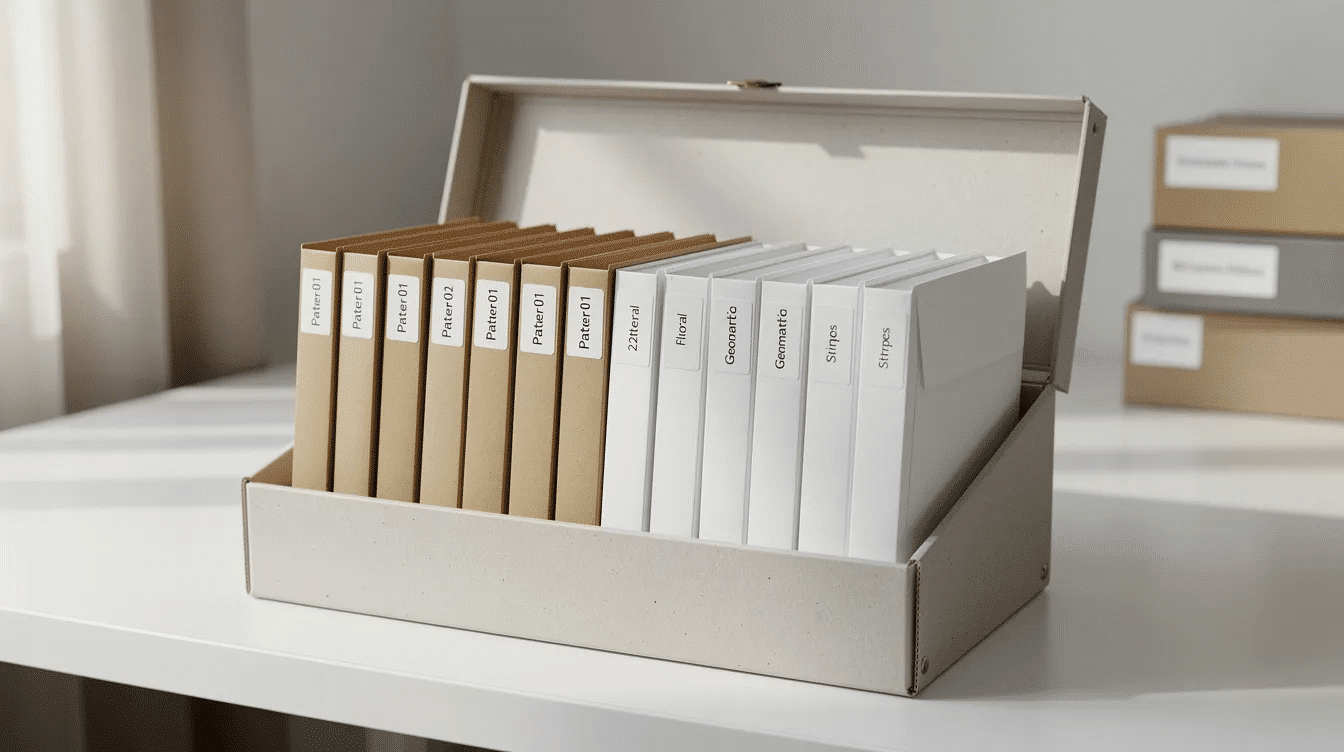
- Organize by garment type: Group patterns into categories—tops, bottoms, dresses, outerwear, accessories, or even separate binders for paper craft inspiration and projects—for quick selection when planning projects
- Storage options: Original envelopes, plastic sleeves in binders, hanging files, or large document boxes labeled with pattern names and designers
- Trace to preserve originals: Use Swedish tracing paper, lightweight kraft paper, or medical exam paper to create working copies while keeping the master pristine
- Add detailed notes directly on paper: Record fabric type, size used, adjustments (e.g., “full bust adjustment +1” – June 2025”), and whether changes succeeded
- Track your sewing history: Date your first use of a pattern and note each new version—this creates a clear record that saves fitting time for future garments
- Prioritize core patterns: Invest extra care in storing and maintaining patterns you return to repeatedly, like T-shirts, jeans, and button-up shirts
Keeping a Long-Term Pattern Library
A simple catalog system turns random pattern pieces into a searchable collection you can use for years.
- Create a catalog: Use a notebook or digital spreadsheet listing each pattern’s name, format (printed, A0, tiled), size range, and first use date
- Group by season and difficulty: Organize entries like “Summer 2024 Dresses” or “Winter 2025 Coats” with difficulty ratings for quick selection
- Revisit favorites annually: Return to the same reliable printed pattern each year to update wardrobe staples like a woven tee or elastic-waist trousers
- Add visual reference: Keep original envelopes or create custom covers with photos of finished garments—pink fabric for a summer blouse, black linen for winter pants—printed and attached for instant recognition
- Note format and location: Record whether each pattern is stored in the binder, the document box, or rolled in a tube, so you can find it without searching
Thanks for reading this guide to patterns to print on paper. Whether you prefer the ease of classic printed patterns, the precision of A0 prints, or the instant access of home-printed tiles, you now have the information to choose confidently. Pick a format, select your next project, and add those pattern pieces to your cart—your fabric is waiting.