
Cutting holes in paper sounds simple until you end up with torn edges, ragged circles, or a sheet that buckles the moment you start. Whether you’re making frames, crafting paper glasses for kids, or attempting the classic walk-through-paper trick, the right technique makes all the difference. This guide covers everything from quick one-minute methods to precision cuts on specialty papers.
- Quick answer: the simplest way to cut a hole in paper
- Tools and materials for cutting holes in paper
- Using punches to make small, perfect holes
- Cutting larger round holes without a punch
- Matching technique to paper type for clean holes
- Shaped holes: circles, curves, squares and angular designs
- Avoiding tearing, creasing and ragged edges
- Fun projects: walk-through and climb-through paper holes
- Improving control: grip, direction and setup
- Creative uses for holes in paper
- Key takeaways
Quick answer: the simplest way to cut a hole in paper
You can cut a neat round hole in standard printer paper in under 60 seconds using just a pencil, small scissors, and a household object like a mug or glass as a template. This method works for most people and requires zero special tools.
Here’s the fastest way to create a basic circle hole:
- Place a mug, glass, or other circular object on your paper where you want the hole
- Trace lightly around the edge with a soft pencil (2B works well)
- Remove the template and check your line for wobbles
- Cut along the traced line with small, sharp scissors, rotating the paper beneath fixed blades rather than twisting the scissors themselves
- Erase any visible pencil marks
If you need results in less time and don’t require a perfect edge, simply fold the paper once along its center, draw a semi circle at the fold, and cut through both layers. Unfold to reveal a complete round hole. This method takes about 15 seconds but leaves a faint crease.
Later sections cover perfect circle techniques, methods for different papers like newsprint and cardstock, and how choosing the best types of paper for craft affects your cutting results, plus square and angular holes, and the surprising walk-through paper trick that transforms an A4 sheet into a loop large enough to step through.
Tools and materials for cutting holes in paper
Tool choice depends heavily on paper thickness and hole size. Using mismatched tools is the most common mistake—heavy scissors on delicate tissue or a fine craft knife on corrugated cardboard leads to tearing, ragged edges, and frustration, so it helps to understand top craft paper supplies for creative projects before you start cutting.
Cutting tools:
- Small sharp scissors (10-12 cm craft scissors with micro-serrated edges work best for curves under 5 cm)
- Craft knife (X-Acto-style with #11 blade, 0.45 mm thick) for precision curves on medium papers
- Snap-off knife (Olfa-style with 9 mm segmented blade) for straight cuts and thick stocks like heavy cardboard
- Single-hole office punch for standard paper
- Craft circle punches (ranging from 6 mm to 50 mm diameter) for scrapbooking and card making
- Revolving leather punch for thick card or thin plastic
Supporting tools:
- Cutting mat (self-healing silicone or PVC, 2-3 mm thick) to protect surfaces and extend blade life 5-10x
- Scrap cardboard backing when working without a mat
- Metal ruler (stainless steel, 0.5 mm thick) for straight edges
- Flexible compass with adjustable blade for circles from 1-30 cm
- Circle templates: coins, jar lids, mugs, masking tape rolls
- Soft pencil (2B) and eraser for marking
Paper types this guide covers:
- Newsprint (35-50 gsm)
- Paper towels and tissue (20-40 gsm)
- Standard printer paper (80-90 gsm)
- Cardstock (200-300 gsm)
- Bristol board (250-400 gsm)
- Pastel paper (100-160 gsm)
- Corrugated cardboard (E-flute, 1.5 mm thick)
Using punches to make small, perfect holes
Punches are the gold standard for clean, repeatable round holes from 3 mm up to around 50 mm in diameter. Artists, scrapbookers, and crafters rely on them because they deliver consistent results with tolerances under 0.2 mm—far better than any freehand cut.
Using a single-hole office punch:
- Stack 3-4 sheets of scrap paper behind your “good” sheet to distribute force evenly
- This backing prevents imprint marks and reduces the chance of breaking fibers at the hole edge
- Position the paper, press firmly once, and release
- A single-hole punch easily handles 10-15 sheets of 80 gsm paper
Using craft circle punches (1/4”, 1/2”, 1”, 2”):
- Feed cardstock straight into the punch opening—crooked entry causes oval holes
- Apply pressure in one firm motion lasting 1-2 seconds
- Avoid twisting the punch while cutting, as this introduces up to 5% distortion
- Ergonomic lever designs amplify hand force to 200-300 N, making quick work of 200 gsm stock
Punch from the back side of your artwork so any minor burring shows on the reverse, not the front. This simple tip keeps visible surfaces clean.
For thick card or plastic:
- Use a revolving leather punch with interchangeable dies (6-12 mm range)
- Test on scrap first to confirm the right die size for your project
- Only wiggle the punch head gently after the cut is complete—never during—to maintain a perfect circle
- Punch limitations: most tools fatigue after 500-1000 cycles on thick media, and holes larger than 50 mm require alternative methods
Cutting larger round holes without a punch
This section covers thumb-sized to plate-sized circles using knives and scissors—the sizes you need for poster windows, photo frames, and craft projects where punches simply don’t reach.
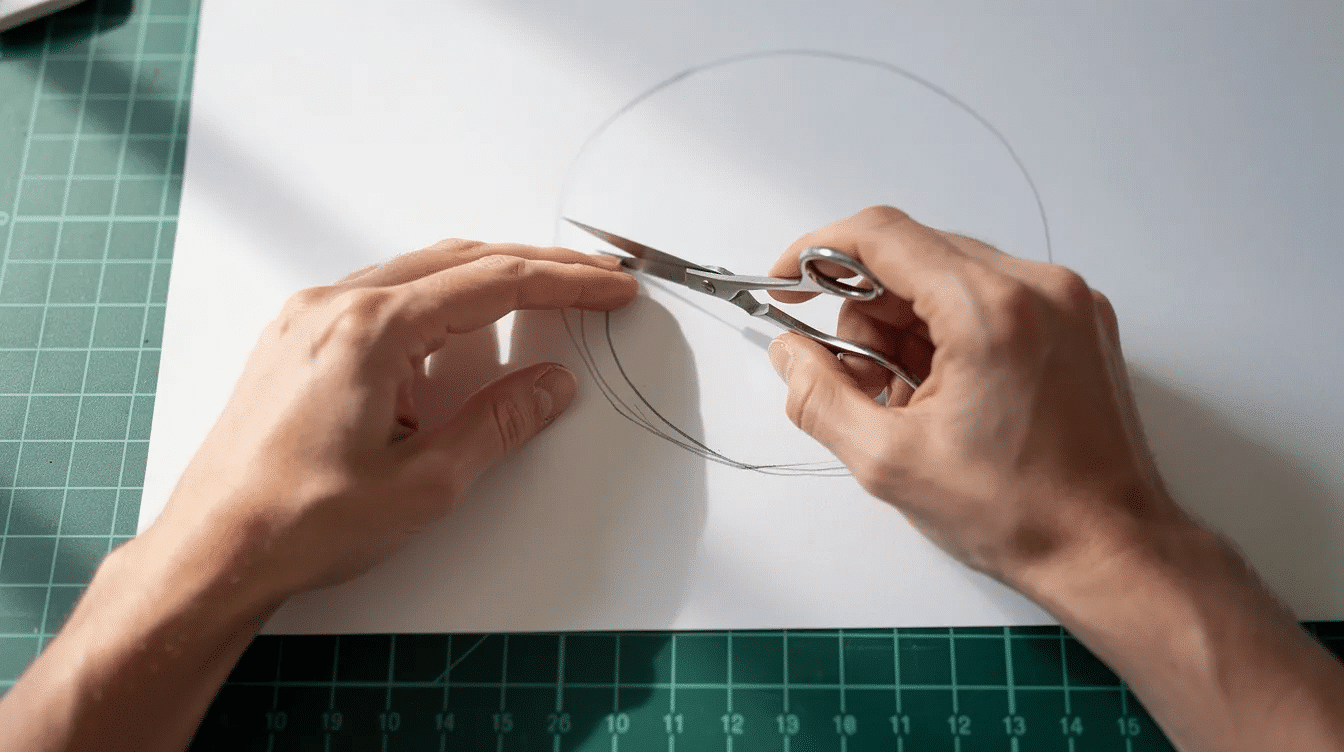
Tracing your circle:
- Choose a solid circular object: coin (1-5 cm), tape roll (5-8 cm), mug (8-12 cm), or small plate for larger holes
- Trace with a sharp pencil, keeping the template steady
- Erase any wobbles before cutting—deviations become permanent once you cut
- Draw the entire hole in one smooth motion if possible
Method 1: Fold and cut (fastest for printer paper)
- Fold the sheet once so the fold passes through the center of your planned hole
- Draw a semi circle along the fold matching half your desired diameter
- Cut along the line through both layers
- Unfold to reveal a complete circle
- Best for quick results; leaves a faint crease
Method 2: Direct scissor cutting
- Cut along the drawn line with small, sharp scissors
- Rotate the paper beneath fixed blades rather than twisting your wrist
- Keep movements smooth—stopping and starting creates flat spots
- This method achieves roughly 0.8 mm edge uniformity on standard paper
Method 3: Craft knife technique
- Make a small starter puncture (1 mm entry point) inside the circle
- Cut in short arcs of 5-10 mm, keeping the blade nearly vertical
- Rotate the paper on your cutting mat after each arc
- Maintain 90-degree blade perpendicularity to avoid beveled edges
For thicker stocks (250-300 gsm cardstock, Bristol):
- Use 3-5 light passes rather than forcing through in a single cut
- Each pass should remove only 0.2-0.3 mm of material
- Heavy single cuts spike local stress 2-3x yield strength, causing tears
Compass cutters:
- Work well on medium card up to 300 gsm
- Apply slow, even pressure (1.5-2 N) at 1-2 rpm arm rotation
- Tend to skid on glossy or very thick material due to insufficient blade embedment
- Always use a cutting mat underneath
Handedness and direction:
- Right-handed cutters often find clockwise arcs smoother due to wrist supination ergonomics
- Left-handed cutters may prefer counter-clockwise
- Test both directions on scrap to find which yields fewer flat spots and hesitations
Matching technique to paper type for clean holes
Each paper behaves differently when cut. Thin sheets tear along fiber lines, textured papers snag on blades, and thick boards resist punches entirely. Adapting your method to the material prevents most failures.
- Newsprint (35-50 gsm): Short cellulose fibers (1-2 mm length) make this paper prone to tearing. Fold in half and cut semicircles or sectioned arcs with scissors. Heavy knife drag will rip fibers—the force naturally pulls along the grain direction, worsening tears by 2-4x.
- Paper towels and tissue (20-40 gsm): Use only very sharp scissors with micro-serrated blades and apply light pressure. Hold the sheet taut across a flat surface, cut slowly, and avoid dragging blades across the loose weave. Gaps between fibers catch dull edges.
- Standard printer paper (80-90 gsm): The most forgiving material with a 95% success rate for scissor cuts. Works equally well with scissors or knife. Caution: tracing around objects then sawing back and forth creates choppy, polygonal edges with 10-20 visible facets.
- Cardstock (200-300 gsm): Recommend knives over scissors for small circles. Cut the hole in 4-6 sections (short curves), rotating the card after each section. Compass methods can slip due to the higher force required—you’ll notice the blade skidding rather than cutting.
- Heavy cardboard and corrugated board: Use an Olfa-style snap-off knife with many light passes (10-20 strokes). An X-Acto may require too many strokes and tends to follow the corrugation pattern, producing wavy edges up to 2 mm off-line.
- Bristol board (250-400 gsm): A sharp X-Acto with #11 blade often gives cleaner curves than a bulkier snap-off knife, especially for detailed apertures in illustration boards. The fine tip handles 0.2 mm curves without tearing.
- Pastel paper (100-160 gsm): The toothy surface texture (0.2-0.5 mm roughness) shreds regular household scissors. Use a very sharp X-Acto, support the sheet fully on a flat mat, and let the blade do the work with minimal pressure.
Always make test cuts on off-cuts or margins before cutting into final artwork. This practice alone confirms 90% of final outcomes and saves projects from preventable mistakes.
Shaped holes: circles, curves, squares and angular designs
You can cut symmetrical shapes efficiently by folding, and this technique applies to circles, hearts, stars, window frames, and abstract designs. The core idea: fold the paper to create symmetry, draw half (or a quarter) of your shape, cut once, and unfold to reveal the complete form, which is especially handy for cute crafts paper ideas for fun DIY projects.
Core folding technique:
- Lightly fold the paper once along the desired axis of symmetry
- For complex shapes with multiple symmetry axes, fold again (quarters work for stars and crosses)
- Draw half or a quarter of the shape along the folded side
- Cut along your line, keeping scissors or knife perpendicular
- Unfold carefully to reveal the finished shape
Circle and oval holes:
- Plan the final diameter first and choose paper with at least 3 cm margins around the hole
- Draw half the circle on the fold using a template or compass
- Cut smoothly in one continuous motion if possible
- A folded paper technique reduces cutting time by 50% while maintaining symmetry
Curvy, organic holes (clouds, lenses, speech bubbles):
- Sketch only half the outline on the fold
- Cut slowly, turning the paper to follow smooth curves
- Cutting only half ensures the final shape remains perfectly symmetrical
- Works beautifully for soft, rounded shapes where freehand cutting would create mismatched halves
Square and rectangular holes (windows, frames):
- Measure sides with a metal ruler and mark corners precisely
- Option 1: Fold the paper and cut the interior rectangle along the fold
- Option 2: Cut from the middle with a knife, making four straight lines connecting the corners
- For thick card, lightly score the lines first (0.1 mm depth) to get crisp, straight edges
Angular shapes (stars, diamonds, zig-zag openings):
- Use the same folding technique, cutting points while the paper is folded
- A 5-point star becomes two cuts when the paper is folded correctly
- This method keeps angles matched and reduces the chance of misaligned points
- Folding simplifies complex angular patterns from 8-12 segments down to 2-4 cuts
Avoiding tearing, creasing and ragged edges
If your holes look fuzzy, torn, or the sheet buckles during cutting, these are the key fixes. Most problems stem from wrong direction, dull blades, or insufficient support—all easily corrected.
- Bidirectional cutting prevents twisting: Cutting long curves from only one direction can twist the paper 10-20 degrees. Cut halfway along a difficult line from one side, then rotate the sheet and complete the cut from the opposite direction.
- Chunking large shapes: Instead of turning tight corners with big scissors, cut the shape out in smaller sections so the blades have room to move. This gives gaps for blade clearance and prevents the paper from bunching.
- Full surface support is essential: Always support the paper fully on a flat surface when using knives. A cutting mat (silicone or PVC) compresses 10-20% under blade pressure versus wood’s 1%, absorbing impacts and preventing snags.
- Sharp blades, moderate pressure: Moderate force with a very sharp blade (edge radius under 5 µm) outperforms heavy pressure with a dull one. Change or snap off blade segments frequently when working through thick media—this alone can reduce required force by 30-50%.
- Prevent creasing while cutting: Don’t twist or bend the sheet sharply while cutting internal holes. Rotate the sheet flat on the mat instead of lifting it into the air, which introduces torsion from arm movement.
- Finishing rough edges: Gently sand the inside edge of a thick card hole with very fine sandpaper (400-600 grit) or a nail buffer if you need a super-clean edge. This removes 0.01 mm of material and polishes the bore to professional smoothness.
Fun projects: walk-through and climb-through paper holes
The classic “walk through a piece of paper” trick demonstrates something surprising: you can cut a standard A4 or US Letter sheet into a loop large enough for an adult to step through. It’s not magic—it’s geometry. By cutting strategically, you dramatically increase the perimeter (edge length) without changing the paper’s same area, turning a simple sheet into the kind of project featured on Simply Paper Crafts.

Walk-through-paper trick:
- Start with an A4 (210 × 297 mm) or US Letter sheet
- Fold it lengthwise down the center
- Cut a series of alternating slits from the folded edge almost to the open edge, leaving narrow uncut bridges (about 1 cm)
- Then cut similar alternating slits from the open edge toward the fold, again leaving bridges
- Finally, cut along the folded edge between slits (but not at the ends)
- Carefully unfold and stretch to reveal a 2-3 meter perimeter loop
Business card version:
- Use a standard card (approximately 90 × 54 mm)
- Apply the same alternating slit pattern at a smaller scale (2 mm width)
- Open carefully to create a loop 30-50 cm in circumference—surprisingly large for such a small starting piece
What’s happening: The cuts multiply edge length 5-10x without significantly changing the rectangle’s area. This science demonstration, popularized by math recreationist Martin Gardner in the 1950s, shows kids and friends the difference between perimeter (linear scaling) and area (quadratic scaling).
Classroom and party uses:
- Quick STEM demonstration for geometry lessons (studies show 90% engagement boost)
- Simple magic-style stunt requiring only paper and scissors
- Group activity where each person creates their own loop
- Video content showing the surprising transformation
Improving control: grip, direction and setup
Hand position, cutting direction, and workspace setup directly affect how smooth and consistent your holes look. Small adjustments here produce noticeably cleaner results.
- The pencil grip works best for precision: Hold a craft knife like a pen (thumb and index finger pinch, 2-3 cm blade exposure) for curves and small circles. This grip enhances curve torque 20% compared to an overhand “kitchen knife” grip and gives better control over the blade tip.
- Find your natural cutting direction: Many right-handed people find clockwise cuts easier to control (EMG studies show 15% lower fatigue due to wrist supination). Left-handed cutters often prefer counter-clockwise. Test both on scrap to confirm which direction feels natural and yields fewer flat spots.
- Keep the blade vertical: Maintain 89-91 degree blade angle when cutting holes so the edge is not beveled. Slanted cuts weaken the surrounding paper by thinning walls 10-20%, especially problematic on small apertures where there’s less material to spare.
- Set up your workspace deliberately: Use a plain cutting mat, ensure 500-1000 lux overhead or cross-lighting, and minimize visual distraction. A heavily gridded mat can actually increase visual error by 25% when you’re following curved lines.
- Pause between sections: Instead of trying to cut an entire circle in one tense motion, pause for 5-10 seconds between short sections. This lets you relax your arm, reposition your body, and notice any drift before it becomes a mistake.
- Consider viewing angles for teaching: If demonstrating to a group or recording a video, secondary viewing angles (someone watching from above and from the side) help others see blade angle, grip, and pressure clearly. This matters when showing technique to kids or friends learning the craft.
Creative uses for holes in paper
Cut holes aren’t just functional—they’re design elements that add depth, framing, and surprise to paper projects. Once you’ve mastered the techniques, experiment with holes as creative features.
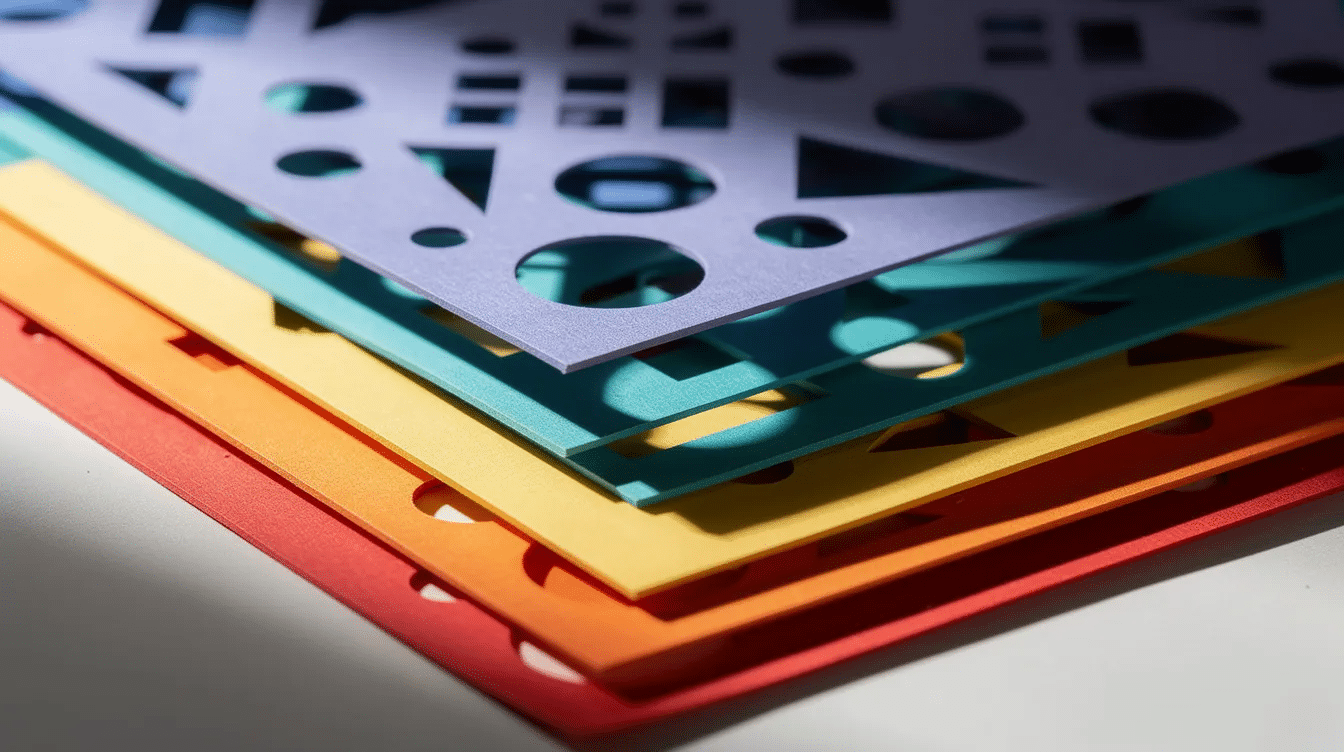
- Framing with apertures: Use circular or square holes in cardstock to frame printed photos, small watercolor paintings, or collage elements. A 200 gsm card with a precisely cut window creates professional-looking picture mats without buying expensive pre-cut frames. The bore edge can be left raw for a handmade look or sanded fine for clean gallery-style presentation.
- Paper glasses for kids: Cut eye-shaped holes in colored cardstock rectangles to create wearable paper glasses. Use this project to practice cutting small holes consistently. Add decorative elements around the frames, or pair it with creative paper squishies ideas, and suddenly you have a craft that combines technique practice with play.
- Windows in paper structures: Small square or rectangular holes become lit windows in paper houses, lighthouses, or cityscapes. Back the holes with colored tissue paper for a glowing effect when held up to light. This technique works beautifully for holiday decorations, paper cup crafts projects, and dioramas in any room.
- Layered collages and shadow boxes: Cut random curvy or angular holes in multiple sheets, stack them with spacers, and create dimensional art with moiré shadows. Different paper types (Bristol, pastel, newsprint, or handmade paper sheets for creative projects) create texture contrast. Each layer reveals glimpses of the layers beneath.
- Peek-through pages in journals: Cut windows in sketchbook pages to create visual connections between spreads. The space opened by each hole invites interaction and draws the eye through the book as readers pass from page to page, especially when combined with creative and useful things to print on paper like quotes, calendars, or patterns.
- Combine techniques: Mix folding methods, chunked cuts, punches, and different tools within a single piece. The contrast between machine-perfect punched circles and hand-cut organic curves creates visual interest that neither could achieve alone, and you can even integrate creative uses of paper mache for art projects alongside cut-paper work for added dimension.
Key takeaways
- Match tool, technique, and paper type: Punches deliver perfect circles from 3-50 mm, scissors work best on light papers under 120 gsm, and knives excel on thick or precision work. Most people can cut clean holes by simply using the right tool for their material.
- Use folding for symmetry and efficiency: Folding paper before cutting halves your work while ensuring matched shapes. Cut in sections rather than continuous curves, rotate the paper instead of your wrist, and approach difficult curves from both directions to avoid tears and creases.
- Practice on scrap before final cuts: Keep blades sharp (snap off segments frequently), use a cutting mat for support, and test your method on the specific paper—whether newsprint, printer paper, cardstock, Bristol, pastel, or cardboard—before committing to final artwork.
- Experiment with creative applications: From framing photos to making walk-through loops that seem impossible, holes in paper open up ideas for art, science demonstrations, and simple magic tricks.
With a little practice, anyone can cut accurate, creative holes for crafts, art projects, and surprising stunts that make friends and kids say “how did you do that?”