Paper decorations transform any space from ordinary to festive without breaking the bank, making them a cheap and budget-friendly way to decorate. Whether you’re prepping for a birthday party, adding charm to your home decor, or looking for fun projects to do with kids, making paper decorations is super easy and surprisingly satisfying. In this post, you’ll learn everything from quick 15-minute garlands to impressive 3D paper stars, with clear instructions for each project.
- Introduction to Paper Crafts
- Quick Start: Easiest Paper Decoration to Make Today
- Essential Tools and Paper Types for Decorations
- Simple Paper Decorations for Everyday Use
- Party & Holiday Paper Decorations
- 3D Paper Decorations and Models
- Kids’ Paper Decorations: Safe and Fun Projects
- Tips for Professional-Looking Paper Decorations
- Common Mistakes to Avoid
- Planning Your Next Paper Decoration Project
Introduction to Paper Crafts
Paper crafts are a fantastic way to bring creativity and personality into your home decor while also helping to reduce waste. With so many ways to make paper decorations, you can transform simple sheets of paper into amazing works of art—whether you’re crafting delicate paper snowflakes, bold garlands, or intricate 3D models. One of the best things about paper crafts is their eco-friendly nature; you can reuse old magazines, scrap paper, or leftover tissue paper to create beautiful decorations and keep waste out of the landfill.
No matter your skill level, paper crafts offer endless opportunities to create and have fun. Beginners can start with super easy projects like snowflakes or simple banners, while experienced crafters can challenge themselves with layered flowers or geometric designs. The world of paper crafts is full of inspiration, and every project is a chance to make paper into something truly special for your home, a party, or just to brighten your day. So gather your supplies and join a community of makers who know that with a little effort, you can create decor that’s both beautiful and sustainable.
Quick Start: Easiest Paper Decoration to Make Today
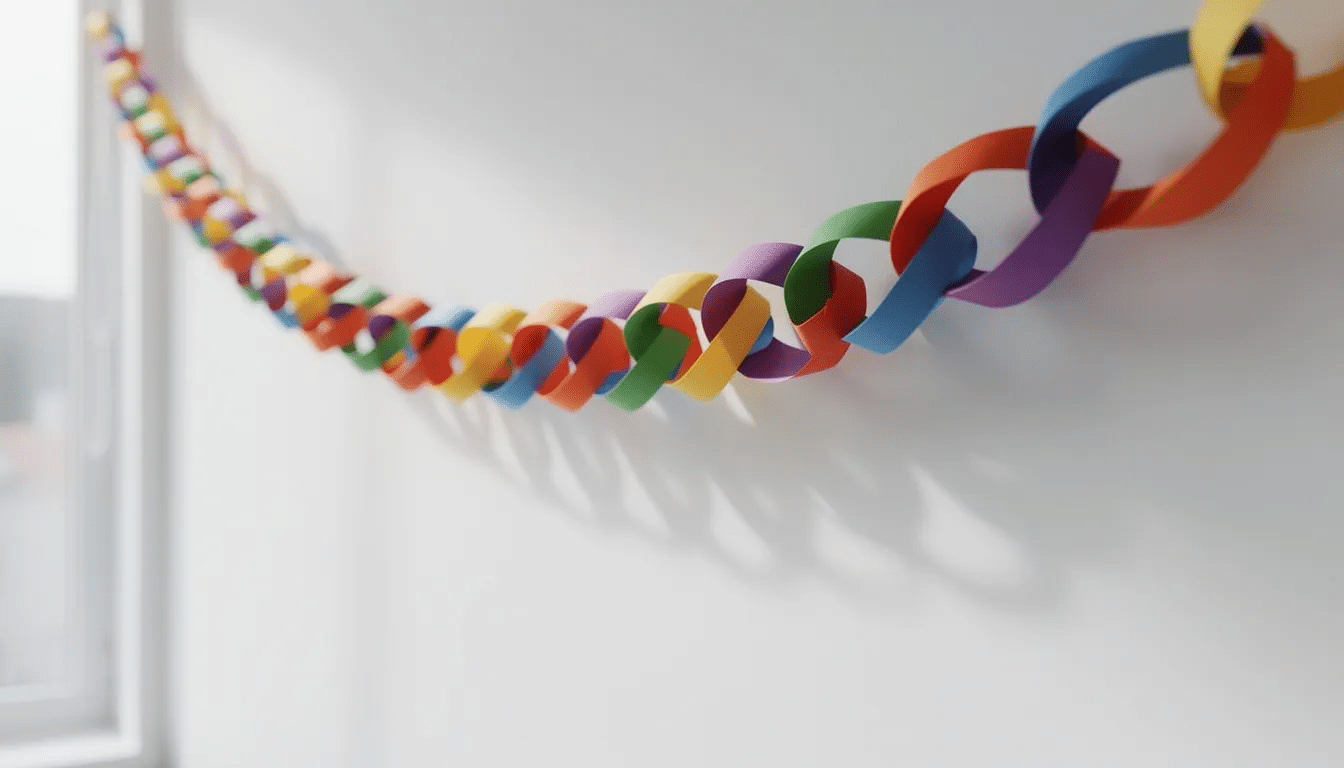
Let’s skip navigation through complex tutorials and get straight to a project you can complete in under 15 minutes. This simple paper chain garland works for any occasion—last-minute birthdays, baby showers, or casual get-togethers where you need decorations fast.
Here’s what you’ll need, and most of these are probably already somewhere in your house:
- 10–15 sheets of A4 colored paper or basic printer paper
- Scissors
- Glue stick or tape
- Pencil
- Ruler
- String (optional, for hanging)
Start by cutting your paper into strips approximately 2.5 cm wide and 20 cm long. Take your first strip and form it into a loop, securing the ends with glue or tape. Thread your second strip through the first loop before closing it into its own ring. Continue this pattern, alternating colors if you like, until you reach your desired length.
Once complete, hang your garland on a wall, across a doorway, or draped along a mantelpiece. The whole project takes about 10–15 minutes for a 2-meter chain.
A quick tip on color selection: match your palette to the event. Red and white work beautifully for a 4th of July celebration, while gold and white create elegance for New Year’s Eve on December 31. For a child’s party, try a rainbow pattern that moves through the spectrum.
Essential Tools and Paper Types for Decorations
Choosing the right paper and tools makes every project easier, safer, and more enjoyable. Before diving into complex craft ideas, understanding your materials prevents frustration and waste.
Common Paper Types:
Standard printer paper (80 gsm) handles most basic projects like garlands and simple cutouts. Construction paper offers vibrant colors and slightly more weight, making it ideal for kids’ projects. Cardstock (200–250 gsm) provides the rigidity needed for 3D models and standing decorations. Tissue paper creates delicate flowers and pom-poms with its lightweight, translucent quality. Crepe paper stretches up to 50% of its length, perfect for ruffled flowers and voluminous decorations. Origami paper comes pre-cut in squares with crisp folding properties.
You can find these materials affordably at local dollar stores, stationery shops, big-box supermarkets, or online marketplaces. In 2024, craft supply accessibility has never been better, with many stores offering budget packs specifically for paper crafts and guides that explain the best types of paper for craft and their uses.
Essential Tools:
Sharp scissors remain your primary cutting tool—invest in a quality pair that stays sharp. A craft knife handles intricate cuts, while a metal ruler ensures straight lines. A self-healing cutting mat protects your table and reduces knife slips by up to 90%. For adhesives, keep both a glue stick for quick bonds and liquid craft glue for stronger holds. Double-sided tape works wonders for clean, invisible attachments. A hole punch and stapler round out your basic kit.
- Safety note: When working with kids, supervise all craft knife and hot glue gun use. Pre-cut complex shapes for younger children and keep sharp tools out of reach between supervised sessions.
Simple Paper Decorations for Everyday Use
Not every decoration needs a special occasion. Simple paper projects can brighten hallways, kids’ rooms, and home offices year-round. These ideas use mainly colored printer paper and take minimal effort to create, much like other cute paper craft ideas for fun and easy DIY projects.
Paper Chain Garlands remain the classic starting point—quick loops of color that transform any corner. Expect about 20 minutes for a full room accent, completely beginner-friendly.
Paper Butterflies add whimsy when clustered above a child’s desk or floating near a window. Cut templates in large, medium, and small sizes, fold slightly at the center for dimension, and attach with a pin or tape. About 15 minutes for a set of five.
Simple Paper Flowers brighten a jar or vase on your table. Roll and layer petals from colored paper, securing with glue at the base. Twenty to thirty minutes creates a small bouquet that never wilts, or you can explore more detailed crepe paper flower ideas for stunning DIY projects.
Paper Drawer Liners turn scrap paper from old calendars or magazines into functional decor. Cut to size and lay flat—zero effort, instant refresh.
Mini Paper Banners spell out words or display patterns across bookshelves. Perfect for when guests arrive for a casual dinner and you want that extra touch.
These projects embrace the reuse philosophy. Old calendars, magazines, and misprinted documents become raw materials instead of waste. You save money while giving new life to paper headed for the recycling bin.
How to Make a Simple Paper Garland
This detailed tutorial provides step-by-step instructions to walk you through creating a classic paper chain garland from scratch. The method is easy to make and works for so many ways of decorating.
Begin by measuring and cutting your paper into strips. Each strip should measure approximately 2.5 cm wide by 20 cm long. Use your ruler to mark consistent widths, then cut with confident, single strokes for clean edges.
Form your first ring by bringing the short ends of one strip together, overlapping by about 1 cm. Apply a small amount of glue or a piece of tape to secure. Press firmly for a few seconds to ensure a solid bond.
Thread your next strip through the completed ring before closing it into its own loop. This interlocking method creates the chain effect. Continue adding links, checking occasionally that your rings face the same direction for a uniform appearance.
For a 2-meter garland suitable for a doorway or window, you’ll need approximately 30–35 links, though this varies slightly based on your paper width and overlap.
Color ideas make all the difference. Alternating two colors creates a classic pattern. Rainbow order delights at kids’ parties. Monochrome chains in varying shades suit minimalist decor. For a birthday party theme, match the honoree’s favorite colors.
Hang your finished garland across windows, drape it along a mantelpiece, wrap it around stair railings, or string it across a photograph wall for an at-home celebration backdrop.
Quick Paper Wall Hanging for Small Spaces
A geometric wall hanging adds visual interest without taking up floor space—perfect for apartments, home offices, or that awkward corner beside a bedroom mirror. It fits right in with other fun paper activities for creative minds of all ages.
Start by choosing your shapes: circles, triangles, or hearts work equally well. For circles, trace around cups or jar lids for consistent sizes. Hearts and triangles work better with simple cardboard stencils you can create once and use repeatedly.
Cut your shapes neatly from cardstock—the heavier weight gives better drape and durability than standard printer paper. Aim for 15–25 shapes total, divided across 3–5 vertical strings.
Punch or pierce a small hole near the top edge of each shape. Thread your string through each hole, spacing shapes at regular intervals (roughly 8–10 cm apart). You can tape the back of each shape to keep it from sliding, or tie small knots above and below each piece.
This project takes around 30–40 minutes and creates an amazing backdrop for video calls, a cute accent above a desk, or a simple focal point in any small space.
Experiment with patterns: all one shape in varying sizes creates cohesion, while alternating shapes adds playfulness. Old greeting cards provide excellent visual texture and let you reuse materials you might otherwise miss and throw away.
Party & Holiday Paper Decorations
Special occasions deserve special decorations. These ideas coordinate with color themes and can typically be prepared a day or two before the event—so if you have a birthday on March 10, start crafting on March 8 or 9 and draw inspiration from the best birthday paper decorations for your celebration.
Tissue Paper Pom-Poms create soft, voluminous spheres perfect for hanging above dessert tables or in corners of the party space. Stack sheets of tissue paper, accordion-fold, secure in the center with a twist tie or wire, then pull and separate each layer into a fluffy ball.
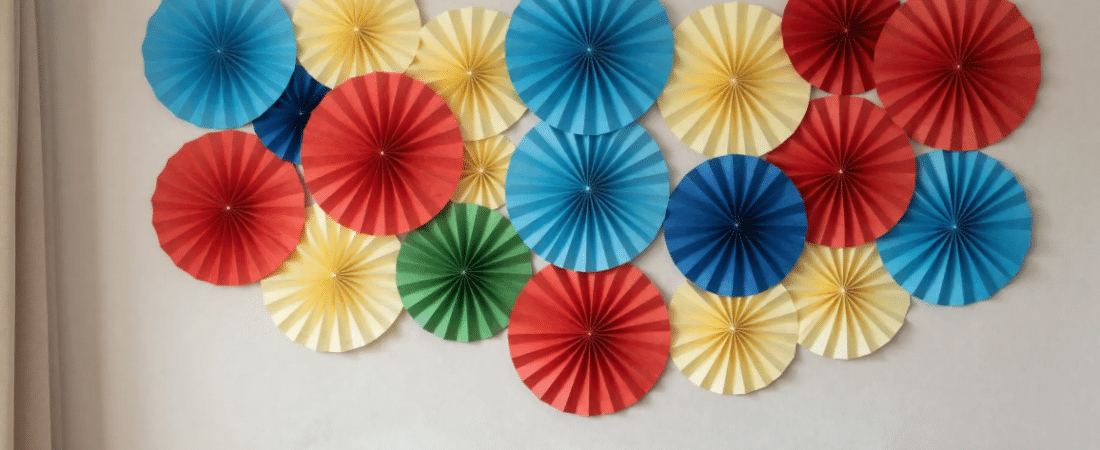
Paper Fans (rosettes) make stunning backdrops behind cakes or photo areas. The accordion-fold technique transforms flat sheets into dramatic circles.
Tassel Garlands add movement and texture along table edges or doorways. Cut tissue paper into fringe strips, roll around string, and hang in cascading rows. Tissue paper tassel garlands are easy to make and can be customized for any party theme.
Paper Table Confetti scattered across serving areas adds instant festivity. Use a hole punch on colorful cardstock for quick, uniform circles, or cut custom shapes matching your theme.
Simple Paper Wreaths welcome guests at the front door. Layer cut shapes—leaves, flowers, or geometric patterns—onto a cardboard ring base.
- Pro tip: Reuse leftover tissue paper from gift bags and wrapping paper from previous holidays to reduce waste and save money. That tissue paper from last year’s birthday gifts becomes this year’s party pom-poms.
- Cupcake liners can be strung together to create colorful garlands or hanging, scalloped banners.
Balloons are also a versatile and colorful embellishment for party decor. Incorporate balloons into garlands or hanging decorations to create a festive atmosphere.
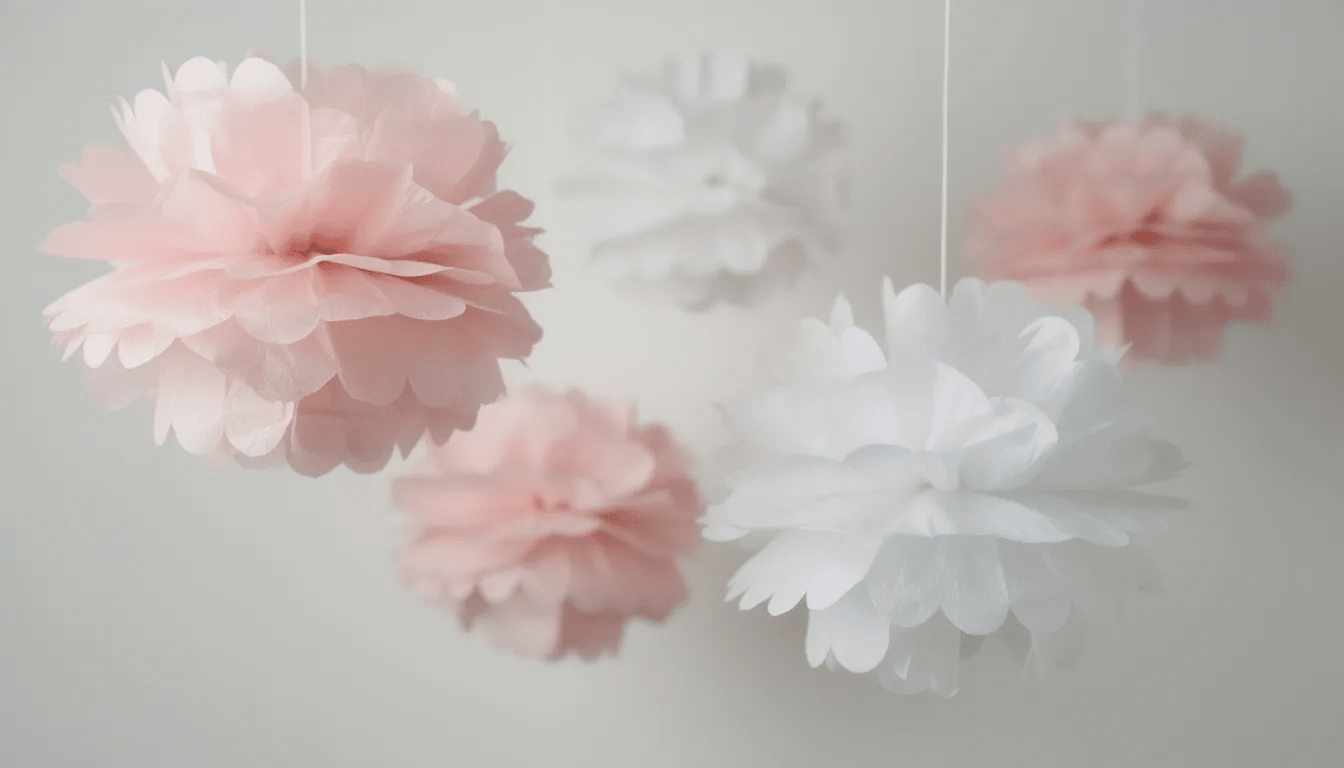
DIY Paper Fans for Photo Backdrops
Circular paper fans (rosettes) rival store-bought decor at a fraction of the cost. Use wrapping paper, scrapbook paper, or even brown kraft paper for different aesthetics.
Start with a strip of paper approximately 30 cm long and 15 cm wide. Fold accordion-style in increments of 2–3 cm, pressing each crease firmly with your fingers or a bone folder for crisp lines.
Once fully folded, pinch the stack at its center and secure with a small piece of tape or a twist tie. Fan out both sides until they meet, then glue or tape the edges together to complete the circle.
Large fans may require joining two or three strips of paper together before folding. For especially large fans, you may need to secure two pieces of scrapbook paper together to form a complete fan, folding and fanning out each half before combining them. Smaller fans work perfectly from a single strip. Mix diameters for visual interest—try 15 cm, 25 cm, and 35 cm fans together.
Layer your completed fans onto a foam board or large piece of cardboard to create a full backdrop. Overlap edges slightly, mixing colors and sizes. Add a contrasting circle cut from cardstock to the center of each fan for a polished finishing touch.
A complete backdrop of 10–15 fans takes approximately 2 hours. Plan this project for the weekend before your event, and you’ll have a professional-looking photo area that impresses every guest. This works beautifully for birthdays, New Year’s Eve parties, or bridal showers.
Seasonal Paper Decorations (Halloween, Christmas & More)
Seasonal decorating becomes simple when you master basic cutting and folding techniques. The same skills create paper snowflakes for December windows, orange paper pumpkins for October 31 Halloween, and red paper hearts for Valentine’s Day on February 14.
Winter Decorations: Classic paper snowflakes for beautiful winter decor remain unmatched for holiday charm. Fold a square of white paper into triangles, cut geometric patterns along the folded edges, then unfold to reveal intricate designs. Hang snowflakes from fishing line at varying heights for a falling snow effect. Seven years ago, this technique filled community center windows—it still works beautifully today.
Halloween Projects: Orange and black paper transform into pumpkins, bats, and spiders. Cut simple pumpkin shapes from orange paper, add black facial features, and string them into a garland for your entryway. Accordion-folded bats add dimension when suspended from ceiling corners.
Valentine’s Decor: Red and pink hearts cut in graduated sizes create a striking wall display above a dining table. Layer three to five heart sizes from largest to smallest, offset slightly, for depth that catches the eye.
Rather than rushing the night before each holiday, make a small set each weekend during the month leading up to the celebration. This spreads the effort and lets you enjoy the creative process without deadline stress.
How to Make Paper Snowflakes
Making paper snowflakes is a super easy and fun project that anyone can try, no matter your age or experience. All you need is a piece of paper, a pair of scissors, and a pencil. Start by folding your paper in half, then fold it again into a triangle or smaller sections for more intricate patterns. Draw your design along the folded edges—think about where you want to cut shapes or patterns to create unique snowflakes.
Carefully cut along your drawn lines, making sure to keep your scissors steady for smooth edges. Don’t be afraid to experiment with different patterns—try zigzags, curves, or tiny triangles for a variety of effects. Once you’re done cutting, gently unfold the paper to reveal your one-of-a-kind snowflake. These paper snowflakes make perfect home decor for winter or any time you want to add a touch of magic to your space. With just a little practice, you’ll be able to create a flurry of beautiful snowflakes to hang on your wall, windows, or even use as party decorations.
3D Paper Decorations and Models
Three-dimensional paper decorations take your skills to the next level. These objects hold their shape, standing on shelves or hanging from ceilings as focal points. Projects include paper lanterns, geometric mobiles, and sculptural stars.
These projects require slightly more time—typically 1–3 hours—and work best with heavier paper. Cardstock in the 200–250 gsm range provides the rigidity needed for structures that won’t collapse under their own weight.
A simple 3D paper star makes a stunning ceiling accent or shelf display. Geometric hanging mobiles combine multiple shapes on strings for kinetic art that moves with air currents. Basic folded paper lanterns, designed for LED candles only, create ambient lighting for evening gatherings.
Pre-cut kits exist for complex models like decorative deer heads or owl sculptures, but cutting your own pieces keeps costs low and builds valuable skills.
For best results, print templates at exactly 100% scale—check your printer settings carefully. Score all fold lines before bending by running a blunt knife or empty ballpoint pen along the line with a ruler. This technique, borrowed from professional paper artists, creates cleaner edges and more polished final results.
YouTube offers a wealth of video tutorials for creating advanced 3D paper decorations, such as geometric mobiles and flower pomander balls. DIY giant crepe paper flowers can be created using crepe paper and wire for dramatic, oversized floral decor.
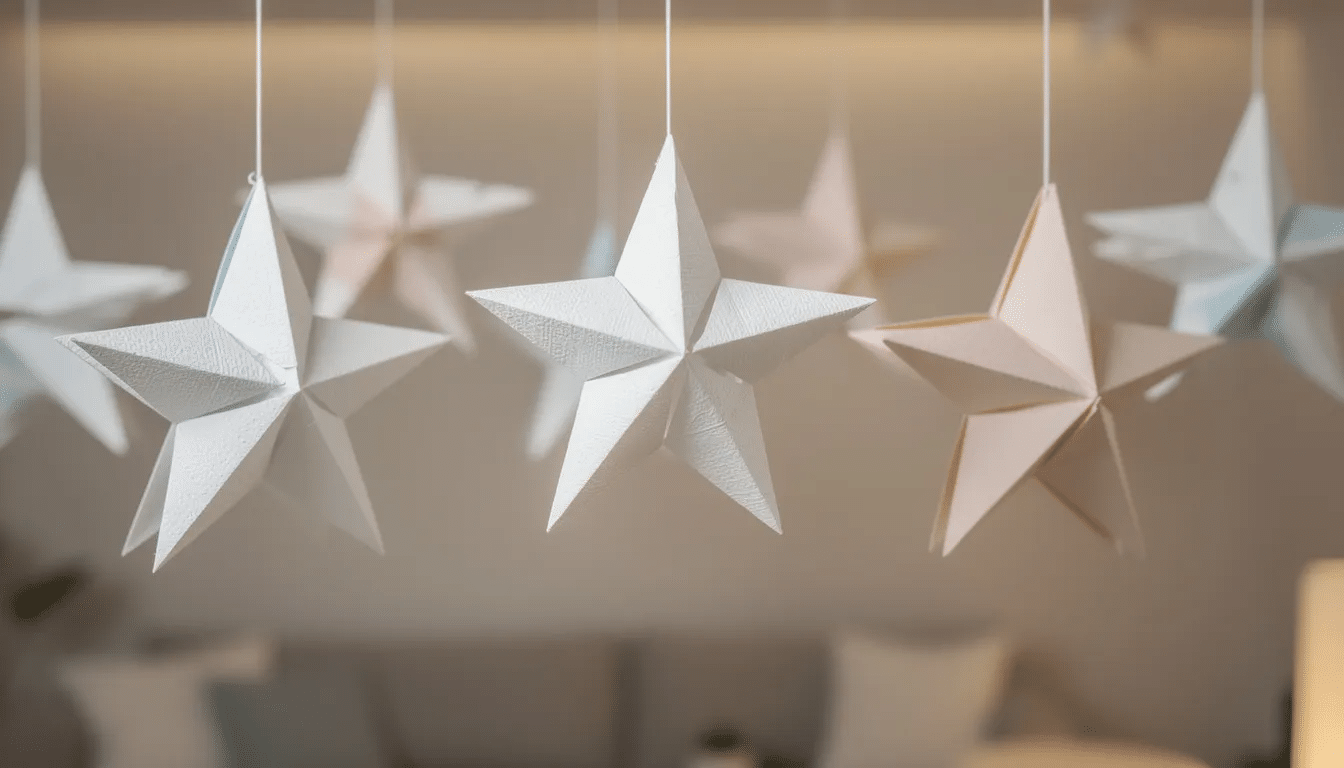
Making a Simple 3D Paper Star
This dimensional star hangs from ceilings or stands on shelves, perfect for winter decor or New Year’s Eve celebrations. The project takes about 45–60 minutes and requires only cardstock, scissors, glue, and optional thread.
Begin by drawing or printing a five-point star template approximately 20 cm across. Cut two identical stars from your cardstock. White, gold, or silver metallic cardstock creates particularly stunning results around late December celebrations.
On each star, score lines from the center point to the inner angles between each point. Fold along these scored lines, pushing alternating sections up and down to create a faceted surface.
Apply glue to one half of one star’s back surface. Align your second star precisely and press the halves together. The opposing folds create volume and dimension that catches light beautifully.
For a hanging decoration, thread a needle with about 30 cm of string and push it through one point before gluing the halves together. Tie a loop at the top for hanging. For a standing decoration, leave one point flat against your surface as a stable base.
Complete stars can be displayed individually or grouped in clusters of three to five for greater impact. Experiment with different sizes—try 15 cm, 20 cm, and 25 cm stars together—for layered visual interest.
Basic Paper Lantern for LED Lights
Paper lanterns create warm, inviting ambience for evening dinners, balcony gatherings, or cozy winter nights. This project produces a rectangular or cylindrical lantern with decorative cut-out patterns that glow when illuminated from within.
Critical safety note: Use only battery-operated LED tea lights inside paper lanterns. Never use open-flame candles. Position completed lanterns away from small children and pets, and never leave illuminated lanterns unattended.
Cut a panel of cardstock approximately 20 cm tall by 40 cm wide for a standard rectangular lantern. Mark your window designs on the inside surface—stars, stripes, simple florals, or geometric patterns all work well.
Using a craft knife on a cutting mat, carefully cut out your marked designs. Work slowly and rotate the paper rather than the knife for curved cuts. Once complete, score vertical fold lines at 10 cm intervals to create four equal sides.
Fold along your scored lines, then glue the short edges together to form a rectangular tube. Cut a base panel slightly smaller than the lantern’s footprint, fold small tabs along each edge, and glue inside the bottom.
Each lantern takes approximately 45–60 minutes. A set of three lanterns creates a cohesive display. Place them along a windowsill, down the center of a table, or grouped on a shelf for maximum effect.
Kids’ Paper Decorations: Safe and Fun Projects
Paper crafts provide excellent opportunities for children aged roughly 5–12 to develop creativity, motor skills, and patience. The key lies in choosing age-appropriate projects and maintaining proper supervision, supported by inspiration from broader paper crafting ideas and tutorials.
Ideal Projects for Kids:
Handprint garlands let children trace and cut their own shapes for personalized decorations. Simple paper crowns become wearable art for pretend play. Paper bag stars transform lunch bags into stunning decorations. Easy accordion fans provide blank canvases for crayon and sticker decoration.
Adult Responsibilities:
Pre-cut small or complex shapes before craft sessions begin. Supervise all scissors and glue use actively—don’t just be in the room, be involved in the process. Choose non-toxic, washable materials appropriate for the age group.
Perfect Occasions:
Birthday party activity stations keep young guests entertained while creating take-home favors. Rainy-day crafts during school holidays prevent boredom without screens. Classroom events in September (back-to-school) or December (winter celebrations) benefit from group decorating projects that draw on fun paper activities for all ages.
Encourage kids to choose their own color combinations and add names or dates to finished pieces. These personal touches transform simple crafts into keepsakes that families treasure for years.
Handprint Paper Garland for Birthdays
This project creates a personalized birthday garland where children trace and cut their own handprints, stringing them together with letters spelling “HAPPY BIRTHDAY” or the honoree’s name.
Have children place their hands flat on colored paper while an adult traces around the fingers with a pencil. For kids aged 7 and up, they can do this step themselves. Younger children may need full assistance.
Cut out the traced hands—adults should handle this for children under 6, while older kids can cut with supervision. Use a hole punch to create holes near the wrist area of each handprint.
Thread string through each hole, spacing handprints evenly. Between hands, add letter cards cut from contrasting paper to spell your message. The complete garland personalizes any celebration.
This project works especially well for milestone birthdays like 5th or 10th celebrations. After the party, roll the garland carefully and store it in a labeled box as a memory of that specific year. Pull it out at future birthdays to see how much hands have grown.
Start this project a day or two before the party. The crafting process keeps kids happily involved in preparations while building anticipation for their special day.
Paper Crowns for Play and Parties
Adjustable paper crowns turn every child into royalty. These simple creations work for pretend play on weekends, themed parties (princess, king, knight), or New Year’s Eve celebrations at home.
Measure a strip of cardstock around the child’s head, adding about 5 cm for overlap. Cut the strip approximately 10–12 cm tall. Along one long edge, cut triangular or rounded peaks to create the crown silhouette—you can do this freehand or use a template.
Children decorate their crowns with markers, stickers, glued-on paper shapes, or even glitter glue (over newspaper for easy cleanup). Encourage creativity here—there’s no wrong way to decorate a crown.
Fit the crown to the child’s head and secure the overlap with tape or a stapler. If using staples, cover them with a small piece of tape to prevent scratching.
Write the current year or event name on the inside of each crown. These small notes transform crowns into mementos that document celebrations throughout childhood. A box of crowns from years past becomes a touching reminder of how quickly children grow.
Tips for Professional-Looking Paper Decorations
Small habits separate amateur-looking crafts from polished decorations. These tips require no extra money—just attention to technique and choosing top craft paper supplies for creative projects.
- Make clean, confident cuts. Single strokes produce cleaner edges than hesitant, start-stop cutting. Use sharp scissors and replace or sharpen them when they start tearing paper.
- Score folds before bending. Run a bone folder, empty ballpoint pen, or blunt knife along fold lines with a ruler. This creates crisp, accurate folds every time.
- Match paper weight to your project. Use lightweight paper (20–80 gsm) for delicate elements like quilling and tissue flowers. Choose midweight (80–160 gsm) for folding. Select cardstock (200–300 gsm) for structures that need to stand independently.
- Test glue on scrap first. Different papers absorb adhesive differently. A quick test prevents visible glue marks on your final piece.
- Allow proper drying time. Rushing assembly causes pieces to shift before bonds set. Let glued elements dry completely before handling.
- Plan your color palette. Choose 2–3 main colors plus one accent, and repeat them across all decorations for a cohesive, intentional look.
- Avoid common mistakes. Too much glue causes warping and visible seepage. Rushed folds create crooked lines. Heavy decorations on weak tape fall mid-party—use appropriate hanging methods for the weight involved.
- Store flat decorations properly. Keep garlands, fans, and flat pieces in labeled envelopes or folders. They’ll last through multiple events throughout the year, saving future effort.
Common Mistakes to Avoid
Even the most creative paper crafts can run into trouble if you’re not careful with a few key steps. One common mistake is using too much glue, which can make your paper soggy and cause your decorations to lose their shape. To avoid this, use a hot glue gun or apply just a small amount of glue—enough to hold things together without soaking the paper.
Another pitfall is not folding your paper correctly. Uneven or rushed folds can distort your design and make your finished piece look messy. Always take your time, use a ruler or straight edge to guide your folds, and press down firmly for crisp lines. Finally, be gentle when handling your paper—pulling too hard can cause tears, especially along the edges or at fold lines. With a little patience and attention to detail, you’ll be able to create paper crafts that look polished and last for years. Remember, practice makes perfect, and every project is a chance to improve your skills and create something beautiful—or even explore paper crafts that sell well for crafters and entrepreneurs.
Planning Your Next Paper Decoration Project
You now have the complete guide to creating paper decorations for any occasion. The question isn’t whether you can do this—it’s which project you’ll try first.
Choose one small project to attempt this week. A simple paper garland for a weekend movie night takes just 15 minutes. A mini fan for an upcoming birthday creates that handmade touch guests remember. Even a handful of paper butterflies above your desk brightens daily life.
Create a simple planning routine: pick your event date, choose a 2–3 color palette, decide on decoration types (perhaps one garland plus one 3D centerpiece), and gather all materials in one box or tray before you begin. This preparation prevents mid-project store runs and keeps creative momentum flowing.
Mix approaches for balanced results. Combine simple 2D decorations like garlands and wall hangings with one 3D centerpiece such as a paper star or lantern. The variety creates visual interest while keeping your workload manageable.
Don’t forget that skill improves quickly with practice. Your first garland might have uneven loops. Your initial paper star might show visible glue marks. These imperfections carry charm—they’re signs of handmade authenticity that mass-produced decorations can never replicate.
Photograph your finished decorations and note what worked well. This simple documentation helps you plan future events, whether that’s next month’s birthday or holidays throughout the year. Join the growing community of crafters discovering that beautiful decorations don’t require big budgets—just paper, basic tools, and a willingness to create.
Your next celebration deserves that personal touch. Pick a project, gather your materials, and start crafting today.