
Last spring, I walked into a party supply store looking for decorations for my daughter’s birthday and nearly dropped my phone when I saw the price tags. Pre-made tissue paper fans were running $4 to $6 each—and I needed at least a dozen for the backdrop I had in mind. That’s when I decided to figure out how to make them myself, and I haven’t looked back since.
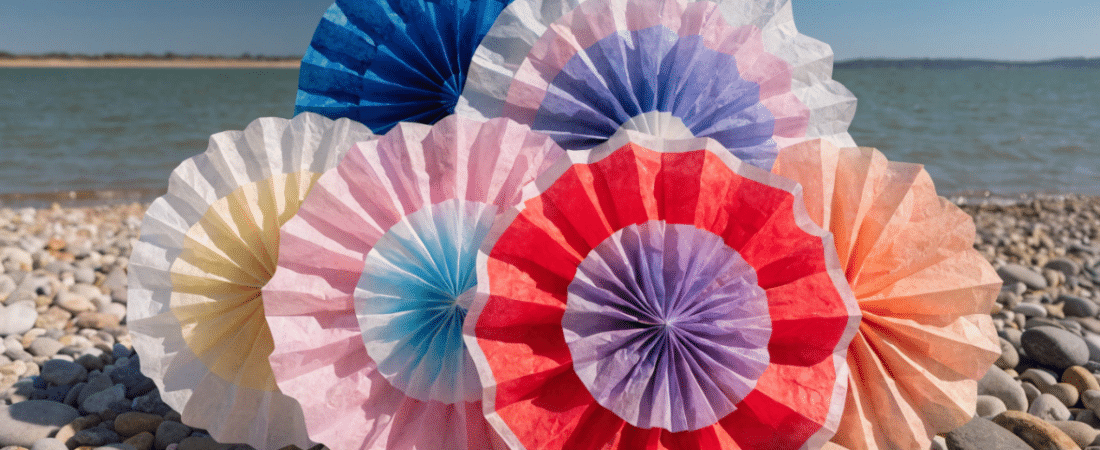
This guide is perfect for beginners, crafters, and anyone looking to create affordable, elegant party or wedding decor. A tissue paper fan is a lightweight, circular decoration made by stacking 8–10 sheets of tissue paper, folding them accordion style, securing the center, and fanning out the folds to create a decorative shape. Tissue paper fans are a cost-effective and customizable way to add color and dimension to any celebration.
Tissue paper fans are a relevant and valuable decoration choice because they are lightweight, easy to hang, and can be reused for multiple events. Their versatility makes them ideal for weddings, birthdays, baby showers, and more. With a wide range of colors and patterns available, you can easily match any event theme or color scheme. Plus, their affordability means you can create a stunning backdrop or festive atmosphere without breaking the bank.
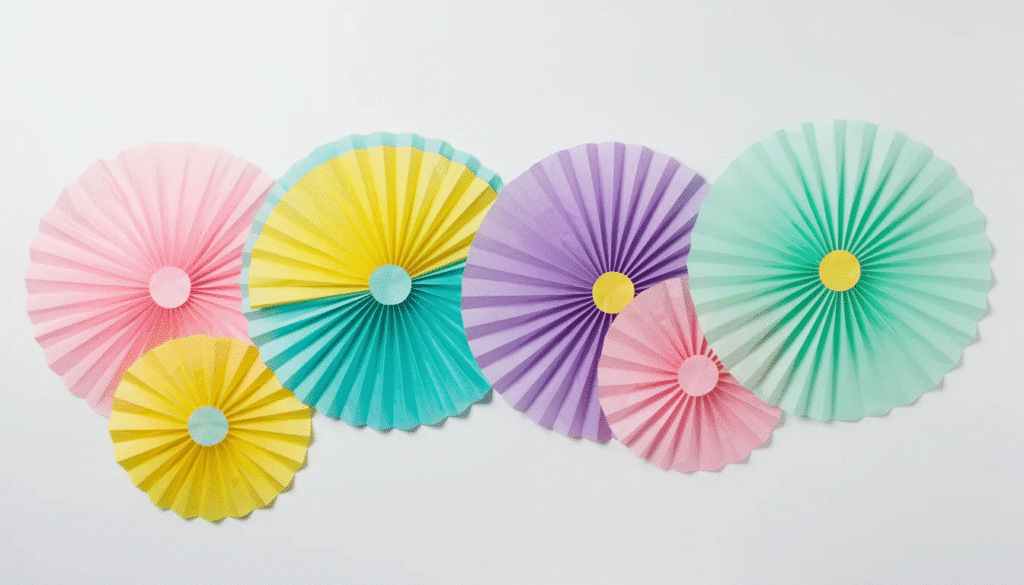
Why Choose Tissue Paper Fans?Tissue paper fans are incredibly versatile and can be used for a variety of occasions, including weddings, birthday parties, baby showers, and holiday celebrations. Their lightweight nature makes them easy to hang on walls, arches, or ceilings, and they can be arranged in clusters or as standalone decorations. Because they are available in many colors and designs, tissue paper fans can be customized to fit any event theme. They are also cost-effective and reusable—simply store them flat after your event and use them again for future celebrations. Whether you want to create a dramatic photo backdrop, decorate a dessert table, or add a pop of color to your venue, tissue paper fans are a practical and beautiful choice.
Here’s what you’ll learn:
- Which supplies to gather and how much tissue paper you actually need
- Step-by-step folding instructions with troubleshooting tips
- How to customize sizes, colors, and decorative centers
- Practical hanging techniques for walls, arches, and rented venues
- Budget breakdowns and theme inspiration for your next party
- Supplies You’ll Need for Tissue Paper Fans
- Step 1: Prep & Stack Your Tissue Paper
- Step 2: Fold Accordion-Style for the Fan Shape
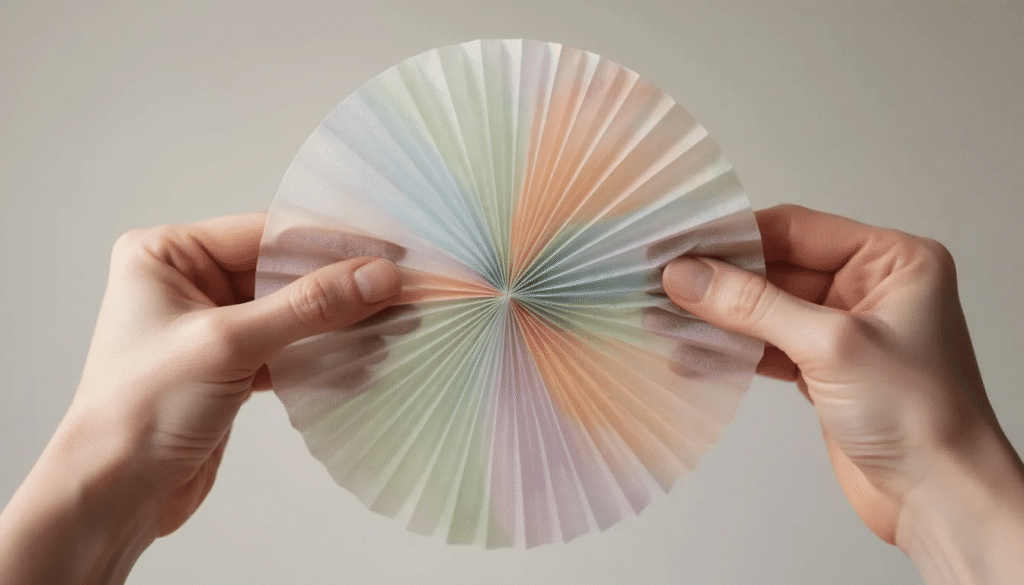
- Step 3: Shape, Secure, and Open the Tissue Paper Fan
- Step 4: Add Decorative Centers and Layered Designs
- How to Hang Tissue Paper Fans for Backdrops & Arches
- Budget, Time, and Theme Ideas
Supplies You’ll Need for Tissue Paper Fans
Before you start folding, gather these materials:
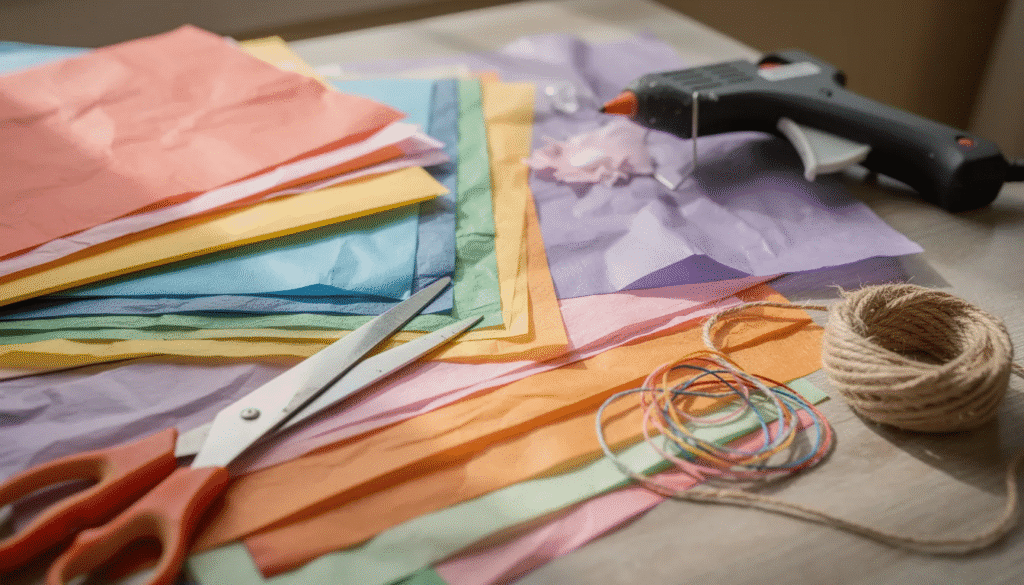
- Tissue paper sheets (20 x 26 inch packs from the party aisle work perfectly)
- Scissors (sharp craft scissors make cleaner cuts)
- Stapler with extra staples
- String or thin twine for securing centers
- Clear tape for connecting fan edges
- Hot glue gun and glue sticks for decorative centers and hanging loops
- Ruler and pencil for marking even folds
- Optional decorative centers (scrapbook paper circles, glitter cardstock, or metallic foil)
A standard pack of 20 tissue sheets will yield roughly 2-3 large fans or 4-6 medium fans, depending on how you cut and stack them. I recommend buying mostly solid colors and throwing in one or two patterned sheets per color family for visual interest without overwhelming the design.
One thing I learned through trial and error: not all tissue paper is created equal. Look for slightly heavier tissue that doesn’t crinkle too easily—the cheap box of tissue from the dollar store will tear more readily and won’t hold its shape as well. Spending an extra dollar on quality tissue paper from a craft store will save you frustration later.
While wrapping paper fans create a bolder, more structured look, this tutorial focuses on tissue paper’s soft, airy aesthetic that works beautifully for weddings and showers where you want that ethereal, romantic vibe, but exploring the best types of paper for craft can help you choose materials for coordinating projects..
Step 1: Prep & Stack Your Tissue Paper
The foundation of a beautiful fan starts with proper preparation. Stack 8 to 10 sheets of tissue paper neatly, aligning all edges as precisely as you can. This fuller stack creates that lush, fluffy appearance when the fan opens. If you prefer a flatter, more graphic look (which can be cute for modern party themes), use just 4 to 6 sheets instead.
For size customization, leave the full sheet intact for large fans that measure around 18 to 20 inches in diameter. Cut your stack in half for medium fans, or in thirds for smaller fans that work as accents between larger statement pieces. Use your ruler and scissors to trim evenly—don’t just eyeball it, or you’ll end up with wonky circles.
Before folding, square up the edges by gently tapping the stack on the table and smooth out any air pockets between layers. This step takes just a few seconds but makes a noticeable difference in how evenly your accordion folds lay.
Here’s where you can get creative: try grouping colors before stacking. For a wedding palette, alternate blush, ivory, and gold sheets within the same fan. When the fan opens, you’ll see subtle stripes of color peeking through—a detail that looks far more complicated than it actually is, and the same playful mindset works for other cute paper craft ideas you might try with your family..
For a full backdrop, plan to prep 12 to 15 large fan stacks, plus another 8 to 10 medium or small stacks to fill gaps. Trust me, it’s easier to prep all your stacks in advance rather than stopping mid-project to cut more paper.
Step 2: Fold Accordion-Style for the Fan Shape
This is the core technique, and once you nail it, every fan after becomes almost meditative to create.
Start on the short edge of your stacked paper. Fold up about 1 to 1.5 inches to form your first pleat, then press the crease firmly with your fingernail or the flat side of your scissors. Consistent fold width matters here—if one fold is half an inch and the next is two inches, your finished fan will look uneven and may not open into a proper circle.
Now flip the whole thing over and fold again in the opposite direction, creating that classic accordion (or concertina) pattern. Keep your folds roughly the same size as you work down the length of the paper. For a typical full-size fan, you’ll make somewhere between 16 and 22 folds depending on your paper size and fold width.
If you’re having trouble keeping folds even, use your pencil to make light marks along one edge as a guide before you start. This is especially helpful when you’re making multiple fans and want them all to look the same size.
Once you’ve folded the entire stack, gently tap the folded strip on the table to align any edges that shifted during folding. Be gentle—tissue paper is delicate, and aggressive handling will cause tears that show up later when you open the fan.
The easiest way to avoid error is to work slowly and press each crease firmly before moving on. Rushing through this step is where most mistakes happen.
Step 3: Shape, Secure, and Open the Tissue Paper Fan
Now comes the fun part—transforming your accordion strip into that gorgeous circular fan.
Fold your accordion strip in half to find the exact middle, and lightly crease that midpoint. This center crease is where you’ll secure everything together. Take your string, twine, or thin ribbon and tie it snugly around the center, placing the knot on what will become the back side of your fan. Don’t crush the folds by pulling too tightly—you want it secure but not strangled.
Before opening the fan, cut the ends of your folded strip into a shape. This detail transforms the whole look:
End Shape | Visual Effect |
|---|---|
Rounded | Soft, floral, romantic |
Pointed | Sharp starburst, modern |
Scalloped | Lace-like, vintage |
Straight | Clean, contemporary |
Use your scissors to cut through all layers at once, keeping the cut as even as possible. |
Now, gently pull open one side of the accordion until it meets the other end. Use clear tape or a staple to connect the outer edges into a full circle. If the whole thing wants to collapse back on itself, add one or two pieces of tape in interior folds near the center for extra stability.
Here’s my best troubleshooting tip: when separating the tissue layers to create that fluffy look, use your fingertips to slowly pull apart each sheet. The area near the tied center experiences the most stress, so work especially carefully there. Minor tears typically become invisible once the fan is fully fluffed, so don’t panic if you hear a small rip.
Step 4: Add Decorative Centers and Layered Designs
This step is optional but makes a dramatic difference in how polished your fans look. Those gorgeous fans you see on Pinterest? They almost always have decorative centers.
Cut 2 to 3 inch circles from scrapbook paper, glitter cardstock, or metallic foil—a drinking glass makes a perfect template if you don’t have a circle punch. Hot glue these circles over the tied center on the front of each fan to hide the knots and any messy tape underneath.
For even more depth, try layering smaller fans on top of larger ones. Glue them fan-to-fan at the center point. Using contrasting colors creates serious visual impact—imagine a large ivory fan with a medium blush fan layered on top, finished with a gold glitter center.
Some palette inspiration to spark your ideas:
- Wedding: Blush and ivory fans with gold glitter centers
- Baby shower: Soft mint, pale yellow, and white with silver centers
- Birthday party: Bright teal, coral, and yellow with bold patterned centers
- Festive holiday: Red, green, and white with star-shaped centers
This is also the moment to attach hanging loops if your fans will hang individually. Cut a short length of string, form a loop, and hot glue it securely to the back of the fan near the top edge.
How to Hang Tissue Paper Fans for Backdrops & Arches
Getting your fans on the wall or into an arch requires some planning, especially if you’re working in a rented venue where you can’t put holes in the wall.
For direct wall mounting, painter’s tape loops or removable adhesive hooks work well and won’t damage paint. Command strips provide superior hold for tissue fans—poster tack alone won’t secure them properly because tissue fans don’t have enough structural body to grip.
A smart technique for movable backdrops: first tape a plastic tablecloth or fabric panel to the wall, then attach your fans to that surface using strips of duct tape or strong masking tape on the backs. This creates a backdrop you can transport and reuse.
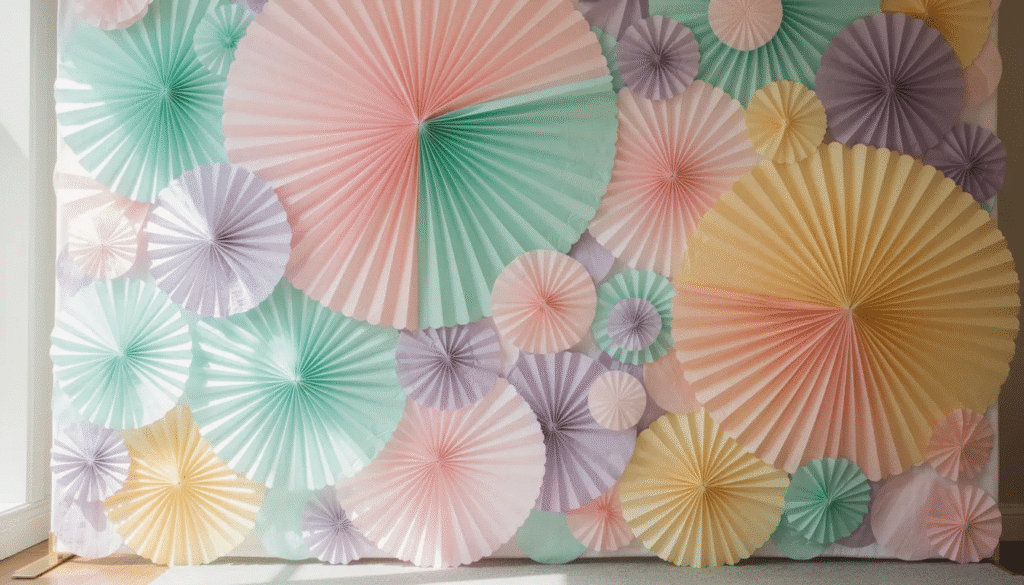
When arranging, start with your largest fans first. Lay them out in a pleasing pattern, overlapping them slightly like fish scales. Then fill gaps with medium and smaller fans to create that full, layered effect you see in professional installations.
For an arch, cut foam core or cardboard into your desired arch shape. Starting from the outside edge and working inward, densely cover the surface with fans. Secure each with hot glue applied to the ridges where the fan touches the cardboard, and consider mixing in softly glowing paper lanterns for every occasion to add light and height variation..
Before committing to permanent taping, take a quick photo of your layout on the floor. When you get to the venue, you can recreate the exact arrangement without second-guessing yourself.
One transport tip that will save you heartache: keep your finished backdrop or loose fans face-up in the car. Stacking them face-down or cramming them in a box will crush the tissue and ruin hours of work.
Budget, Time, and Theme Ideas
Let’s talk numbers. In 2024, a pack of 20 tissue sheets typically costs between $1 and $3 at most craft stores. That means each large fan costs you roughly 10 to 30 cents—compared to $4 to $6 each at the store. An entire backdrop that would cost $50 to $75 pre-made can be created for under $10 in materials.
Time investment is equally reasonable. Once you’ve learned the folding technique, expect to spend about 5 to 7 minutes per fan. A medium-sized backdrop takes approximately 1.5 to 2 hours from start to finish, including hanging time. You can easily decorate an entire wall in an evening while watching videos or listening to a podcast.
Here are some theme combinations to experiment with:
Event | Color Palette | Center Accent |
|---|---|---|
Baby shower | Soft pastels (mint, lavender, pale pink) | Silver or white circles |
Birthday | School colors or favorite bright shades | Patterned scrapbook paper |
Wedding | Dusty rose, sage, ivory | Gold glitter cardstock |
New Year’s Eve | Black, white, gold, silver | Metallic foil stars |
Graduation | School colors | Glitter in school colors |
Feel free to mix tissue paper fans with coordinating elements like tissue pom poms, string lights, or simple paper birthday decorations. The fans work as your main decoration while these accents add dimension and sparkle.
Don’t forget to save your favorites—snap photos for your website, share them on social media, or keep them as inspiration for future events. You can even pair your fans with custom printable decor and stationery like tags, banners, or signage. Many fans can be carefully stored flat in a box and reused if you’re gentle with them.
Here’s my challenge to you: make one test fan this week. Just one. See how simple the whole thing actually is, then scale up for your next event. Once you’ve mastered that accordion fold, you’ll never pay store prices for these decorations again. Drop a comment below sharing what event you’re creating fans for—I’m always excited to see what readers come up with, and your ideas might inspire someone else planning their own celebration.