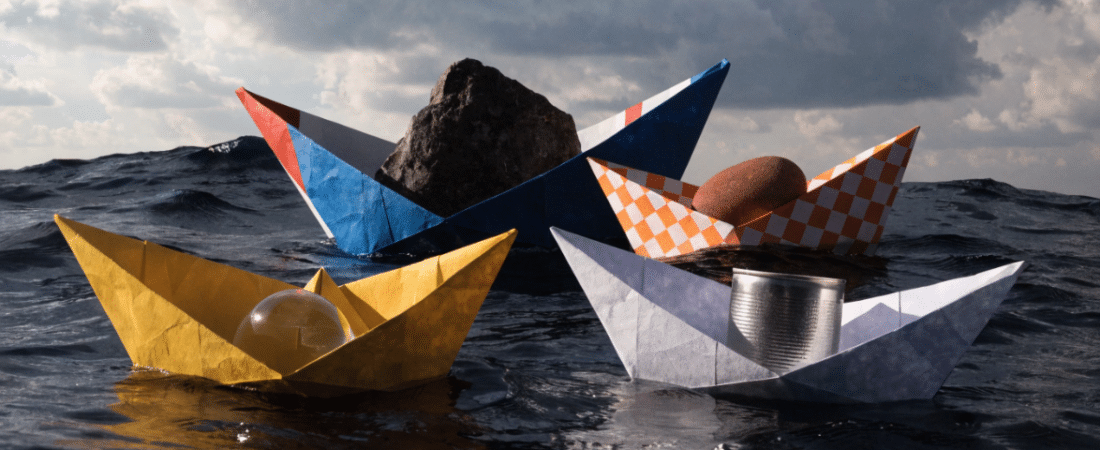
This article focuses on specific paper boat designs that can hold real weight—coins, mini figures, or other small cargo—without sinking immediately. You’ll quickly learn the best designs for maximum capacity, realistic benchmarks for how much weight they can hold, and how to test and improve them at home or in the classroom.
Understanding which paper boat designs hold the most weight helps children and adults learn about basic engineering and physics principles in a fun, hands-on way.
The instructions here are beginner-friendly, but they also include STEM-style tips for deeper experiments and data collection. Whether you’re a parent looking for a rainy-day activity, a teacher planning a science lesson, or a curious kid ready to experiment, this guide delivers practical results.
- Learn which hull shape holds the most weight
- Understand the science behind why things float
- Get specific capacity benchmarks (in pennies and grams)
- Use simple materials you already have at home
- Quick Start: The Strongest Paper Boat Design (for Holding Weight)
- Materials and Tools That Make a Big Difference
- Step-by-Step: Classic Origami Boat Modified to Hold More Weight
- Understanding Why Some Paper Boats Hold More Weight
- STEM Challenge: Paper Boat Weight-Holding Contest
- Boosting Capacity: Waterproofing and Reinforcement Tricks
- Age-Appropriate Variations and Learning Goals
- Testing, Troubleshooting, and Common Mistakes
- Conclusion: Turning Simple Paper Boats into Real Mini-Engineering Labs
Quick Start: The Strongest Paper Boat Design (for Holding Weight)
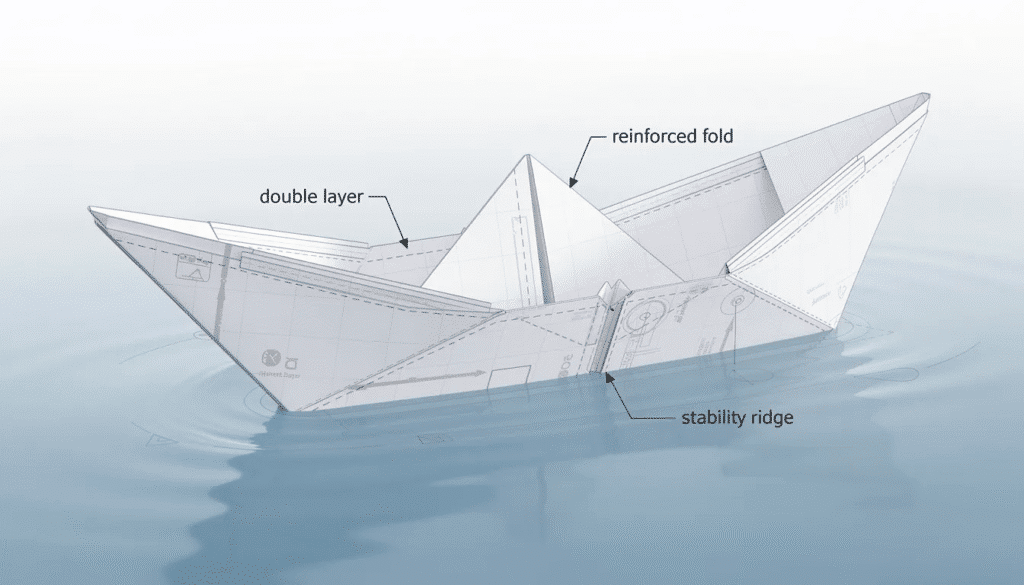
Summary:
The strongest paper boat designs for holding weight are wide, flat-bottomed, and shallow hulls (Fact: 1, 2, 3, 4). With proper design, paper boats can support significant weight, sometimes over 100 pennies, depending on their buoyancy and structural integrity (Fact: 5).
Which paper boat design holds the most weight? The answer is the flat-bottom barge-style boat with a wide hull. Unlike the classic pointed origami boat, a rectangular barge maximizes the surface area touching the water, which means it can displace more water and support heavier cargo before sinking.
This design isn’t as decorative as a sail boat, but it’s the most practical choice when your goal is to carry coins or other small weights. Let’s build one right now.
Materials needed:
- One sheet of standard A4 or US Letter copier paper (80–90 gsm)
- A large bowl or shallow plastic tub filled with water
- Small coins for testing (US pennies from 1982+ work well at approximately 2.5 grams each)
- Paper towel for drying between tests
Folding steps for a simple barge design:
First, lay your sheet flat on a clean, dry surface. Fold the paper in half lengthwise, creating a long rectangle—some call this the hot dog style fold. Press the crease firmly with your fingernail or the edge of a ruler.
Second, open the paper back up. Now fold each long edge toward the center crease, creating two thick walls about 1.5 inches tall. Press these folds firmly.
Third, fold up the short ends to create walls on all four sides. You’ll need to pinch and fold the corners so they overlap neatly—think of it like making a shallow rectangular tray or box.
Fourth, reinforce seams by pressing every crease one more time with a ruler edge. Weak spots in your folds will be the first places water enters.
Testing your barge:
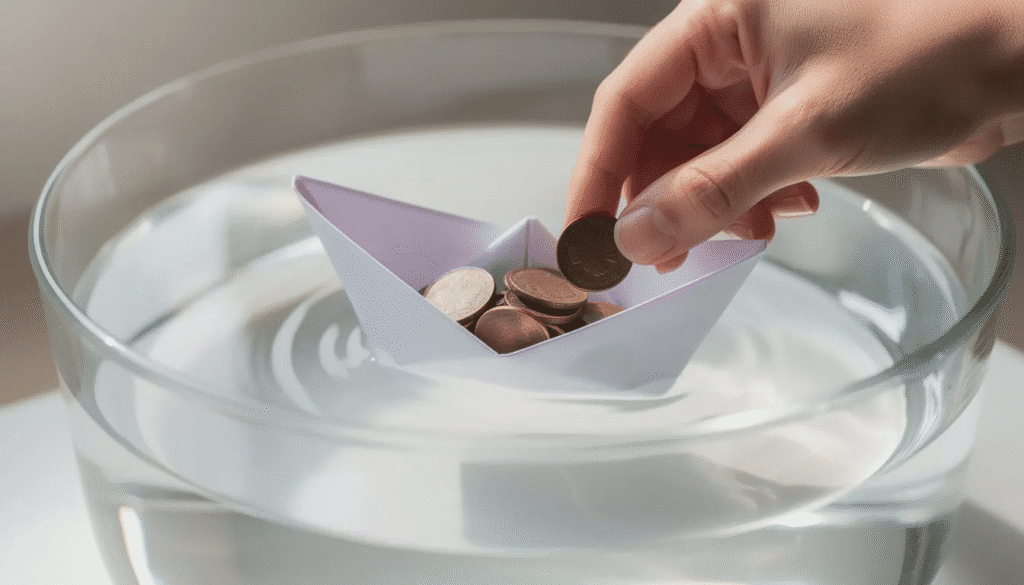
Place your finished barge gently on the water surface and let it settle for 30 seconds to check for immediate leaks. If it floats level, begin adding pennies one at a time to the center of the boat. Count each coin as you add it, waiting 3–5 seconds between additions.
A well-folded barge from 80–90 gsm paper can typically hold 15–30 modern pennies before taking on water, depending on your folding precision and how steady the water is. That’s roughly 37–75 grams of cargo from one sheet of paper.
Materials and Tools That Make a Big Difference
Paper choice and a few simple tools can double the weight capacity of the same design. Before you assume all paper is equal, consider that materials directly affect both strength and buoyancy.
Paper types and their effects:
- Standard printer paper (80–90 gsm): The baseline. Easy to fold, lightweight, but absorbs water within 2–3 minutes.
- Heavyweight printer paper (120 gsm): About 10–20% more capacity due to higher tensile strength. Sits slightly lower in the water due to added weight.
- Construction paper: More rigid initially but wicks moisture faster. Best for short tests.
- Thin cardstock (up to 160 gsm): Excellent for skeletal frames and reinforced designs. Can support 50+ pennies when combined with waterproofing.
- Waxed baking/parchment paper: Naturally water-resistant but harder to crease sharply.
- Aluminum foil-backed paper: Rare but excellent—combines foldability with waterproofing.
Trade-offs to understand: Heavier paper creates a stronger structure but sits lower in the water, reducing freeboard (the distance between waterline and edge). Very light paper is more buoyant but deforms easily under load.
Optional waterproofing supplies:
- Clear packing tape for sealing edges
- Wax crayons (thick application on the bottom)
- Candle wax (melt and rub—adult supervision required)
- Thinned white school glue brushed lightly and dried overnight
- Clear nail polish for small test areas (with adult supervision)
Tools for better results:
- Ruler for crisp, straight folds
- Blunt butter knife or bone folder for pressing creases
- Digital kitchen scale to weigh coins or cargo precisely
- Stopwatch or phone timer for consistent testing
- Notebook or simple data sheet for recording experiments
Mini materials test: Build the same barge design twice—once with 80 gsm paper and once with 120 gsm. Test both in the same tub with the same coins. Record how many each holds. This simple experiment reveals how much materials matter.
Step-by-Step: Classic Origami Boat Modified to Hold More Weight
The familiar “hat boat” or classic origami boat is a childhood staple. With its pointed bow and folded paper structure, it’s satisfying to make—but it doesn’t hold much weight in its default form. The good news: small modifications can significantly increase its cargo capacity, and once you’re comfortable with this model you can explore other top origami designs for every skill level..
Basic classic boat folding (abbreviated):
Start with your sheet oriented portrait-style. Fold in half widthwise. Fold the top corners down to meet at the center crease, forming a smaller triangle shape. Fold the bottom flaps up on each side. Open the triangle shape and flatten it into a square. Pull the outer points outward to open it into a boat.
This creates the classic shape, but it’s prone to tipping and has a narrow bottom. Here’s how to improve it:
Modifications for better weight capacity:
- Make narrower, taller sides: When folding the bottom flaps, fold them up higher than usual. This creates taller walls that prevent water from sloshing in when the boat sits lower under load.
- Add one extra fold to thicken the rim: After folding the bottom flaps up, fold them over one more time. This double-layer rim acts as a reinforcement beam around the top edge.
- Reinforce the pointed ends: The bow and stern of the classic boat are weak spots. Fold these points inward slightly before opening the boat, tucking them into the hull rather than leaving them as sharp points.
- Line the inside bottom: Cut a smaller rectangle of paper and place it flat inside the hull before testing. This distributes weight more evenly and prevents the center from sagging.
Weight test protocol:
Float your modified classic boat on calm water. Using tweezers or gentle fingers, add pennies or small metal washers one by one to the center. Stop adding weight when water reaches the side folds or the boat begins to tip.
A well-folded, reinforced classic boat typically holds 8–15 pennies, depending on symmetry and paper type. Compare this to the barge design, which often holds 15–30 pennies from the same sheet. The classic boat looks nicer, but the barge usually wins for cargo capacity.
Understanding Why Some Paper Boats Hold More Weight
Why does a flat sheet of paper sink while a folded paper boat can float and even carry cargo? The answer comes down to buoyancy and a principle discovered over 2,000 years ago.
Archimedes principle states that any object in water experiences an upward push equal to the weight of the water it displaces. If that upward force is greater than the weight of the boat plus everything inside it, the boat will stay afloat. If the downward weight exceeds the upward push, it will sink.
Buoyancy is the upward force that allows objects to float in a fluid (Fact: 2). Displacement is the principle that explains how buoyancy works; an object will float if it displaces a volume of water equal to its weight (Fact: 1). The shape of a boat affects its buoyancy and stability in water (Fact: 3).
A wider base displaces more water before the boat’s shape begins to submerge. This is why flat-bottom barge designs hold more coins than narrow, tall boats. The boat’s shape literally determines how much water it can push aside—and how much upward force it receives in return.
Stability matters too. When you place coins in your boat, you’re adding weight. If that weight sits low and centered, the boat’s center of gravity stays low, and it resists tipping. If you stack coins high or place them near one edge, the center of gravity rises or shifts, and the boat becomes unstable. Watch what happens when you place the same number of coins in a tall stack versus spread flat across the bottom corner—the flat arrangement almost always survives longer.
Crisp, straight folds act like structural beams in a building. They distribute weight across the hull instead of letting the paper sag in the middle. This is why pressing every crease with a ruler edge isn’t just a nice touch—it’s essential for maximum capacity.
A simple numeric example: A barge that supports 25 pennies is holding approximately 62.5 grams of cargo. If the paper barge itself weighs around 5 grams, then the water is supporting nearly 70 grams total. That’s impressive for folded paper!
Try this experiment: Load one boat with 10 pennies spread evenly across the bottom. Load an identical boat with the same 10 pennies stacked in a tall pile in the center. Observe which tips first. This demonstrates how density of cargo placement affects stability—not just total weight.
STEM Challenge: Paper Boat Weight-Holding Contest
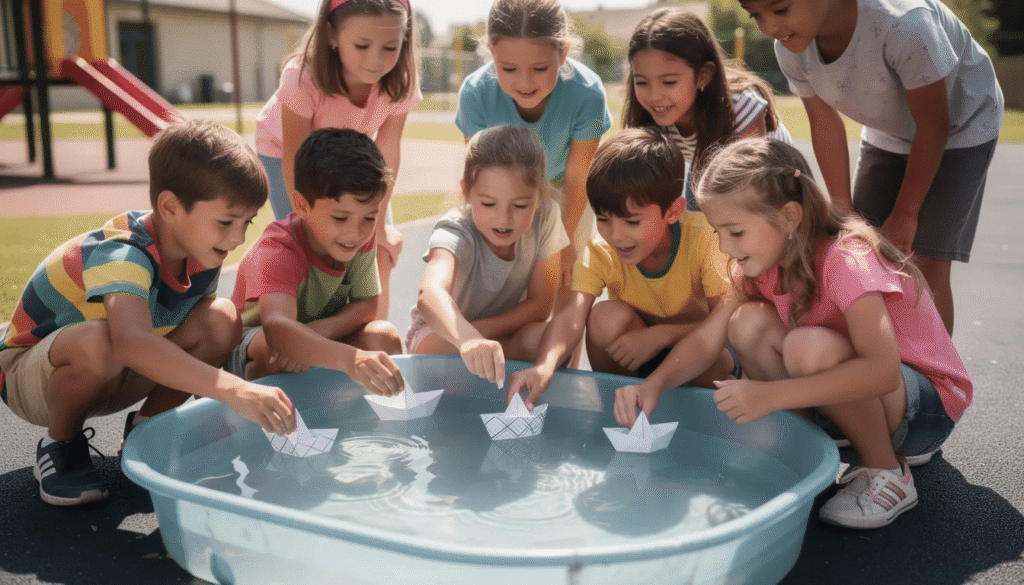
Turn paper boat building into a full STEM challenge for a classroom, scout group, or family activity. This works well for kids ages 6–12 with varying levels of adult help, and it teaches real engineering principles through hands-on problem solving.
Setting clear rules:
For fair competition, establish consistent parameters. Each team gets one sheet of paper per boat—no substitutions. In the first round, use no tape or glue to isolate the effect of folding technique. Everyone tests in the same size tub with room-temperature tap water. Use identical weights, such as US pennies dated 2000–2024 (all approximately 2.5 grams each).
Defining success criteria:
The boat must float in the middle of the tub without touching the sides. It must hold its cargo for at least 10 seconds without sinking or taking on significant water. Record the maximum number of coins held before failure.
Engineering Design Process for kids:
Walk participants through a simplified version of how real engineers work:
- Ask: How can we hold more pennies than anyone else?
- Plan: Sketch 2–3 design ideas on scrap paper. Choose one to build first.
- Build: Fold your boat carefully, pressing all creases firmly.
- Test: Float the boat and add coins one by one. Count and record.
- Improve: Analyze what failed first (sides, bottom, or tipping). Make one change and test again.
This cycle of iteration mirrors professional engineering. Students learn that the first prototype rarely performs best—improvement comes from testing and refinement, and they can later apply the same mindset to other fun paper activities and creative crafts..
Basic data collection:
Create a simple chart with columns for Team Name, Design Type (barge, classic, canoe, other materials), Paper Type, and Number of Pennies Held. This turns the activity into a real experiment with documentation.
Extensions for older kids:
Calculate total mass supported by multiplying coins by 2.5 grams. Plot results on a bar graph comparing different hull shapes. Discuss which designs performed best and why. This connects the activity to math and data analysis skills.
Boosting Capacity: Waterproofing and Reinforcement Tricks
Even small amounts of water soaking into paper reduce its strength and cause the hull to sag under load. This is why an unprotected boat’s capacity drops significantly after 2–3 minutes in the water. Waterproofing extends float time and increases how many coins you can add before failure.
Accessible waterproofing methods:
- Wax crayons: Color the outside hull heavily, especially the bottom and lower sides. The wax creates a water-repellent barrier. This is one of the safest methods for younger children.
- Candle wax: Rub a plain white candle across the exterior, then gently warm the surface with your hands to help the wax penetrate. This requires adult supervision if any melting is involved.
- Clear packing tape: Wrap the bottom of your boat in a single layer of clear tape before adding water. This seals potential leak points.
- Diluted white glue: Mix school glue with water (about 50/50) and brush a thin layer on the exterior. Let it dry completely overnight before testing.
Reinforcement techniques:
- Double-layer bottoms: Cut a smaller rectangle of paper and tape or glue it inside the hull floor. This spreads load across more material.
- Folded rims: Fold the top edges over twice to create thicker walls. This prevents the rim from buckling under weight.
- Paper ribs: Cut thin strips of scrap paper, fold them into small triangles or L-shapes, and glue them under the floor like supports.
Keep weight in check: Every bit of tape or glue adds weight to your boat, which reduces net capacity. Use reinforcement sparingly and test versions with and without to see if the trade-off is worthwhile.
Before/after experiment: Build two identical barge boats. Leave one plain. Coat the other thoroughly with wax crayon. Test both in the same tub under the same conditions. Record how many pennies each holds. Waterproofed versions often hold 50–100% more weight because the paper maintains its structural integrity longer.
Safety note: If you explore any wax melting techniques, adults should handle open flames or hot tools. Ensure good ventilation when using nail polish or strong adhesives.
Age-Appropriate Variations and Learning Goals
Different age groups can approach paper boat designs that hold weight at different complexity levels, all using the same basic materials. The key is matching the activity to developmental skills while maintaining the core concept of buoyancy and engineering.
Ages 4–6: Introduction through play
For younger kids, an adult can fold simple boats while children decorate with wax crayons—which also provides some waterproofing benefit. Instead of coins, use lighter objects like small plastic animals, bits of dry pasta, or foam shapes. Focus conversation on “heavy vs. light” and watch together as things float or sink. This builds early fine motor skills and vocabulary around buoyancy without requiring precise measurements.
Ages 7–9: Independent building with guided testing
Younger children in this range can fold their own simple barge or easy origami boats with minimal help. They can test with coins, keeping a simple tally of how many each boat holds. Encourage them to try one change per iteration—making sides taller, widening the base, or reinforcing one corner. Ask guiding questions: “What do you think will happen if we fold this edge again?” This age group benefits from concrete cause-and-effect experiments.
Ages 10–12+: Variables and data collection
Older kids can explore variables systematically. Introduce the idea of changing one thing at a time: paper type, hull shape, waterproofing method. Have them sketch designs before folding, write hypotheses (“I predict the wax-coated boat will hold more because…”), and create tables of results from multiple trials. They can calculate total mass supported and make simple bar graphs. This connects directly to scientific method concepts while still leaving room for playful projects like creative paper duck origami ideas..
Curriculum connections:
Educators can tie this activity to science standards covering forces and motion, properties of materials, and data collection. Math connections include measurement, multiplication (coins × weight), and graphing. The engineering design process itself aligns with NGSS standards for grades 3–7.
Testing, Troubleshooting, and Common Mistakes
Every sinking boat teaches you something. Rather than viewing failure as frustrating, treat each collapse as data that informs your next design. Here are the most common mistakes and how to fix them.
Common problems and solutions:
Problem | Likely Cause | Quick Fix |
|---|---|---|
Water leaks in immediately | Folds not fully flattened | Refold and press all creases with ruler edge |
Boat lists to one side | Asymmetrical sides or uneven folds | Trim uneven edges before folding; start with square paper |
Tips over with few coins | Weight placed near ends or edges | Always place cargo low and centered |
Sinks faster than expected | Paper already damp before folding | Use fresh, dry, unwrinkled paper |
Coins shift and cause tipping | Adding coins too quickly | Add one coin every 3–5 seconds; place gently |
Recommended testing protocol: | ||
Set your tub on a stable, level surface where it won’t be bumped. Fill with room-temperature tap water. Place your empty boat on the surface and let it sit for 30–60 seconds to check for slow leaks. If it stays dry, begin adding coins one at a time to the center of the hull. Wait at least 3 seconds between additions to let the boat stabilize. |
Reflection questions after each test:
Ask yourself or your students: What failed first—the sides, the bottom, or did it tip? Where did water enter? What one change should we test next? Document your answers. This creates a feedback loop that mimics professional engineering practice.
Imagine you’re designing a real cargo ship. You wouldn’t just build one version and hope it works. You’d test, analyze, and iterate. That’s exactly what this activity teaches—and it’s why STEM challenges using paper boats appear in classrooms worldwide.
Conclusion: Turning Simple Paper Boats into Real Mini-Engineering Labs
Summary:
The strongest paper boat designs for holding weight are wide, flat-bottomed, and shallow hulls (Fact: 1, 2, 3, 4). With proper design, paper boats can support significant weight, sometimes over 100 pennies, depending on their buoyancy and structural integrity (Fact: 5).
The best paper boat designs that hold weight are wide, flat-bottomed shapes with crisp folds, appropriate paper selection, and thoughtful weight placement. You don’t need fancy other materials or complex techniques—just careful folding and an understanding of why some boats float better than others.
Classic origami boats can be upgraded to carry more cargo by reinforcing rims and bottoms and applying simple waterproofing where appropriate. A modified classic boat won’t match a barge for raw capacity, but it demonstrates how small changes create measurable improvements.
Every sinking boat provides data, not failure. Each test reveals something about form, materials, or technique that you can apply to the next iteration. This is exactly how real engineers approach problems—and it’s a skill that transfers far beyond paper crafts.
Your challenge: Host your own paper boat weight challenge this weekend or in your classroom this month. Set up a tub, gather some pennies, and see which design in your group can pass 40 pennies. Watch videos of other people’s attempts on YouTube for inspiration, then create something better. Record your results, share what you learn, and explore what happens when you push the limits of simple materials.
The history of ships and naval architecture started with questions just like this one: How do we make things float while carrying more cargo? Now you have the tools to experiment and find your own answers.