

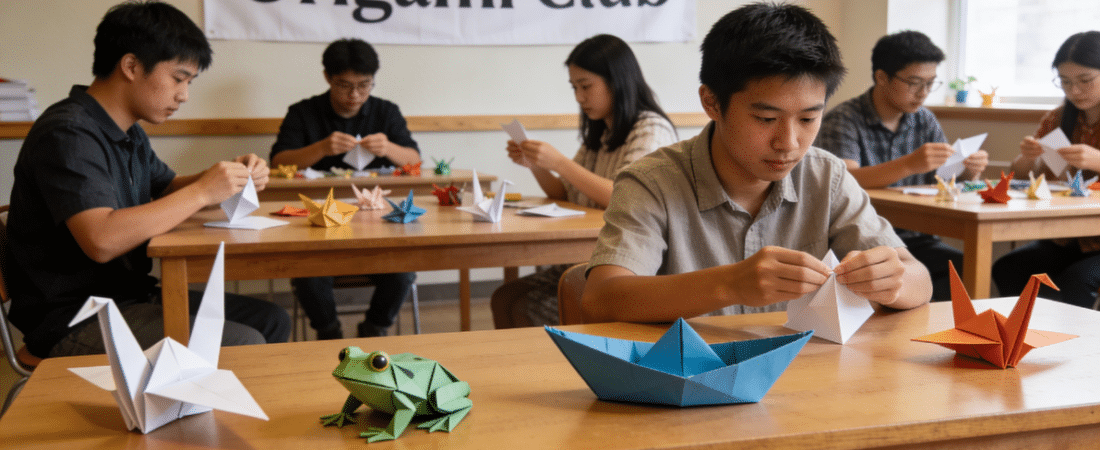
Starting or joining an origami club is one of the simplest ways to build community around a creative, hands-on practice. Whether you want to fold paper cranes during lunch breaks or organize monthly sessions at your local library, an origami club offers structure, social connection, and a surprisingly effective way to unwind.
Origami clubs are accessible to everyone—no prior experience is required, and simple printer paper is enough to start. You don’t need expensive materials or specialist equipment to participate or set up a club. For those interested in starting or joining a group, resources like the OrigamiUSA Local-area Group Handbook provide guidance on forming and maintaining a community, and the Community Origami Groups directory on the OrigamiUSA website helps you find local chapters in the United States and internationally.
This guide walks you through everything you need to know—from gathering basic materials to leading your first session.
What Is an Origami Club?
An origami club is a group dedicated to the Japanese art of paper folding, where members create 3D sculptures from paper without using scissors or glue. These clubs are regular gatherings where people meet to fold paper models together, improve their skills, and relax. Clubs can be based in schools, libraries, universities, community centers, or run informally in homes. The format is flexible: some groups meet weekly for 45 minutes, while others hold monthly two-hour sessions.
Origami clubs are open to all and require no prior experience. Simple printer paper is enough to get started, and you don’t need expensive supplies or years of practice to participate. For those looking to start or join a club, the OrigamiUSA Local-area Group Handbook offers step-by-step guidance, and the Community Origami Groups directory on the OrigamiUSA website lists local and international chapters.
Key benefits of joining an origami club:
- Better hand-eye coordination and fine motor skills
- Improved sequencing skills and spatial awareness
- Practice with patience and focused attention
- Stress relief and screen-free relaxation
- Social connection with others who share your interest

Why Start or Join an Origami Club?
Interest in origami clubs has grown steadily since around 2010, especially in schools and libraries looking for low-cost, high-engagement activities. The appeal makes sense—origami requires minimal materials but delivers substantial benefits across social, educational, and mental health dimensions.
Social benefits are often the primary draw. Clubs create opportunities to make friends with similar interests, work together on modular projects that require multiple folders, and establish mentoring relationships between experienced and new members. As Zachary Sakti, founder of an origami club at his school, explained: “We wanted to make a club that was fun, creative, stress free and didn’t require any outside knowledge to participate in.”
Educational benefits are equally concrete. Participants practice fractions and symmetry while working with paper squares. They learn geometric vocabulary—valley fold, mountain fold, crease pattern—and improve concentration during 30-60 minute sessions. Teachers have noted that origami helps students visualize mathematical concepts they struggle to grasp abstractly.
Mental health and mindfulness represent another significant motivation. Quiet, focused folding can help reduce anxiety and provide a screen-free break after lessons or work. Research cited by university origami organizations indicates that origami has been proven to improve mindfulness, mood, and productivity.
Finally, clubs serve as creative outlets that can culminate in displays during events like school art weeks or local festivals, or expand into other fun paper activities for all ages that members can share with friends and family.
Main motivations to join:
- Build friendships around a shared creative interest
- Develop mathematical and spatial reasoning skills
- Find a calming, meditative activity
- Create tangible work for exhibitions and gifts
Basic Equipment and Materials
Very little specialized equipment is needed to run an origami club, but choosing the right craft paper supplies for creative projects will make sessions smoother and more enjoyable. Most items are inexpensive or already available in classrooms and homes.
Beyond origami, many members also enjoy exploring broader paper crafting inspiration and projects between meetings.
Paper Types
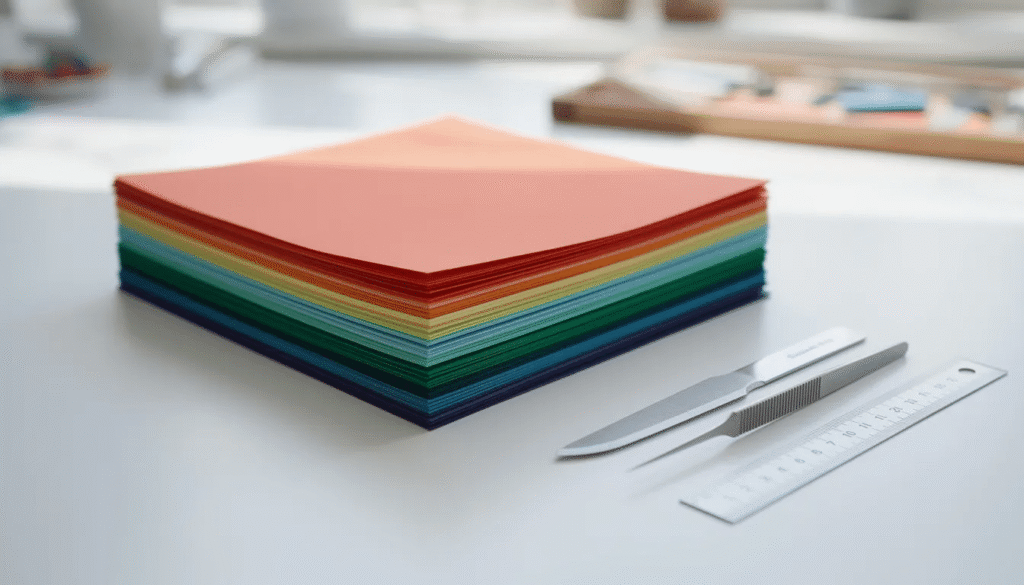
- Cut squares from A4 or US Letter printer paper (15 cm × 15 cm for standard models, 7.5 cm × 7.5 cm for smaller designs)
- Commercial kami (standard origami paper) for color variety—a pack of 200 sheets costs a few dollars
- Washi or patterned paper for special projects and displays
Simple Tools
- Small rulers or plastic set squares to use as makeshift bone folders for crisp creases
- Clipboards or trays to keep paper from sliding during folding
- Small envelopes or zip bags to store partly finished modular units between sessions
Reference Materials
- Keep 3-5 origami books suitable for mixed ages: one beginner book with simple animals, one book of modular stars and cubes, and one focused on holiday decorations
- Laminated instruction sheets for frequently requested models
Optional Extras
- Glue sticks for assembling tessellations into posters
- Washi tape for mounting models on card stock
- A display board or shadow box for finished work
- Colored card stock for backing mounted pieces
Digital and Web Resources
Online resources can supplement printed origami books and help members who prefer animated instructions. Many folders find it easier to follow along with video demonstrations than static diagrams, especially for complex folds, and curated lists of top origami designs for every skill level can give your club ready-made project ideas.
Types of Useful Sites
- Step-by-step photo tutorials with printable PDFs
- Animated folding sequences that show exactly how paper moves
- Video platforms with playlists organized by difficulty level
Building a Digital Library
To build a small “digital library,” bookmark 5-10 beginner models (crane, jumping frog, traditional box, waterbomb) and 5+ intermediate models (modular sonobe cube, flapping bird, lily). Include a few themed tutorials such as creative paper duck folding ideas to add variety and seasonal charm. Organize these by category so you can find the right instructions quickly during a session.
For clubs with access to devices, mobile apps and tablet-friendly content work well. Use classroom projectors so everyone can see the folds simultaneously—this eliminates the need for members to crowd around a single screen.
Categories to include in your digital library:
- Beginner animals (crane, frog, dog face)
- Seasonal decorations (snowflakes, hearts, pumpkins)
- Mathematical models (waterbomb, stellated octahedron)
- Modular designs (sonobe cube, kusudama ball)
How to Choose and Organize Web Resources
- Test each tutorial yourself before presenting it to the group
- Save page links in a shared document or bookmark folder
- Note the estimated difficulty and time required for each model
- Create a simple order from easiest to most challenging
Planning and Leading Origami Sessions
A typical 60-120 minute club meeting works best when broken into phases: warm-up folds, main project, and sharing or display time. This structure keeps energy levels appropriate and gives everyone a sense of accomplishment.
Session Structure
Break meetings into clear phases: start with warm-up folds, move to the main project, and finish with sharing or display time.
Teaching Foundational Skills
Start the year with foundational skills. Teach the difference between valley and mountain folds, demonstrate reference folds (halving, thirds), and introduce classic bases. The waterbomb base, bird base, and frog base appear in countless models, so mastering them early pays dividends later.
Leading Step-by-Step Folding
Leading step-by-step folding requires patience and good sightlines. The leader folds under a document camera or at the front table, pausing after each step so everyone can match their model. Experienced members should circulate to help beginners catch up—nobody should feel left behind.
Themed Sessions
Themed sessions create anticipation and structure your planning throughout the year:
- January: Snowflakes and stars
- February: Hearts and envelopes
- April: Flowers and butterflies
- October: Bats and pumpkins
- December: Gift boxes and ornaments
Use “skill ladders” to track progression over a term. Start with simple one-piece models, move to easy modular designs by mid-term, and finish with more complex animals or tessellations. Remember that the goal is gradual improvement, not perfection.

Types of Origami Clubs and Communities
Origami clubs take different forms depending on age group, venue, and goals. Understanding these variations helps you find or create the right fit.
School-based clubs typically hold weekly 45-60 minute meetings after classes for students aged 8-14. A teacher or volunteer runs the sessions, and the group often culminates in a corridor display at the end of term. As one faculty advisor noted, the appeal is that “it’s not academic and people can come in and just do arts and crafts kind of things.”
Library or community-center clubs usually meet monthly for about 2 hours. These sessions are open to adults and children, with an expectation that children under 12-13 attend with a parent or guardian. The longer format allows for more ambitious projects.
University clubs are typically student-run societies with weekly practice sessions, occasional guest folders, and outreach visits to local schools or hospitals. Bella Wapi founded the origami club at the University of Montana during her freshman year because “she was excited to find other people who shared her interest in origami, and no class or club existed.”
Informal neighborhood or family groups meet at someone’s home a few times a year for seasonal projects like New Year cranes or summer flowers. These gatherings require minimal organization but still provide meaningful connection.
Club Type | Frequency | Duration | Typical Audience |
|---|---|---|---|
School-based | Weekly | 45-60 min | Students 8-14 |
Library/Community | Monthly | 2 hours | All ages |
University | Weekly | 1-2 hours | College students |
Informal/Home | Seasonal | Varies | Family/neighbors |
Community Projects, Displays, and Outreach
Origami clubs often move beyond simple practice to collaborative projects and local service. These activities build purpose and give members something larger to work toward.
Concrete project ideas:
- 1,000-paper-crane installations for school halls or memorial events
- Modular star garlands for cultural festivals or holiday celebrations
- Folded bookmarks donated to local libraries
- Simple models given to hospital pediatric wards—Dartmouth’s origami club explicitly plans to donate creations to hospitals and youth mentoring programs
To organize a themed exhibition, choose 8-10 model types and have members fold multiple copies over several meetings. Mount finished pieces on colored boards and label them with the folder’s name and model title. This creates a professional-looking display that celebrates everyone’s work.
Consider hosting an “origami open day” once or twice a year where club members demonstrate easy models to visitors. Inviting families and community members builds awareness and often brings in new participants.

Getting Started: Practical Steps
Set a first meeting date rather than waiting for everything to be perfect. You can refine your approach as you go, but nothing happens until you actually meet.
Step-by-Step Checklist
- Choose a venue and time (e.g., first Tuesday of each month, 4:00-5:30 pm in the Salem community center or school library)
- Gather basic supplies: paper squares, rulers, and 2-3 beginner model instructions
- Select 2-3 beginner models to teach at the first session (traditional crane, simple box, jumping frog)
- Prepare simple instruction sheets or bookmark video tutorials
- Advertise through school newsletters, community boards, or university mailing lists—specify that beginners are welcome and materials will be provided
- Create a simple sign-in sheet at the first meeting to collect names and email addresses for future announcements
- End the first session by asking members which theme and models they want to explore next
- Use those suggestions to plan the next 3-4 meetings
The most important step is the first one: pick a date within the next month and commit to it. You don’t need perfect planning or professional-grade supplies. A stack of printer paper, a few sets of instructions, and genuine enthusiasm are enough to get started.
Every origami master began with a single fold. Your club can start the same way.